OLDER BULLETIN POSTINGS THAT
REMAIN TIMELY CONTINIUE BELOW:
“You have seen hell where the souls of poor sinners
go. To save them, God wishes to establish devotion to My Immaculate Heart. If
what I say to you is done, many souls will be saved and there will be peace …”
“To
prevent [specified chastisements], I shall come to ask for the Consecration of
Russia to My Immaculate Heart, and the Communion of Reparation on the First
Saturdays. If My requests are heeded, Russia will be converted, and there
will be peace; if not, she will spread her errors throughout the world, causing
wars and persecutions of the Church. The good will be martyred, the Holy Father
will have much to suffer, various nations will be annihilated.”
“In
the end, My Immaculate Heart will triumph. The Holy Father will consecrate
Russia to Me, and she will be converted, and a period of peace will be granted
to the world.”
Blessed
Virgin Mary at Fatima, July 13, 1917
"In the
end.... (Russia) will be converted and a period of peace will be granted to the
world."
On the
Orthodox Church in Ukraine and Russia, state operated religious institutions.
For
example, we’re talking about specifically the Orthodox Church. Back in 1948,
there was essentially a coup in Constantinople (Istanbul) that removed the
patriarch then, Maximos, who was considered to be too
friendly toward the Russian Church—which, let’s be honest, at the time was
under the control of the Soviet authorities—and replaced him with the
archbishop here in America, Athenagoras, who was
actually flown over there on Truman’s plane and installed by the U.S.
government, the Greek government and the Turkish government acting in concert,
and [the Ecumenical Patriarchate] has been an asset of the United States, the
State Department and the CIA, ever since 1948. Of course, this is also
consistent with Constantinople’s kind of “neo-papal” aspirations within the
Orthodox Church, which is itself a-historical.
At
the same time, you’ve got Russia, which—again in a very peculiar structure
among the local Orthodox churches—is itself a majority of the entire Orthodox
Church, a good chunk of that being in Ukraine.
Now
in Ukraine, the Orthodox Church is called the Ukrainian Orthodox Church. It is
an autonomous part of the Russian Orthodox Church; it is self-ruling in
virtually all aspects. That church is the canonical Church in Ukraine. Its
status has not changed.
What
has happened is, with U.S. support, Constantinople has tried to create a rival
Orthodox church in Ukraine from a group of—actually several groups of—schismatics that they tried to cobble together into a new
church. That’s where we stand right now. We have two competing Orthodox
churches in Ukraine. The canonical one aligned with Moscow, which is very much
the majority, and a much smaller one supported by the United States and
Constantinople, which is not acceptable to most of the rest of the world—in
Romania and Jerusalem and Serbia and Bulgaria and the other places of the
Orthodox Church.
Again,
I know this is very complex “inside baseball,” but what it shows is frankly a
degree of sophistication, and again, cynicism of the Western powers that they’re
willing to manipulate this in order to make some kind of a political game.
Because I think the way they see it is, just as the Maidan
in 2014 was a political coup to try to separate Russia from Ukraine, this is,
if you will, a spiritual coup to try to accomplish the same thing: to take two
very closely kindred people in language, culture and especially religion, and
set them at odds against each other. It’s not working, it’s not successful, but
it is creating a lot of discord, a lot of unhappiness and hurt, and even to
some extent, violence.
James George Jatras,
JD, interview, January 28, 2022. Mr. Jatras is
member of the Greek Orthodox Church who
is a Washington, DC-based attorney, political analyst, and media &
government affairs specialist. He formerly served as a senior foreign policy
adviser to the US Senate Republican leadership, and before that served as a
diplomat in Mexico, the Office of Soviet Union affairs, and the Office of the
Under Secretary for Political Affairs.
COMMENTARY:
"Errors
of Russia" spoken by the Blessed Virgin at Fatima does not refer primarily
to atheistic communism as presupposed by so many Catholics during the 20th
century. It may not refer to it at all. Atheistic communism was not so much an
"error of Russia" as a punishment permitted by God against the
Russian people for the errors of the Orthodox schism and heresy which, since
the fall of Constantinople, the Russians became the primary defenders and
propagators. Orthodoxy began in schism and has ended in extensive heretical
opinions. Importantly, the Orthodox deny the primacy of jurisdiction of the
Pope in Rome and they deny the dogma of the Immaculate Conception of the
blessed Virgin Mary without which devotion to the Immaculate Heart of Mary
becomes absurd. And, like all heretical sects, deny the in dissolvability of
Marriage permitting two divorces and three marriages. Marriage is the metaphor
used by God to describe His relationship to His Church and to each of the
faithful individually. The
consecration of Russia to the Immaculate Heart of Mary by the Pope in union
with the bishops of the world as requested by the Blessed Virgin Mary directly
opposes an act of unity with the pope of Rome against those who deny the
necessity of this unity as being of divine origin and necessary for salvation.
It further affirms the dogma of the Immaculate Conception denied by the
Orthodox and consequently, the devotion to the Immaculate Heart. The
irony of Vatican II is that John XXIII assuming that the "errors of
Russia" referred to atheistic communism refused to criticize this error in
return for permitting the Orthodox heretics to attend his Council. The Vatican
thereby publically accepted the "errors of Russian" and hold that
these errors do not prejudice salvation for the Orthodox. No one benefitted
from this stupidity which began be denying the dogma that there is no salvation
outside the Catholic Church.
“Neither Jewish ethics
nor Jewish tradition can disqualify terrorism as a means of combat. We are very
far from having any moral qualms as far as our national war goes. We have
before us the command of the Torah, whose morality surpasses that of any other
body of laws in the world: ‘Ye shall blot them out to the last man.’”
Yitzhak Shamir,
Israeli Prime Minister 1986-1992, 1943 Quote
taken from “Document: Shamir on Terrorism
(1943)” Middle East Report 152
“With them
that hated peace I was peaceable: when I spake unto
them, they fought against me without cause.” (Ps. cxix)
“Forty years long was I nigh unto that generation, and said: They do always err
in their heart; and they have not known My ways to whom I swore in My wrath
that they should not enter into My rest.” (Ps. xciv)
 “In the later editions of the Talmud the
allusions to Christianity are few and cautious compared with the earlier or
unexpurgated copies. The last of these was published at Amsterdam in 1645. In
them our Lord and Saviour is ‘that One,’ ‘such a
One,’ ‘a fool,’ ‘the leper,’ ‘the deceiver or Israel,’ &c.; efforts are
made to prove that He is the son of Joseph Pandira
before his marriage with Mary. His miracles are attributed to sorcery, the
secret of which He brought in a slit in his flesh out of Egypt. His teacher is
said to have been Joshua, the son of Perachlah. This
Joshua is said to have afterwards excommunicated Him to the sound of 800 rams’
horns, although he must have lived seventy years before His time. Forty days
before the death of Jesus a witness was summoned by public proclamation to
attest his innocence, but none appeared. He is said to have been first stoned
and then hanged on the eve of the Passover. His disciples are called heretics,
and opprobrious names. They are accused of immoral practices; and the New
Testament is called a sinful book. The references to these subjects manifest the most bitter aversion and
hate.”
“In the later editions of the Talmud the
allusions to Christianity are few and cautious compared with the earlier or
unexpurgated copies. The last of these was published at Amsterdam in 1645. In
them our Lord and Saviour is ‘that One,’ ‘such a
One,’ ‘a fool,’ ‘the leper,’ ‘the deceiver or Israel,’ &c.; efforts are
made to prove that He is the son of Joseph Pandira
before his marriage with Mary. His miracles are attributed to sorcery, the
secret of which He brought in a slit in his flesh out of Egypt. His teacher is
said to have been Joshua, the son of Perachlah. This
Joshua is said to have afterwards excommunicated Him to the sound of 800 rams’
horns, although he must have lived seventy years before His time. Forty days
before the death of Jesus a witness was summoned by public proclamation to
attest his innocence, but none appeared. He is said to have been first stoned
and then hanged on the eve of the Passover. His disciples are called heretics,
and opprobrious names. They are accused of immoral practices; and the New
Testament is called a sinful book. The references to these subjects manifest the most bitter aversion and
hate.”
Dr.
Joseph Barclay, LL.D, Rector of Stapleford, Hertfordshire, London, The Talmud, 1878, from Introduction, p.
30
Archdiocese of Baltimore files new
proposed plan for Chapter 11 reorganization
NCR | Baltimore | May 19, 2026
 The Archdiocese of Baltimore submitted
a proposed plan for reorganization May 15 in an effort to complete
its Chapter 11 bankruptcy reorganization, with the goal of equitably
compensating victims of child sexual abuse by clergy and others affiliated with
the Catholic Church in Maryland.
The Archdiocese of Baltimore submitted
a proposed plan for reorganization May 15 in an effort to complete
its Chapter 11 bankruptcy reorganization, with the goal of equitably
compensating victims of child sexual abuse by clergy and others affiliated with
the Catholic Church in Maryland.
The
proposal includes establishing a survivor compensation trust totaling at least
$168.9 million to evaluate and resolve claims. That amount would be funded by
contributions from the archdiocese and its insurers.
Additional
funds will be contributed by participating parishes, schools and
related Catholic entities. That amount is still to be calculated.
A statement from the archdiocese
at the time the plan was filed said, "At its core,
the proposed plan seeks to provide equitable compensation to
survivors while sustaining the Church's mission and ministries. It reflects a
commitment to transparency and a realistic assessment of available
resources."
It
continued: "While the
archdiocese remains firmly committed to reaching an agreed-upon resolution
through mediation, no final agreement has yet been achieved.
The proposed plan is intended to advance discussions, provide a
framework for resolution and support continued dialogue among all
parties."
The plan
includes $43.9 million from the archdiocese and at least $125 million combined
from two insurance companies that covered parishes, schools and the archdiocese
during the times covered by some of the claims.
Funds to the trust from the
archdiocese would come from unrestricted assets. The plan does not
anticipate the Baltimore Archdiocese selling any real estate, according to
Christian Kendzierski, archdiocesan executive
director of communications.
The parishes or other entities would
also contribute from unrestricted assets.
Other
insurance carriers are expected to contribute to the trust as well, he said,
although the specifics cannot be revealed now because the conversations are
part of the mediation process, which is confidential.
The
archdiocese's proposed plan also includes "non-monetary
obligations to further enhance the existing child safety and protection
policies and procedures within the archdiocese," which is something the
survivors' committee, known as the Unsecured Creditors Committee, has
requested.
Baltimore
Auxiliary Bishop Adam Parker, who has testified in the court process and has
been present for many hearings, said the archdiocese discussed with the
Creditors Committee the
possibility of retaining an independent, third-party consultant who is an
expert on the subject matter to review archdiocesan policies and procedures for
screening and training.
The
court approved in February a joint motion by the archdiocese and the committee
to designate Guidepost Solutions as that agency.
"We
welcome the opportunity to review our zero-tolerance policies. Our goal is to
have the safest possible environment for our young people, and to ensure that
what happened in the past would never be repeated," he told
the Catholic Review, media outlet of the Archdiocese of Baltimore.
[.....]
COMMENT: Nowhere in the article is the word
"homosexual" found. There is now a discussion of the "possibility of retaining
an independent, third-party consultant who is an expert on the subject matter
to review archdiocesan policies and procedures for screening and
training." The very nature of bankruptcy proceedings is to have
outside experts to review the cause and the proposed correct of the financial
collapse. Since 90% of the sexual abuse cases are homosexual clerics committing
the crime of pederasty let me suggest an "expert" opinion of the
solution: remove all homosexuals from the clerical state and institute
screening methods to exclude all homosexuals from seminary training. Do not hold
your breath waiting for this to happen. The clerics who have committed these
crimes and those who have contributed to them by COUNSEL, COMMAND, CONSENT,
PROVOCATION, PRAISE OR FALTTERY, CONSCEALMENT, PARTAKING, SILENCE, and DEFENSE
OF THE ILL DONE share in the guilt and must be punished. But they are not nor
will they ever be as long as there is money to be had. If the goods of the
Church were held by the individual parishes and these parishes were responsible
for rectitude of its clerics and staff then none of this would ever happen. It
began by bishops steeling the wealth of the Church for their own personal use
and this was accomplished in Maryland by the bishops replacing permanent
priests who were pastors with temporary clerics thinking about their next
assignment. The primary loyalty of the priest was transferred from his
parishioners to the his local ordinary. When the wealth is gone, the
homosexuals will look for another sinecure.
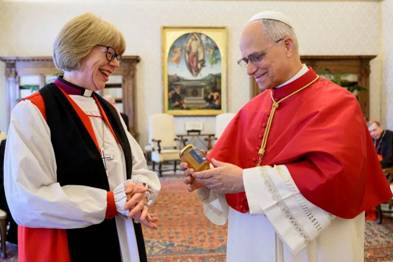
MESSAGE OF POPE LEO XIV
ON THE OCCASION OF THE INSTALLATION OF THE ARCHBISHOP OF
CANTERBURY
_________________
To The Most Reverend and Right Honourable
Dame Sarah Mullally
Archbishop of Canterbury
 “Grace, mercy, and peace will be with us,
from God the Father and from
“Grace, mercy, and peace will be with us,
from God the Father and from
Jesus Christ, the Father’s Son, in truth and love.” (2 Jn
1:3)
With this assurance of God’s abiding presence, I send prayerful
greetings to Your Grace on the occasion of your Installation as Archbishop of
Canterbury.
I know that the office for which you have been chosen is a weighty one,
with responsibilities not only in the Diocese of Canterbury, but throughout the
Church of England as well as the Anglican Communion as a whole. Moreover, you
are commencing these duties at a challenging moment in the history of the
Anglican family. In asking the Lord to strengthen you with the gift of wisdom,
I pray that you may be guided by the Holy Spirit in serving your communities,
and draw inspiration from the example of Mary, the Mother of God.
Sixty years ago, during their historic encounter in Rome, our
predecessors of happy memory, Saint Paul VI (sic) and Archbishop Michael
Ramsey, committed Catholics and Anglicans to “a new stage in the development of
fraternal relations, based upon Christian charity” (Joint Declaration, 24 March
1966). That fresh chapter of respectful openness has borne much fruit over the
past six decades and continues to this day.
On that same occasion, Pope Paul and Archbishop Ramsey also agreed
to initiate a theological dialogue. Indeed, the Anglican-Roman Catholic
International Commission (ARCIC) has contributed enormously to a growth in
mutual understanding since its creation. The rewards of this valuable work have
set us free to witness together more effectively (cf. International
Anglican-Roman Catholic Commission for Unity and Mission, Growing Together in
Unity and Mission, 93). This is especially vital given the manifold challenges
facing our human family today. I am grateful, therefore, that this important
dialogue continues.
At the same time, we also know that the ecumenical journey has not
always been smooth. Despite much progress, our immediate predecessors, Pope
Francis and Archbishop Justin Welby,
acknowledged frankly that “new circumstances have presented new disagreements
among us.” Nevertheless, we have continued to walk together, because differences
“cannot prevent us from recognizing one another as brothers and sisters in
Christ by reason of our common baptism” (Joint Declaration, 5 October 2016).
For my part, I firmly believe that we need to continue to dialogue in truth and
love, for it is only in truth and love that we come to know together the grace,
mercy and peace of God (cf. 2 Jn 1:3), and
thus can offer these precious gifts to the world.
What is more, the unity which Christians seek is never an end in
itself, but is directed towards the proclamation of Christ, in order that, as
the Lord Jesus himself prayed, “the world may believe” (Jn 17:21).
In addressing the Primates of the Anglican Communion in 2024, Pope Francis
declared that “it would be a scandal if, due to our divisions, we did not fulfil our common vocation to make Christ known” (Address
to Primates of the Anglican Communion, 2 May 2024). Dear sister, I
willingly make these words my own, for it is through the witness of a
reconciled, fraternal and united Christian community that the proclamation of
the Gospel will resound most clearly (cf. Message for the 2026 World Mission
Day, 2).
With these fraternal sentiments, I invoke upon you the blessings of
Almighty God as you take up your high responsibilities. May the Holy Spirit
come down upon you and make you fruitful in the Lord’s service.
From the Vatican, 20 March 2026
Memorial of Saint Cuthbert, Bishop
LEO PP. XIV
COMMENT: Pope Leo/Prevost is cut from the same dishrag as his
predecessor Francis/Bergoglio. When Leo says, "That fresh chapter of respectful openness has
borne much fruit over the past six decades and continues to this day," the
"fruit" he is talking about is the destruction of the Catholic
Church. Leo says "we need to continue to dialogue in truth and
love," while he is a bald liar and the love of God cannot abide in him.
The Anglican Church was founded by a serial wife killer, murderer, adulterer,
thief, and tyrant who made himself the head of the Church. To this day the king
of England is the head of this Church that continues in the spirit of its
founder. Anglicans cut off from God's grace sink daily in the same moral
depravity.
St. Cuthbert was not an Anglican. He was a Catholic saint and is the
Catholic patron saint of Northumbria in England where
he was a monk and later the abbot of the Abby of Lindisfarne
from 648 until his death in 686. He is possibly the most venerated saint in
England. The "Life of Cuthbert," written at Lindisfarne
by an unknown author, is the oldest extant piece of English historical writing.
There is also a historical record of his life and miracles by St. Bede. When
St. Cuthbert died in 687, he was initially buried at the Abby of Lindisfarne. There were many documented miracles at his
tomb and his body later found to be incorrupt resulted in the island of Lindisfarne becoming a major destination for pilgrimages
for hundreds of years. Lindisfarne was abandoned and
St. Cuthbert's body transferred in 793 to Benedictine Durham Priory to avoid
desecration from Viking raids. Durham Priory re-established the monastery at Lindisfarne as a priory in 1093. With the dissolution of
the monasteries in 1563, Lindisfarne Priory was
closed and used as a naval storehouse. Durham Priory, attached to Durham
Cathedral, was destroyed and the Cathedral was given to the Anglicans. The
Anglicans have no claim on St. Cuthbert and despise everything in his life.
Leo/Provost by publically recognizing the legitimacy of this absurd posturing
of a laywoman as a bishop exercising jurisdiction given by a perverted king is
a continuation of the destruction established by Henry VIII. Leo/Provost is an
enemy of the Catholic faith. Pray God to convert him and, if he wont be converted, send him to his appointed place.
Prophecy
and our times!
An unhappy time is coming of revolt and dissension in the Church.
Oh my children, do not let yourselves be led astray by innovations. Rally
and hold fast. Stay on the same road, the same footpaths as your pious
fathers trod. Preserve and maintain what they have taught you. It
will be enough if you resist the attacks, the tempests, the hurricanes that
will arise with such violence.
The Church will be punished because the majority of her members, high
and low, will become so perverted. The Church will sink deeper and deeper
until she will at last seem to be extinguished, and the succession of Peter and
the Apostles to have expired. But, after this, she will be victoriously
exalted in the sight of all doubters.
St. Nicholas of Flu, 15th Century
During the fifth period, we saw only calamities and devastation;
oppression of Catholics by tyrants and heretics; execution of Kings, and
conspiracies to set up republics . . . Are we not to fear, during this period,
that the Mohammedans will come again, working out their sinister schemes
against the Latin Church? . . . During this period men will abuse the freedom
of conscience conceded to them . . . there will be laxity in divine and human
precepts. Discipline will suffer. The holy canons will be completely
disregarded, and the clergy will not respect the laws of the Church.
Everyone will be carried away and led to believe and to do what he fancies,
according to the manner of the flesh. . . But, by the hand of God Almighty,
there occurs so wondrous a change during the sixth period that no one can
humanly visualize it.
The sixth period of the Church will begin with the powerful Monarch and
the holy Pontiff . . . and it will last until the revelation of
Antichrist. In this period, God will console His Holy Church for the
affliction and great tribulation she has endured during the fifth period.
All nations will become Catholic. Vocations will be abundant as never
before, and all men will seek only the Kingdom of God and His justice.
Men will live in peace, and this will be granted because people will make their
peace with God. They will live under the protection of the Great Monarch
and his successors.
All nations will come to worship God in the true Catholic and Roman
faith. There will be many Saints and Doctors on earth. Peace will
reign over the whole earth because God will bind Satan for a number of years
until the days of the Son of Perdition. No one will be able to
pervert the Word of God since, during the sixth period, there will be an
Ecumenical Council which will be the greatest of all councils. By the
grace of God, by the power of the Great Monarch, by the authority of the Holy
Pontiff, and by the union of all the most devout princes, atheism and every
heresy will be banished from the earth. The Council will define the true
sense of Holy Scripture, and this will be believed and accepted by everyone.
Venerable Bartholomew Holzhauser, holy priest
of the seventeenth century
In the twentieth century there will be a time of great corruption of
customs, and this devotion will be the safeguard of this land during the times
to come when it will no longer be a colony, but a free and libertine
republic. Let us weep, pray, and do penance so that this time will not be
of long duration.
The secular clergy will leave much to be desired because priests will
become careless in their sacred duties. Lacking the divine compass, they
will stray from the road traced by God for the priestly ministry, and they will
become attached to wealth and riches, which they will unduly strive to
obtain. How the Church will suffer during this dark night! Lacking
a Prelate and Father to guide them with paternal love, gentleness, strength,
wisdom and prudence, many priests will lose their spirit, placing their souls in
great danger. This will mark the arrival of My hour.
Therefore, clamor insistently without tiring and weep with bitter tears
in the privacy of your heart, imploring the Celestial Father that, for love of
the Eucharistic Heart of my Most Holy Son and His Precious Blood shed with such
generosity and the profound bitterness and sufferings of His cruel Passion and
Death, He might take pity on His ministers and bring to an end those Ominous
times, sending to this Church the Prelate who will restore the spirit of its priests.
. . [When all seems lost, it will be] the happy beginning of the complete
restoration. This will mark the arrival of my hour, when I, in a
marvelous way, will dethrone the proud and cursed Satan, trampling him under my
feet and fettering him in the infernal abyss.
Blessed Virgin Mary, Our Lady of Good Success, to Venerable Marianne de
Jesus Torres (1563-1635)
It was revealed to me that through the intercession of the Mother of
God all heresies will disappear. The victory over heresies has been reserved by
Christ for his Blessed Mother… The power of Mary in the latter days will be
very conspicuous. Mary will extend the reign of Christ over the heathens and
the Mohammedans, and it will be a time of great joy when Mary is enthroned as
Mistress and Queen of hearts. Venerable
Maria of Agreda, seventeenth century
When arguing
with a Neo-Modernist Novus Ordite Remember -
Modern Mind,
Modern Thought: Don't be surprised when you at last discover that the Modern Mind
is Mindless and Modern Thought is Thoughtless!
Modem Thought shirks definition. In all truth it is a giant’s task to
extract a clear-cut and intelligible statement of what it exactly means by the
terms it uses. For a definition requires thought; it requires a close
examination and analysis of the nature of the thing to be defined, an accurate
discrimination between its essentials and accidentals, and a painstaking
comparison of that thing with similar things in order to discern what it has in
common with them, and then to pick out just that specific note which makes it
the thing that it is and different from everything else. All that, I say, calls
for accurate and connected reasoning, and Modern Thought is quite unequal to
the task. For it moves in a twilight of half-intelligence where it sees vague
shapes and transforms them into monsters. Make the experiment of this for
yourselves; if you will, take up the print of Modern Thought, some of which I
shall presently indicate, and see what travesties it can make of the ideas of
“dogma,”“faith,”“theology,”“metaphysics,”“God,”“morality,” etc., as well as of
“civilization,”“culture,”“science” and “progress.” To whatever other tortures
it may subject these words, or with whatever welter of brilliant sentences it
may mix them—define them it does not.
All this is the same as saying that Modern Thought is flippant,
cynical, skeptical, irrational and thoughtless—no one of which is the mark of
thought truly so-called. In the face of searching questions, Modern Thought is
as irresponsible as Boccacio’s “Cymon,”
who:
Shunned the Church and used not much to
pray,
He trudged along, unknowing what he
sought,
And whistled as he went for want of
thought.
It is difficult to speak of a flippant thing without oneself seeming to
indulge in flippancy. Yet, were I to take Modern Thought very seriously and to
define its most serious aspect, I could do no more than say that it is an
attitude of mind which prefers to interpret life and judge the world not in the
light of principles, tradition and authority, but according to a mood prompted
by the moment and by the expediency of immediate environment—or the gravitation
of man’s lower nature.
In justice to Modern Thought let it be said that at is not consistent
with itself, for, while it spurns authority, it will nevertheless place the
blindest reliance on any “authority” that serves its mood and temper, and this
mood can, with the greatest ease, swing from the namby-pambiest
optimism to the murkiest pessimism. And, if besides being observant persons you
are moderately well read in history, it will soon break upon your realization
that, after all, there is nothing modern about this mental affliction. It is as
ancient as the day when Adam and Eve maimed their souls and bodies in Paradise
in a fit of independence; it is as ancient as Heracitus,
Epicurus, and the classic pagans. Its mood and their mood are essentially the
same, the setting alone is different, the chief difference being that to-day
the printing-press, the cinema and the radio (the T.V. and the Internet) offer the neo-paganism so many more
facilities to waft itself abroad and spread the contagion of its mood.
Rev. Demetrius Zema, S.J., The
Thoughtlessness of Modern Thought, Conference at Fordham University, 1933
Rene
Descartes, the Catholic, and Immanuel Kant, the Protestant, the twin pillars of
modern philosophical atheism!
“I cannot forgive Descartes; in all his philosophy he did his best to
dispense with God. But he could not avoid making Him set the world in motion
with a flip of His thumb; after that he had no more use for God.”
Blaise Pascal, Pensees
Synod
on Synodality attempting to make the unthinkable thinkable
Cardinal Eijk accuses the synodal report
on homosexuality of undermining Catholic doctrine
by INFOVATICANA | May
15, 2026
 Cardinal Willem Eijk
has launched a critique against the report prepared by Study Group 9 of the
Synod on Synodality and accuses its authors of weakening the Church’s moral
teaching, especially on issues related to homosexuality.
Cardinal Willem Eijk
has launched a critique against the report prepared by Study Group 9 of the
Synod on Synodality and accuses its authors of weakening the Church’s moral
teaching, especially on issues related to homosexuality.
In an analysis published by National Catholic Herald, the Archbishop of Utrecht
denounces that the document introduces “dangerous ambiguities” about Catholic
doctrine and opens the door to reinterpretations incompatible with the Church’s
permanent teaching on sexuality, marriage, and moral law.
Eijk’s intervention comes amid the growing controversy sparked by the report
coordinated by Cardinal Carlos Castillo, Archbishop of Lima, especially due to
the testimonies included in the text and the criticisms directed at the Courage
apostolate.
“Homosexual acts
are intrinsically evil”
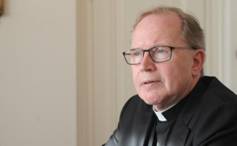 The
Dutch cardinal particularly criticizes the report for reproducing without
correction statements according to which sin would not reside in the homosexual
relationship itself, but in “the lack of faith in a God who desires our
fulfillment.”
The
Dutch cardinal particularly criticizes the report for reproducing without
correction statements according to which sin would not reside in the homosexual
relationship itself, but in “the lack of faith in a God who desires our
fulfillment.”
For Eijk, this statement directly contradicts
Catholic doctrine.
“Homosexual acts are intrinsically evil; this is an already established
Catholic doctrine,” the prelate states. Although he recognizes that every
Christian needs to trust in God’s grace to avoid sin, he emphasizes that this
does not eliminate the objective gravity of certain acts.
The cardinal also accuses the report’s drafters of deliberately
introducing doctrinal confusion by presenting those testimonies without
clarifications or references to the Catechism of the Catholic Church.
Eijk denounces the attack on Courage
Another of the points most criticized by the Archbishop of Utrecht is
the treatment that the report gives to Courage International, an apostolate
approved by the Church that accompanies people with same-sex attraction to help
them live in accordance with Christian chastity.
The synodal document includes the testimony
of a person who implicitly accuses Courage of promoting “conversion therapies,”
a claim that the movement has already publicly rejected, qualifying it as
“slander and defamation.”
According to Eijk, the report implicitly
conveys the idea that homosexual relationships can be normalized within the
life of the Church, something he considers incompatible with consistent
Catholic teaching.
Criticism of the synodal process method
Beyond the specific issues on homosexuality, Eijk
criticizes the general approach of the document, which he accuses of replacing
moral doctrine with a model focused solely on personal experiences and
listening processes.
The cardinal particularly rejects that the authors question the
application of universal moral norms and present doctrine as something “rigid”
or merely “abstract.”
According to the prelate, this way of framing pastoral care ends up
weakening moral truth and creating the impression that the Church’s teachings
can be modified according to cultural circumstances or subjective experiences.
“The truths about marriage and sexuality were established by God once
and for all,” Eijk asserts.
The cardinal also recalls that St. John Paul II already condemned this
type of approach in the encyclical Veritatis Splendor, where he rejected
so-called “pastoral solutions” contrary to the Magisterium.
“Doctrine cannot
be revised through synodal processes”
Eijk warns that the consequences of the report go far beyond the debate on
homosexuality. In his view, relativizing universal
moral norms ends up affecting the entire ethical teaching of the Church,
including the defense of human life.
For this reason, he considers that the document must be “firmly
refuted” and assures that several cardinals and bishops are already preparing
objections directed to the Roman Magisterium.
“The Church’s teaching is not subject to revision through synodal processes,” the Dutch cardinal concludes. “It is
the truth that sets us free.”
Hermeneutics of Continuity/Discontinuity
Catholic Church Teaches:
“That the mystical body of Christ
and the Catholic Church in communion with Rome are one and the same thing, is a
doctrine based on revealed truth.” Pius XII, Humani Generis
(Modernism teaches that) “the formulas which
we call dogma must be subject to these vicissitudes, and are, therefore, liable
to change. Thus the way is open to the
intrinsic evolution of dogma. Here we
have an immense structure of sophisms which ruin and wreck all religion.” Pope St. Pius X, Pascendi, 1907
With truly lamentable results,
our age, casting aside all restraint in its search for the ultimate causes of
things, frequently pursues novelties so ardently that it rejects the legacy of
the human race. Thus it falls into very serious errors, which are even more
serious when they concern sacred authority, the interpretation of Sacred
Scripture, and the principal mysteries of Faith. The fact that many Catholic
writers also go beyond the limits determined by the Fathers and the Church
herself is extremely regrettable. In the name of higher knowledge and historical
research (they say), they are looking for that progress of dogmas which is, in
reality, nothing but the corruption of dogmas.
Pope St. Pius X, Lamentabili Sane, 1907
The Vatiacan II Church Teaches:
“Church of Christ… subsits in the Catholic Church.” Lumen Gentium,
Vatican II
NOTE: The author of this term, “subsist in,”
was Pastor Wilhelm Schmidt, a Protestant minister who made the suggestion to
Cardinal Augustin Bea, the ecumenist, modernist
biblical scholar, patron of Fr. Annibale Bugnini, and confessor to Pope Pius XII, who in turn
recruited the support of Fr. Joseph Ratzinger who
then convinced Cardinal Josef Frings of Cologne to
bring the matter to the Council. This
story was personally verified by Fr. Franz Schmidberger,
First Assistant to the Superior General of the SSPX, by directly contacting
Pastor Schmidt.
The problem remains if Lumen Gentium
strictly and exclusively identifies the Mystical Body of Christ with the
Catholic Church, as did Pius XII in Mystici Corporis. Can we not call it into doubt when we observe that not only is the attribute “Roman”
missing, but also that one avoids saying that only Catholics are members of the
Mystical Body. Thus they are telling us that the Church of Christ and of
the Apostles subsistit in, is found in the Catholic Church.
There is consequently no strict identification, that is exclusive, between the
Church of Christ and the “Roman”
Church. Vatican II admits, fundamentally, that non-Catholic Christians are
members of the Mystical Body and not merely ordered to it. Yves Cardinal Congar
Church of Christ is not exclusively identical to the Roman Catholic
Church. It does indeed
subsist in Roman Catholicism but it is also present in varying modes and
degrees in other Christian communities. (Bold face in original).
Avery Cardinal Dulles, a member
of the International Theological Commission
It is difficult to say that the Catholic Church is still one, Catholic,
apostolic, when one says that the others (other Christian communities) are
equally one, Catholic and apostolic, albeit to a lesser degree. ---- at Vatican
Council II, the Roman Catholic Church officially abandoned its monopoly over
the Christian religion. Fr. Edward Schillebeeckx
Concretely and actually the Church of Christ may be realized less,
equally, or even more in a Church separated from Rome than in a Church in
communion with Rome. This conclusion is inescapable on the basis of the
understanding of Church that emerges from the teaching of Vatican Council
II. Fr.
Gregory Baum
And we now ask: What does it mean to restore the unity of all
Christians?... This unity, we are convinced, indeed subsists in the Catholic Church, without the possibility of ever
being lost (Unitatis Redintegratio)
the Church in fact has not totally disappeared from the world. On the other
hand, this unity does not mean what
could be called ecumenism of the return: that is, to deny and to reject
one’s own faith history. Absolutely not!
Pope Benedict XVI, addressing
Protestants at World Youth Day, August 19, 2005
Congregation for the Doctrine of the Faith Offers
Clarification (?):
QUESTION:
What is the meaning of
the affirmation that the Church of Christ subsists in the Catholic
Church?
RESPONSE:
Christ “established here on earth”
only one Church and instituted it as a “visible and spiritual community”, that
from its beginning and throughout the centuries has always existed and will
always exist, and in which alone are found all the elements that Christ himself
instituted. “This one Church of Christ, which we confess in the Creed as one,
holy, catholic and apostolic […]. This Church, constituted and organized in
this world as a society, subsists in the Catholic Church, governed by the
successor of Peter and the Bishops in communion with him”.
In number 8 of the Dogmatic Constitution Lumen
Gentium ‘subsistence’ means this perduring, historical continuity and the permanence of all
the elements instituted by Christ in the Catholic Church, in which the Church
of Christ is concretely found on this earth.
REPLY:
Lutherans, Methodists,
Anglicans, and many other Protestant groups recite the Nicene Creed professing
a belief in the “one, holy, catholic, apostolic Church.” They clearly do not define the word
“catholic” in the same sense as Roman Catholics do. Is the CDF giving a Catholic or Protestant
meaning to the word “catholic” when it explains the words “subsist in”? Is the comment
of Cardinal Congar explaining the significance of the
failure to use the word “Roman” important to our understanding of the CDF’s
response? Is this a cleaver corruption of dogmatic truth through dissembling
corruption of language? Should we be grateful to Cardinal Congar
for his open and honest comments? Since
the “ecumenism of return” is rejected then, do Protestants that do not have to
“return” to the Roman Catholic Church already belong to the “Church of Christ”? Is
there salvation in the “Church of Christ” separated from the Roman Catholic
Church? It is a Dogma, an article of divine and Catholic faith, that there is
one universal Church of the faithful outside of which there is no salvation.
“The Devil is
fighting a decisive battle”
Sr. Lucy also told me:
“Father, the Devil is fighting a
decisive battle against the Virgin and, as you know, what most offends God and
what will gain him the greatest number of souls in the shortest time is to gain
the souls consecrated to God. For this also leaves unprotected the field of the
laity and the Devil can more easily seize them.
“Also, Father, tell them that my cousins Francisco and Jacinta made sacrifices
because they always saw the Blessed Virgin was very sad in all her apparitions.
She never smiled at us. This anguish that we saw in her, caused by offenses to
God and the chastisements that threaten sinners, penetrated our souls. And
being children, we did not know what measures to devise except to pray and make
sacrifices. …”
Referring to the
vision of Hell that Our Lady showed her and Jacinta and Francisco, she said:
“For this reason, Father,
it is my mission not just to tell about the material punishments that will
certainly come over the earth if the world does not pray and do penance. No, my
mission is to tell everyone the imminent danger we are in of losing our souls
for all eternity if we remain fixed in sin.
“Father, we should not wait for a call to the world from Rome on the part of
the Holy Father to do penance. Nor should we wait for a call for penance to
come from the Bishops in our Dioceses, nor from our Religious Congregations.
No, Our Lord has often used these means, and the world has not paid heed. So,
now each one of us must begin to reform himself spiritually. Each one has to
save not only his own soul, but also all the souls that God has placed on his
pathway.
“Father, the Blessed Virgin did not tell me that we are in the last times of
the world, but I understood this for three reasons:
“The first is because she
told me that the Devil is engaging in a battle with the Virgin, a decisive
battle. It is a final battle where one party will be victorious and the other
will suffer defeat. So, from now on, we are either with God or we are with the
Devil; there is no middle ground.
“The second reason is
because she told me, as well as my cousins, that God is giving two last
remedies to the world: the Holy Rosary and devotion to the Immaculate Heart of
Mary. And, being the last remedies, that is to say, they are the final
ones, means that there will be no others.
“And the third, because in the plans of the Divine Providence, when God
is going to chastise the world He always first exhausts all other remedies.
When He sees that the world pays no attention whatsoever, then, as we say in
our imperfect way of talking, with a certain fear He presents us the last means
of salvation, His Blessed Mother.
If we despise and reject this last means, Heaven will no longer pardon
us, because we will have committed a sin that the Gospel calls a sin against
the Holy Spirit. This sin consists in openly rejecting – with full knowledge
and will – the salvation that is put in our hands.
“Also, since Our Lord is a very good Son, He will not permit that we
offend and despise His Blessed Mother. We have as obvious testimony the history
of different centuries where Our Lord has shown us with terrible examples how
He has always defended the honor of His Blessed Mother.
“Prayer and sacrifice are
the two means to save the world. As for the Holy Rosary, Father, in these last
times in which we are living, the Blessed Virgin has given a new efficacy to
the praying of the Holy Rosary. This in such a way that there is no
problem that cannot be resolved by praying the Rosary, no matter how difficult
it is - be it temporal or above all spiritual - in the spiritual life of each
of us or the lives of our families, be they our families in the world or
Religious Communities, or even in the lives of peoples and nations.
“I repeat, there is no
problem, as difficult as it may be, that we cannot resolve at this time by
praying the Holy Rosary. With the Holy Rosary we will save ourselves, sanctify
ourselves, console Our Lord and obtain the salvation of many souls.
“Then, there is devotion to the Immaculate Heart of Mary, our Most Holy
Mother, holding her as the seat of mercy, goodness and pardon and the sure door
to enter Heaven. This is the first part of the Message referring to Our Lady of
Fatima, and the second part, which is briefer but no less important, refers to
the Holy Father.” Sister Lucy of Fatima
to Fr. Augustin Fuentes in 1957
St.
Pius X identified Emmanuel Kant as the Philosophical Father of Modernism
because Kant denied that objective truth can be known and communicated to
others.
"Thinking men may to-day be divided into two classes: those who go
back beyond Kant, and those who have received, as it were, their philosophic
initiation and baptism from his Critique."
Auguste Sabatier, Dean of the Faculty of Protestant theology in Paris, quoted
by Jules Leberton, S.J.,
Professor, Catholic Institute of Paris, The Encyclical (Pascendi) and Modernist
Theology
Western
Civilization is at its end! Either conversion to the Catholic faith or complete
descent into barbarism are the only options!
Since civilization is the
reign of social law issuing in social stability and in the security of life,
limb and property, and a stable relation of mutual confidence and trust between
man and man, it is quite obvious that such stability must rest upon an ethical
basis, that is to say, upon the virtues of honesty, truthfulness, good-will,
respect for the rights and feelings of others, self-restraint and submission to
just law. It is obvious, too, and history confirms it a thousand times, that
these virtues can have no stability or binding power in society so long as they
rest only on the quicksand of mere external propriety and expediency. No, my
good Friends, the virtues which make up a civilization require a more solid
foundation than mere convenience and self-interest, and this bed-rock of
civilization can only be the moral law
accepted as an imperative duty—as the
Will flowing from the Nature of a Divine Lawgiver.
Rev. Demetrius Zema, S.J., The Thoughtlessness of Modern Thought,
1933
"The first rule for
interpreting an author's texts is not to interpret them in such a way as to
make him contradict himself."
Fr. Garrigou
Lagrange, O.P, "Our Saviour and His Love for
Us", p. 44
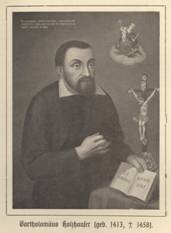 Dogma is the answer to their "senseless questions and
elaborate arguments"!
Dogma is the answer to their "senseless questions and
elaborate arguments"!
"During this period the Wisdom of God guides
the Church in several ways:
1) by chastising the Church so
that riches may not corrupt her completely;
2) by interposing the Council of Trent
like a light in the darkness, so that the Christians who see the light may know
what to believe... They will ridicule Christian simplicity; they will call it folly
and nonsense, but they will have the highest regard for advanced knowledge, and for the skill by which the axioms of
the law, the precepts of morality, the Holy Canons and religious dogmas are
clouded by senseless questions and elaborate arguments. As a result, no
principle at all, however holy, authentic, ancient, and certain it may be, will
remain free of censure, criticism, false interpretations, modification, and
delimitation by man."
Ven. Bartholomew Holzhauser, 8-24-1613 to 5-20-1658, Priest, Confessor, Prophet
SSPX
and the Evolution of Catholic Dogma: CCC goes from ‘NOT engraved in stone’
to ‘engraved in stone’ in 28 years! Is the SSPX ‘maturing’ or growing
senile?
“The Catechism of the
Catholic Church is a non-Catholic catechism.” SSPX position,
1994
“Cardinal Reinhard Marx declared in an
interview published on March 31, 2022 in the newspaper Stern, that The Catechism of
the Catholic Church ‘is not engraved in stone’ and that, consequently, ‘one
can doubt what it says.’ In itself, this proposition is aberrant…. The catechism is nothing other than the
teaching of the Church, dogmatic and moral, made available to the faithful.”
SSPX position 2022
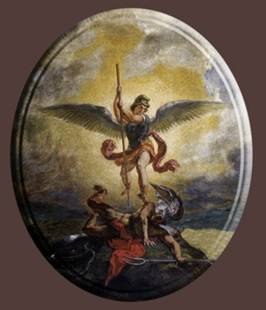
In 2022 there were 42,000 nuns left in the United States
with an average age of over 80 years. Only 1% of these nuns were under 40 years
of age.
"Love
Cannot Be Silenced"? - With a decline of 73% since Vatican II and an
average age of 74 years, we will soon be entertained by the silence of the
grave!
The Vanishing
of the Nuns
 Michael Winerip | December 2, 2012
In 1965, when the average age of a baby boomer was 10, there were 180,000 nuns in the United States. Today there are about 56,000. But even more dramatic than this decline is the age of the average Roman Catholic sister — 74 years old.
Will there even be nuns in the church by the time the millennials reach middle age? Will the boomers be the last generation to know nuns as a large and powerful force in American Catholicism?
Sister Kathy Sherman of LaGrange Park, Ill., at 60, a young nun by today’s standards, came of age during the Vietnam War, playing antiwar protest songs on her guitar. These days, Sister Sherman — whose voice sounds a lot like Judy Collins — has become known for a protest song she’s written (Love Cannot Be Silenced), aimed at the Vatican’s efforts to rein in American nuns.
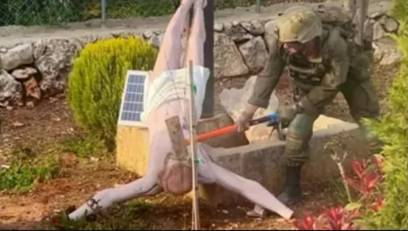
Soldier from
the Israeli Army desecrates image of Jesus Christ during their current invasion
of southern Lebanon. This is what they
do when not killing women and children and other non-combatants.
Novus
Ordo "Saint" John Paul II taught the novel heretical doctrine that by
the Incarnation, when the "Word was made flesh," all men became
"Son(s) of the living God" regardless of faith or reception of the
sacraments or their morality!
All of you who are still seeking God, all of you who already have the
inestimable good fortune to believe, and also you who are tormented by doubt:
please listen once again, today in this sacred place, to the words uttered by
Simon Peter. In those words is the faith of the Church. In those same words is
the new truth, indeed, the ultimate and definitive truth about man: the son of
the living God—"You are the Christ, the Son of the living God."
John Paul II, first homily, October 27, 1978
“The Holy Roman Church firmly believes, professes
and preaches that all those who are outside the Catholic Church, not only
pagans but also Jews or heretics and schismatics, cannot share in eternal life
and will go into the everlasting fire which was prepared for the devil and his
angels, unless they are joined to the Church before the end of their lives..,
and that nobody can be saved, no matter how much he has given away in alms and
even if he has shed blood in the name of Christ, unless he has persevered in
the bosom and unity of the Catholic Church.”
Pope Eugene IV, Council of Florence, Cantate Domino, 1441, ex cathedra
On
the Necessity of the Sacrament Baptism for Salvation: St. Gregory Nazianzen
“If you were able to judge a man who intends to commit murder solely by
his intention and without any act of murder, then you could likewise reckon as
baptized one who desired baptism. But, since you cannot do the former, how can
you do the latter? If you prefer, we will put it this way: If, in your opinion,
desire has equal power with actual baptism, then make the same judgment in
regard to glory. You would then be satisfied to desire glory, as though that
longing itself were glory. Do you suffer any damage by not attaining the actual
glory, as long as you have a desire for it? I cannot see it!”
St. Gregory Nazianzen, Bishop, Confessor, Father & Doctor of the
Church, Oration on Divine Light
Doctrine may develop in itself in
"due proportion".... with "no variety of its definition."
Dogma cannot develop in itself because its "proportion" and
"definition" are fixed by God. It can only develop in its
implications!
“Shall we then have no advancement of religion in the Church of Christ?
Let us have it indeed, and the greatest . . .
But yet in such sort that it be truly an advancement of faith, not a change
(sed ita tamen ut vere profectus sit ille
fidel, non permutatio), seeing that it is the nature of an advancement,
that in itself each thing (severally) grow greater, but of a change that
something be turned from one thing into another. . . . Let the soul’s religion imitate the law of
the body, which, as years go on, develops indeed and opens out its due
proportions, and yet remains identically what it was. . . . Small are a baby’s limbs, a youth’s are
larger, yet they are the same. . . . So
also the doctrine of the Christian religion must follow those laws of
advancement; namely, that with years it be consolidated, with time it be
expanded, with age it be exalted, yet remain uncorrupt and untouched, and be
full and perfect in all the proportions of each of its parts, and with all its
members, as it were, and proper senses; that it admit no change besides,
sustain no loss of its propriety, no variety of its definition. Wherefore,
whatsoever in this Church, God’s husbandry, has by the faith of our fathers
been sown, that same must be cultivated by the industry of their children, that
same flourish and ripen, that same advance and be perfected.”
St. Vincent of Lerins, Commonitorium,
nfl. 28, 29
“The
doctrine which God has revealed has not been proposed as some philosophical
discovery to be perfected by the wit of man, but has been entrusted to Christ’s
Spouse as a Divine deposit to be faithfully guarded and infallibly declared.
Hence sacred dogmas must ever be understood in the sense once for all (semel) declared by Holy Mother Church;
and never must that sense be abandoned under pretext of profounder knowledge
(altioris intelligentiae).”
Vatican Council I, Sess. iii. chap. 4
DOGMA AND DEVOTION or the Worshop of God 'in Spirit and
in Truth'
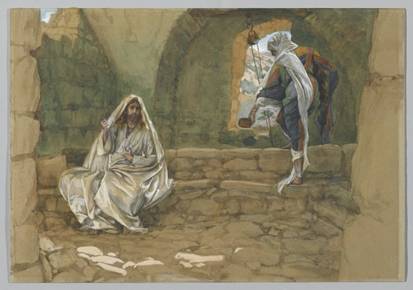 Now our Divine Lord, speaking to the woman of Samaria, said, ‘You adore
that which you know not;’ because they were ‘an idolatrous people, of mixed
race, partly of Israel, partly of the nations brought and planted in a portion
of the Promised Land. They had intermarried with the people of Israel, they had
received the books of the Pentateuch, and they had a sort of fragmentary
knowledge of the old revelation; but they did not rightly know the True God; and so much as they did know of
the True God, they did not know truly. Therefore they could not worship Him ‘in
spirit and in truth.’ For this cause our Divine Lord said, ‘You worship
that which you know not;’ and He then further said, ‘We adore that which we
know, for salvation is of the Jews.’ The full and pure light of revelation is
in Jerusalem. The true knowledge of the True God is with us; and yet the time
is coming when ‘they that adore shall adore neither in this mountain nor in
Jerusalem, but everywhere in spirit and in truth.’
Now our Divine Lord, speaking to the woman of Samaria, said, ‘You adore
that which you know not;’ because they were ‘an idolatrous people, of mixed
race, partly of Israel, partly of the nations brought and planted in a portion
of the Promised Land. They had intermarried with the people of Israel, they had
received the books of the Pentateuch, and they had a sort of fragmentary
knowledge of the old revelation; but they did not rightly know the True God; and so much as they did know of
the True God, they did not know truly. Therefore they could not worship Him ‘in
spirit and in truth.’ For this cause our Divine Lord said, ‘You worship
that which you know not;’ and He then further said, ‘We adore that which we
know, for salvation is of the Jews.’ The full and pure light of revelation is
in Jerusalem. The true knowledge of the True God is with us; and yet the time
is coming when ‘they that adore shall adore neither in this mountain nor in
Jerusalem, but everywhere in spirit and in truth.’
From these words I draw one conclusion, namely,
that knowledge is the first and vital condition of all true worship. You will remember how S. Paul at Athens found an altar ‘to the unknown
God,’ and how he commended the people for their intentions of piety, but
reproved them for their ignorance. He said, ‘Him whom you ignorantly worship,
Him I declare unto you.’ Without knowledge there can be no adoration ‘in spirit
and in truth;’ and just in the measure of our knowledge will our adoration be
more or less perfect, that is, intelligent and spiritual. If our knowledge be
full and perfect, so will our adoration be. From this let us draw two
consequences, and then pass on.
The first is
this. How great is the superstition of those who for centuries have pleased
themselves by accusing the Catholic Church of teaching that ‘ignorance is the
mother of devotion.’ The other consequence is: that the mother of all true
knowledge relating to God, and therefore the mother of all true worship, is the
Holy Catholic Church alone. Is it not a masterpiece of craft that the father of
lies should have so darkened the understandings of our adversaries as to lead
them into the profound superstition of believing that we keep people in ignorance
in order to make them devout? My purpose, then, will be to trace out the connection between what the
world scornfully calls dogma and devotion, or the worship of God ‘in spirit and
in truth.’
Cardinal Henry
Edward Manning, The Glories of the Sacred Heart, Chapter 3, Dogma, the Source
of Devotion
DOGMA: "A
genuine message from the First Cause of the universe"
If the teaching proposed by the Church as dogma is not actually and
really the doctrine supernaturally revealed by God through Jesus Christ Our Lord,
[........]then there could be nothing more pitifully inane than the work of the
Catholic Magisterium. [........]
This common basis of the false doctrinal Americanism and of the Modernist
heresy is, like doctrinal indifferentism itself, ultimately a rejection of Catholic
dogma as a genuine supernatural message or communication from the living God
Himself. It would seem impossible for anyone to be blasphemous or silly enough
to be convinced, on the one hand, that the dogmatic message of the Catholic Church
is actually a locutio
Dei ad homines, and to
imagine, on the other hand, that he, a mere creature, could in some way improve
that teaching or make it more respectable. The very fact that a man would be so rash as to attempt
to bring the dogma of the Church up to date, or to make it more acceptable to
those who are not privileged to be members of the true Church, indicates that
this individual is not actually and profoundly convinced that this dogmatic
teaching of the Catholic Church is a supernatural communication from the living
and Triune God, the Lord and Creator of heaven and earth. It would be the
height of blasphemy knowingly to set out to improve or to bring up to date what
one would seriously consider a genuine message from the First Cause of the
universe.
Fr. Joseph C. Fenton, American Ecclesiastical Review, Sacrorum Antistitum and the Background of the Oath Against
Modernism
DOGMA, the
proximate rule of faith for all the faithful:
According to Fr. Joseph Fenton, editor of the American Ecclesiastical Review:
·
Dogmas
are “truths,” not precepts.
·
Dogmas
are “teachings we are obliged to believe with the assent of divine and Catholic
faith.”
·
Dogmas
are defined “truths” which the “apostles of Jesus Christ preached to His
Church.”
·
Dogmas
are “truths” that have been “supernaturally communicated or revealed by God
Himself.”
·
Dogmas
“constitute the central or primary object of the Church’s infallible teaching
activity.”
A dogma is by definition immutable and unchangeable. The denial of any
dogma makes one a heretic by definition.
·
Hence,
also, that understanding of its sacred dogmas must be perpetually retained,
which Holy Mother Church has once declared; and there must never be recession
from that meaning under the specious name of deeper understanding.
Therefore... let the understanding... be solely in its own genus, namely the
same dogma, with the same sense and the same understanding. Vatican I, Dei Filius
·
Let
nothing of the truths that have been defined ( i.e.: dogmas) be lessened,
nothing altered, nothing added; but let them be preserved intact, in word and
meaning. Pope Gregory XVI, Mirari
Vos
·
[Dogma
must be understood] by the very sense by which it is defined and must be held
to be by itself a sufficient demonstration, very sure and adapter to all the
faithful. Ven. Pope Pius IX, Inter
Gravissimas, 1870
·
If anyone
shall have said that it is possible that to the dogmas declared by the Church a
meaning must sometimes be attributed according to the progress of knowledge,
different from what the Church has understood and understands: let him be
anathema. Vatican I, Dei Filius
·
[Regarding
dogma] nothing else is to be believed other than the words; and I hold that
this absolute and unchangeable truth, which was preached by the Apostles from
the earliest times, is to be understood in no other way than by the
words. Oath Against Modernism
Sources of the corruption of Catholic DOGMA:
Baptism
is Necessary for both justification and salvation!
By which words, a description of the Justification of the impious is
indicated, as being a translation, from that state wherein man is born a child
of the first Adam, to the state of grace, and of the adoption of the sons of
God, through the second Adam, Jesus Christ, our Saviour. And this translation,
since the promulgation of the Gospel, cannot be effected, without the laver of
regeneration, or the desire thereof, as it is written; unless a man be born
again of water and the Holy Ghost, he cannot enter into the Kingdom of God.
[.....]
The instrumental cause
(of justification) is the sacrament of baptism, which is the sacrament of
faith, without which (faith) no man was ever justified. We must believe
that to those justified nothing more is wanting from being considered as having
satisfied the divine law by those works which have been done in God according
to the state of this life, and as having truly merited eternal life to be
obtained in its own time (if they shall have departed this life in grace) [Rev.
14:13] (Denz. 809).
Council of Trent,
Decree on Justification, copied from Vatican source
Comment: Neo-modernist as a rule habitually take Catholic doctrinal
teaching out of context. They even do this with dogma which never admits to contextualization.
Doctrinal examples can be easily provided where Neo-modernist have taken a
single sentence out of a paragraph and given it a meaning that contradicts the
paragraph from which it was taken. In this example they take a word out of
context to imply an overturning of the intentional meaning of the sentence from
which it is taken.
In this quotation from the Council of Trent, the Vatican publication
puts the word "faith" in parenthesis after the pronoun
"which" in the first sentence. Their purpose is to convey the meaning
that no man is justified without faith (which is true) but some men are
justified without baptism (which is NOT true). It is this type of word
manipulation from which Pope Francis embraced the Lutheran heresy of
"justification by faith alone." And since the Council of Trent
teaches that justification is all that is necessary for salvation therefore,
since a man is justified by faith alone, he therefore obtains salvation by
faith alone and consequently they believe that the sacraments are NOT necessary
for salvation!
The Vatican makes the prepositional phrase, "without which no man
was ever justified" modify "faith" as if it has no other bearing
on the rest of the predicate which is grammatical non-sense! Well, what faith
is the sentence talking about? It is talking about the "sacrament of
faith"! And what is the "sacrament of faith"? The answer is the
"sacrament of baptism" without which "no man was ever
justified" modifies as part of the predicate!
And thus, the Council of Trent dogmatically declared:
If any one saith, that the sacraments of the New Law are not
necessary unto salvation, but superfluous; and that, without them, or without
the desire thereof, men obtain of God, through faith alone, the grace of
justification; though
all (the sacraments) are not indeed necessary for every individual; let him be
anathema.
Council of Trent, Canon 4
This dogma condemns three propositions: 1) If you say that the baptism
is not necessary for salvation, let
him be anathema; 2) If you say that baptism is not necessary for
justification, "OR" 3) If you say that the desire for baptism is not
necessary for justification, let
him be anathema.
Those like Pope Francis who follow Martin Luther's heresy on
justification and salvation claim that in this dogma, the coordinating
conjunction "or" must be taken in an exclusive sense meaning that the
"desire" for baptism makes the sacrament itself unnecessary for
justification as a necessity of means. Luther's heresy of justification by
faith alone is supposedly defended by Catholic dogma! But this interpretation
is impossible!!!
It is true that the coordinating conjunction “or” can grammatically be
used in an exclusive or inclusive sense. It is more often
exclusive, but either way, the sense is always reciprocal. For example,
if you were to win a new car and the dealer says you can have it in red or
white, if you take the white, you cannot have the red. Reciprocally, if you take the red, you
cannot have the white. This is taking the conjunction exclusively.
In the dogma cited, the assumption of the heretics is that the conjunction “or”
is exclusive in that you can have the "desire" without the sacrament
and be justified. Therefore,
if this were correct, the reciprocal would have to occur, that is, the sacrament
without the desire would then end in justification. We know that this
cannot happen. If for example, a Jew while staying a Jew, is baptized because
he wants to escape persecution and has no desire to receive the sacrament, then
the sacrament itself without the desire will not end in justification because
he has rejected the faith. Therefore,
the conjunction “or” in this dogma must necessarily be inclusive and cannot be
exclusive because, only in the inclusive sense is the relationship reciprocal.
That means there must be both the sacrament present and the desire for the
sacrament present to end in justification.
The dogma confirms the teaching of the narrative text that both the
sacrament of baptism and the desire for the sacrament are necessary for justification,
"as it is written; unless a man be born again of water and the Holy Ghost,
he cannot enter into the Kingdom of God." It confirms that a state of
justification is all that is necessary for salvation. And it confirms that the
sacrament of baptism is necessary for salvation.
Heresy
is the Denial of Dogma as the Rule of Faith; Modernism is the "Synthesis
of all Heresies" because it denies ALL DOGMAS! It denies what Dogma essentially is!
[Modernism is the] synthesis of
all heresies [whose] system means the destruction not of the Catholic religion
alone, but of all religion....
[Modernists] partisans of error are to be sought not only among the
Church’s open enemies; but what is to be most dreaded and deplored, in her very
bosom, and are all the more mischievous the less they keep in the open.... They
put themselves forward as reformers of the Church [though they are] thoroughly
imbued with the poisonous doctrines taught by the enemies of the Church.... They assail all that is most sacred in the
work of Christ.... [They are] the most pernicious of all the adversaries of the
Church... They lay the axe not to the branches and shoots, but to the very
root, that is, to the Faith and its deepest fibers.... The most absurd tenet
of the Modernists, that every religion according to the different aspect under
which it is viewed, must be considered as both natural and supernatural. It is thus that they make consciousness and
revelation synonymous. From this they
derive the law laid down as the universal standard, according to which
religious consciousness is to be put on an equal footing with revelation, and
that to it all must submit, even the supreme authority of the Church. St. Pius X, Pascendi
Therefore:
In the Novus Ordo Church of Sweet Dreams where harshness is always frowned upon
harshly!
·
Religious
Liberty is the doctrinal validation of “Religious Consciousness.”
·
Ecumenism is
the collectivization and synthesis through dialogue of the individual’s
“Religious Consciousness.”
·
“Faith” is the
affirmation of the subjective “Religiousness Consciousness” on the authority of
the believer.
·
“Dogma” is the
historical and transitory collective expression of “Religiousness
Consciousness” for a particular age.
·
“Tradition” is
the historical perceptions from which the present “Religious Consciousness” has
evolved.
The Church at Vatican
Council I (1869-70) defined that a dogma is a truth formally revealed by God
which must be believed with “divine and Catholic faith” as necessary for salvation.
A dogma is, by definition, immutable and unchangeable. Dogmas are not maxims,
nor are they axioms where they are to be understood simply as general points of
belief. Pope St. Pius X solemnly condemned this notion in his encyclical Pascendi
Dominici Gregis (False Doctrines of the Modernists, September 8, 1907: DNZ
2079-81). Rather, each dogma is a specific truth revealed by God and proposed
by the Church whose very nature allows for no change and is the same for all
time.
Adam Miller, Catholic
Apologist, Dogmatic Deception
“The time is fast approaching when the omnipotent God will punish the
world with justice and righteous anger, for the sins and crimes that stain His
holy sanctuary. The corruption of morals will reach such an extreme that the
atmosphere will be saturated with the stench of impurity, and these evil times
will bring a chastisement like no other.
Confusion will reign in the sanctuary, and many of those entrusted with the
care of souls will become lost themselves, dragging many others with them into
error. The light of true faith will seem almost extinguished, and the flock,
abandoned by many shepherds, will be scattered. In these moments of
tribulation, those who remain faithful will suffer unspeakably. They will be
persecuted, ridiculed, and oppressed, for the world will hate the truth and
those who uphold it.
But do not fear, for just when all seems lost and paralyzed, when the wicked
believe they have triumphed, this will mark the arrival of my hour, when I will
overthrow the proud and accursed Satan, trampling him under my feet and
chaining him in the infernal abyss. This restoration will be swift and
marvelous. It will bring joy to the faithful and shame to those who warred
against God and His Church.”
Our Lady of Good Success to Mother Marianna
When
Pope Leo XIV denied the BVM her title of Co-Redemtrix, he was following
Francis!
Hermeneutics
of Continunity/Discontinunity
Blessed
Virgin Mary, Co-Redemptrix, “The Mother of all the living”!
Pope
Francis theological tripe:
“Being faithful to her Master, who is her Son, the only Redeemer, she
never wanted to take anything for herself from her Son. She never presented
herself as a co-redemptrix…. When they come to us with the story according to
which we should declare this, or that other dogma, let us not get lost in
foolishness.”
Pope Francis, denying the title of the Blessed Virgin as Co-Redemptrix
Wisdom
of Catholic Truth:
·
“Just as
Eve, wife of Adam, yet still a virgin, became by her disobedience the cause of
death for herself and the whole human race, so Mary, too, espoused yet a
virgin, became by her obedience the cause of salvation for herself and the
whole human race.” St. Irenaeus, 2nd
century
·
“Death
through Eve, life through Mary.” St.
Jerome, 4th century
·
“Through
the Blessed Virgin Mary, we are redeemed from the tyranny of the devil.” Modestus of Jerusalem, 7th century
·
“Hail
thou, through whom we are redeemed from the curse.” St. John Damascene, 8th century
·
“Through
her (the Blessed Virgin Mary), man was redeemed.” St. Bernard of Clairvaux, 12th century
·
“That
woman (namely Eve), drove us out of Paradise and sold us; but this one (Mary)
brought us back again and bought us.”
St. Bonaventure, 13th century
·
“The
Blessed Virgin merits for us de congruo what Christ merited de condign.” Pope St. Pius X, Ad diem illum
·
“(The
Blessed Virgin Mary) offered Him on Golgotha to the Eternal Father together
with the holocaust of her maternal rights and her motherly love like a new Eve
for all children of Adam.” Pope Pius
XII, Mystici Corporis
COMMENT:
Many ignorantly date the title of the Blessed Virgin Mary as
Co-Redemptrix to the 16th century. It is actually much older. The theological truth that the title describes
is found in Scripture, the Church Fathers and the constant tradition of the
Catholic Church. It may have become more evident in the 16th century only
because the Protestants deny it.
Pope Francis denied the title because he had common ground with
Protestant heretics. He is on public record affirming his belief in Luther’s
heretical doctrine of Justification which denies any incorporation of the
baptized into Jesus Christ with the end to share in His sanctification and
glorification. Catholic truth teaches that every Catholic “who has been
baptized in Christ, has put on Christ” (Gal 3:27). And every Catholic who has
“put on Christ” must then “deny himself, and take up his cross, and follow
(Jesus Christ)” (Matt 16:24) so that he can “fill up those things that are
wanting of the sufferings of Christ, in my flesh, for his body, which is the
church” (Col 1:24). Every baptized Catholic is called upon to be a co-redemtrix
with Jesus Christ and this constitutes the greatest honor for any of the
faithful. Pope Pius XII said:
Because Christ the
Head holds such an eminent position, one must not think that he does not
require the help of the Body. What Paul said of the human organism is to be
applied likewise to the mystical Body: “The head cannot say to the feet: I have
no need of you.” It is manifestly clear that the faithful need the help of the
Divine Redeemer, for He has said: “Without me you can do nothing,” and
according to the teaching of the Apostle every advance of this Mystical Body
towards its perfection derives from Christ the Head. Yet this, also, must be
held, marvelous though it may seem: Christ has need of His members. First,
because the person of Jesus Christ is represented by the Supreme Pontiff, who
in turn must call on others to share much of his solicitude lest he be
overwhelmed by the burden of his pastoral office, and must be helped daily by
the prayers of the Church. Moreover as our Savior does not rule the Church
directly in a visible manner, He wills to be helped by the members of His Body
in carrying out the work of redemption. This is not because He is indigent and
weak, but rather because He has so willed it for the greater glory of His
spotless Spouse. Dying on the Cross He left to His Church the immense treasury
of the Redemption, towards which she contributed nothing. But when those graces
come to be distributed, not only does He share this work of sanctification with
His Church, but He wills that in some way it be due to her action. This is a
deep mystery, and an inexhaustible subject of meditation, that the salvation of
many depends on the prayers and voluntary penances which the members of the
Mystical Body of Jesus Christ offer for this intention and on the cooperation
of pastors of souls and of the faithful, especially of fathers and mothers of
families, a cooperation which they must offer to our Divine Savior as though
they were His associates.
Pope Pius XII, Mystici Corporis
“The salvation of many depends
on the prayers and voluntary penances which the members of the Mystical Body of
Jesus Christ offer for this intention.” Those who will not “take up their
cross” and enter into applying this “treasury of the Redemption” for the
salvation of others are not “worthy of Jesus Christ.” “No, I say to you: but
unless you shall do penance, you shall all likewise perish” (Luke 13:3).
Now if it can be predicated that every one of the faithful is called
upon to be a co-redemptrix, a fortiori, what can be predicated concerning the
Mother of God, the ever Blessed Virgin Mary, the new Eve, the new Mother of all
the Living who are reborn of God to the life of grace? The Blessed Virgin, our
Lady of Sorrows, is the exemplar Co-Redemptrix sine qua non. It was her fiat
at the Annunciation and repeated at the foot of the cross that brought Christ
from the Father and offers Him again to the Father as a sacrificial reparation
for the salvation of all.
For Pope Francis our Lady’s title was “foolishness.” And why? “But the
sensual man perceiveth not these things that are of the Spirit of God; for it
is foolishness to
him, and he cannot understand, because it is spiritually examined” ( 1 Cor
2:14).
Cursed be the man who denies the Blessed Virgin Mary, our Lady of
Sorrows, her rightful title conferred upon her by God as Co-Redemptrix.
Sensus fidei for the Neo-Modernist: Goal is to direct the mob and use the mob to confirm their heterodoxy!
“The Second Vatican Council highlights that ‘all human beings are
called to the new people of God’ (LG, 13). God is truly at work in the entire
people that he has gathered together. This is why ‘the entire body of the
faithful, anointed as they are by the Holy One, cannot err in matters of
belief. They manifest this special property by means of the whole people’s
supernatural discernment in matters of faith when from the Bishops down to the
last of the lay faithful, they show universal agreement in matters of faith and
morals’ (LG, 12).” Vademecum on
Synodality Syndod
COMMENT: The
word “universal” is corrupted to exclude the attribute of time. A universal by
definition necessarily includes the attribute of time without which it is not a
universal. The sensus fidei that
excludes time considering only the current mass of Catholics at one specific
historical period looks only to popular trends and not Catholic truth. If every
Catholic in the Church at one given time holds a doctrine or moral position
that is contrary to the traditional teaching or practice, then it is not
evidence of the sensus fidei but
rather evidence of general apostasy and nothing more. “When the Son of man
comes, will he find faith on earth?” (Lk 18:8). The implied answer is No! He
will find apostasy and He will not call it a new sensus fidei.
Novus
Ordo 'Dogma': Congregation for the Doctrine of the Faith Gutting Catholic
Truth!
"[.....] With all this in mind, it must be said that the dogmatic
formulas of the Magisterium of the Church have been apt from the beginning to
communicate the revealed truth and, as long as they are maintained, they will
always be fit for those who interpret them correctly. However, it does not suggest that each of them has
been or will remain so to the same extent. For this reason theologians try to
determine exactly what is the intention to teach really contained in the
various formulas, and provide with this work a remarkable help to the living
Magisterium of the Church, to whom they (the theologians) are subordinate.
For this very reason it may also be that some ancient dogmatic formulas and
others related to them remain alive and fruitful in the habitual use of the
Church, provided that new exhibitions and statements are added in due course
and that they preserve and illustrate their primary meaning. On the other hand, it has also
happened sometime that in this same usual use of the Church some of these formulas
have given way to new expressions that, proposed or approved by the sacred
Magisterium, express their sense clearer and more fully.
"As for the meaning of dogmatic formulas, this remains ever true
and constant in the Church, even when it is expressed with greater clarity or
more developed. The faithful therefore must shun the opinion, first, that
dogmatic formulas (or some category of them) cannot signify truth in a
determinate way, but can only offer changeable approximations to it, which to a
certain extent distort of alter it; secondly, that these formulas signify the
truth only in an indeterminate way, this truth being like a goal that is
constantly being sought by means of such approximations. Those who hold such an
opinion do not avoid dogmatic relativism and they corrupt the concept of the
Church's infallibility relative to the truth to be taught or held in a
determinate way.
"Such an opinion clearly is in disagreement with the declarations
of the First Vatican Council, which, while fully aware of the progress of the
Church in her knowledge of revealed truth, nevertheless taught as follows:
"That meaning of sacred dogmas...must always be maintained which Holy
Mother Church declared once and for all, nor should one ever depart from that meaning
under the guise of or in the name of a more advanced understanding." The
Council moreover condemned the opinion that "dogmas once proposed by the
Church must, with the progress of science be given a meaning other than that
which was understood by the Church, or which she understands." There is no
doubt that, according to these texts of the Council, the meaning of dogmas
which is declared by the Church is determinate and unalterable." [.....]
Declaration in Defense of the Catholic
Doctrine on the Church Against Certain Errors of the Present Day, Sacred
Congregation for the Doctrine of the Faith, Mysterium Ecclesiae, June 24, 1973
COMMENT:
The word
"magisterium" is used equivocally in this document. There is the
Magisterium (with a capital "M") of the Church grounded upon the
Church's divine attributes of Infallibility and Authority to teach without the
possibility of error in the name of God. This is what is meant when Jesus
Christ said, "He who heareth you, heareth Me." When a pope engages
the Magisterium of the Church he is entering into the one and same Magisterium
that every pope in the history of the Church has entered since Pope Peter the
Apostle to this present day.
There is also the magisterium (with a lower case "m")
of churchmen teaching by virtue of their grace of state. This teaching has been
deserving of a presumption of correctness and respectful adherence throughout
the history of the Church, however, this teaching is the product of men and is
capable of error. Since Vatican II the repeated teaching by the magisterium of
churchmen has been heretical more often than not. Under Pope Francis it has not
only been doctrinally heretical but at time grossly immoral.
Ultimately, only the pope can engage the Magisterium of the
Church. The teaching that proceeds from the Magisterium is infallible and is
called Dogma and constitutes the formal object of divine and Catholic faith.
Dogma is God giving explicit clarity of definition to His revealed doctrine.
God is the formal and final cause of Dogma. The pope is the necessary but
wholly insufficient material and instrumental cause of Dogma. Since God is the
cause of Dogma, Dogma is infallible in both the truth it teaches and the words
by which that truth is taught. That is, Dogma is irreformable in both its form
(the truth) and its matter (the words) employed. Dogma ends theological
discussion on the doctrine defined. Theologians may develop the implications
that are necessarily derived from Dogmatic Truth but the Dogma in itself
remains fixed in its truth and its manner of expression. Therefore, the proper
tools for understanding Dogma are definition and grammar, and not necessarily
theological competency.
This citation is three
paragraphs from the document from the Sacred Congregation for the Doctrine of
the Faith published in 1973. It both defends the infallible truth of Dogma in
the second and third paragraph by citing the teaching of Vatican I, while at
the same time, it undermines and corrupts Dogmatic truth in the first
paragraph!
It corrupts Dogma when it recognizes and presupposes that Dogma
is the proper subject matter for speculation by theologians and development by
the "living magisterium," (the pope teaching by his fallible grace of
state), to articulate a different non-literal meaning. Theologians are
permitted to critically contextualize Dogma to "interpret them
correctly." Theologians are directed to examine the "intention"
of the Dogmatic formulation. Is this even possible? Well no, it is not. The
"intention" is God's and no one can know the mind of God beyond what
God has revealed. The "intention" of what is in fact the wholly
insufficient material and instrumental cause of Dogma is irrelevant and
completely immaterial to the question. Imagine asking the chisel and the block
of marble what its "intention" was in producing Michelangelo's Pieta! So we end up with fallible theologians
and the fallible "living magisterium" determining that "some of these formulas
(Dogmas) have given way to new expressions." We have the fallible
reformulating the infallible. This has been the rule of the churchman for the
last fifty years since the publication of this document and the sub rosa practice for about 35 years
before that. We are fortunate that God has a perfect memory. His truth is not
compromised by lying churchmen. They claim to be speaking in the name of God to
make God a liar like themselves. It will not work. The remote rule of faith is Scripture and Tradition. The
proximate rule of faith is Dogma. Heresy is defined as the denail of Dogma! Our
duty is to keep the faith inviolate and uncompromised for which God has
promised the eternal reward of His divine presence. Those who corrupt God's
revealed Truth will have their eternal reward as well.
O Mary, Mary, bearer of the fire of love, and dispenser of mercy! Mary,
co-redemptrix of
the human race, when you clothed the Word with your flesh, the world was
redeemed. Christ paid its ransom with His Passion, and you paid it with the
sorrows of your body and soul.
St. Catherine of Siena, Doctor of the Church, Instructed by God Himself
Vatican
II peritus, Hans Kung, who denied the Resurrection of Jesus Christ from the
dead, appealed to John Henry Cardinal Newman as his theological predecessor,
invoking the same liberal modernist principles!
In John Cardinal Newman's Grammar
of Assent are found all of the elements that determined the character of
Newman's thought. The basis of his-peculiar form of liberalism that troubled
Church authorities in his day manifests itself in this his most mature essay,
written in 1870, five years after the Apologia. The underlying current of the entire essay reveals an
aversion for the traditional methods of philosophy and theology on account of
their being, as he would say, too abstract and impersonal.[.....]
It was also Newman's liberal personalism that made him reluctant to
accept the definition of Infallibility in its fullest sense and import, as can
be seen from a letter he wrote in 1871 (after the dogma of infallibility was
defined) to Mr. Mashell, an Oxford convert who had published a pamphlet against
Cardinal Manning. After Newman writing "I never; expected to see such a
scandal in the Church.[.....]
An entire thesis, if not a small book, is required to do justice to the
topic of Newman's position in the Grammar of Assent; here only the chief
position will be discussed and contrasted with the philosophy of St. Thomas and
those who follow him and the exigencies of reality. The philosophical principles which the Church from
time immemorial has upheld and which Newman rejected, or seems to reject, are
as follows:
1. that the abstract and speculative is
superior to the concrete and practical;
2. that true science depends upon the
admission that the nature of things can be known by the mind by abstracting from
the here and the now;
3. that the natural order and the moral law
are independent of men's perception of it and are not based upon a man's
personal characteristics;
4. that causation in nature is discernable by
the human mind without an a priori reference to itself;
5. that the existence of God is demonstrable
by an investigation of nature and not merely by examining a man's consciousness
and his awareness of his conscience;
6. that final causes are operative in the
whole of creation and that God is the final cause, or purpose, of all things;
7. that logic is a noble and useful art which
is grounded upon reality and aids the human mind to understand the conspectus
of reality without falsity;
8. and that the dogmas and doctrines of the
Church are apprehended by 'believers as they are in themselves, and not in an
uncertain personalist fashion.
I hope that the reader untrained in the fundamental principles of
philosophy will be able to perceive that Newman's thinking, however subtly and
elegantly expressed, is opposed to and incompatible with true Catholic
philosophy.
Richard Sartino, Another Look at
John Henry Cardinal Newman
Is
the Resurrection of Jesus Christ to be taken literally or metaphorically?
NEO-MODERNISM:
It's Formal Manifesto from Norte Dame University
What implications does the true nature of papal infallibility have for
our life and practice as faithful Catholics? We can say the following.
First, the Church has a confident humility about papal infallibility.
On the one hand, we believe that the Church does understand and declare what is
true. On the other hand,
we also believe that verbal formulations of divine truths, even the infallible
formulations, are not the Truth per
se, but
limited, conditioned expressions of the truth.
Second, it is the
real truths that are infallible, not the verbal formulations that contain them.
An infallible statement is not at all wrong, but the way it might be said, even
in an infallible definition, might not be perfectly adequate.
In the end, every Catholic can say with Augustine, “If you comprehend
it, it is not God,” and
with Vatican I, that the pope possesses infallibility. Thanks to the gift of
infallibility of the Church exercised by the Magisterium, we worship him who is
beyond our comprehension in spirit and in truth.
Christopher Baglow, Director of the Science & Religion Imitative of
the McGrath Institute for Church Life at the University of Notre Dame, Infallibility, Ideology, and the Road to
Ecclesial Harmony, January 22, 2024
COMMENT: The denial of DOGMA is the definition of Heresy. If DOGMA need
not be taken literally than neither does any Heresy and the Creed we profess at
every Mass is meaningless. The end of Neo-Modernism is no different from its
precursor, Modernism. Both seek the destruction of DOGMA and the Catholic
Faith. Taking DOGMA literally, such as, the DOGMA that Jesus Christ literally
rose from the dead on the first Easter morning, does not place God within the
comprehension of man. It places man under the obedient conformity to God's
truth and delivers him from the opinion of idiots.
 St. Dominic Painting
The picture in the vestibule is
a canvas print of a painting of St. Dominic (d. 1221) by Fra Bartolomeo Della
Porta (d. 1517). Fra Bartolomeo was considered
the greatest Dominican painter after the great Blessed Fra Angelico (d.
1455). He was brought into the Dominican
Order by Jerome Savonarola, O.P. (d. 1498) and was one of his most ardent
admirers. Tradition relates that Fra
Bartolomeo was one of the armed friars and citizens that tried to defend the
convent of San Marco when Savonarola was captured by his enemies. He most certainly was a witness when the
Borgia Pope, Alexander VI, got his revenge by having Savonarola burned as a
“heretic.” Fra Bartolomeo gave up
painting for many years after the death of Savonarola because, with his death,
also ended the elevated principles of artistic purpose which he brought to
Florence. Only under obedience did he once
more begin to paint. One of his best
known paintings is that of Savonarola.
That painting hung in the cell of St. Catherine de Ricci (d. 1589), one
of the greatest Dominican saints who bore the stigmata for 47 years. Her body remains incorrupt to this day. The painting of St. Dominic emphasis the
spiritual importance of silence in the Dominican life as of essential
importance to fulfill the key to the Dominican vocation “to live, defend and
propagate the faith.” The axiom, “the
word of the Preacher must flow from a soul of silence.” St. Dominic, pray for us.
Our Lady of Good Success to
the Catholics of Today
My Beloved Daughter, I am Mary of Good Success, your Mother and your Protectress, I carry my most Holy Son in my left arm and the scepter of the world in my right arm…. The sanctuary lamp which you just saw go out has several meanings.
Firstly, towards the end of the nineteenth century and during a large part if the twentieth century there will arise various errors and the whole universe will become Republican. The precious light of faith will be going out following on the almost complete destruction of morals; in that time there will be many tribulations, moral tribulations also, both public and private. The little group of people who keep the true worship of faith and the virtues will have to suffer cruelly and indescribably. The constant martyrdom will bring many to an early death, they will be counted amongst the martyrs, they have sacrificed themselves for Church and country. In order to deliver oneself from the slavery of these errors one will need great strength of will, perseverance, courage and a great trust in God. These are gifts of the merciful love of my Divine Son, He has provided them for the renewal. In order to test the faith and the trust of the just and good men there will be moments when everything seems to be lost and paralyzed but that is the moment in which the happy beginning of the complete renewal starts.
Secondly, my communities will be abandoned, sunk in an abyss, a deep ocean of bitterness and they will seem to be satiated with sufferings and afflictions. How many good vocations are lost because of lack of good and prudent spiritual direction; the Novice Mistresses should take great care of the prayers of the novices and they should show understanding of souls.
The Third reason for the extinguishing of the sanctuary lamp is the spirit of impurity of those times, the air will be filled with this unclean spirit. A flood of filth will overflow the streets, the squares, and all public places so that there will be no virginal souls left in the world.
Fourthly, in all layers of society errors will strive with great cunning to penetrate into the families in order to corrupt the youth too; Satan will congratulate himself that he can feed himself in the fouled way on the hearts of the children. The innocence of children will hardly exist anymore. Priestly vocations will be lost. That will be a true misfortune and priests will turn away from their holy duties and enter upon a false, wrong course, and therefore the Church will go dark. No prelate and father will be watching any longer with love, strength and prudence over this flock, and many of the prelates will lose the spirit of God and bring their own souls into danger. Pray constantly, call upon heaven without tiring, and weep without ceasing inwardly in your heart and pray to the Heavenly Father through the Eucharistic Heart of my Divine Son Who has nobly shed blood.
Out of the bitterness and pains of His sufferings and death, pray that He will have compassion upon His servants, that He will bring an end to this terrible scourge by sending to the Church a prelate to renew the spirit of His priests. My Divine Son and I will surround this beloved son with a special love, we shall pour out a heap of many graces of humility of heart and docility towards God’s inspirations, and the strength to defend the rights of the Church so that he will know how to defend the rights of the Church with a heart which enables him to behave like another Christ towards the mighty people of this world and the little people of this world without despising the unfortunate ones. He will, with a divine gentleness, lead into the convents and monasteries souls consecrated to God for the service of God without making the yoke of the Lord heavy upon them. He holds in his hands the scales of sanctity in order that everything happen according to the weight and measure so that God be glorified.
This prelate and father will form a counter-weight against the lukewarmness of priests and religious who are meant to be dedicated to God. As a result of the guilt of these faithless men, Satan will gain upon earth control of this world like a dark cloud which darkens the sky and darkens all of the people who are consecrated to the Most Holy Heart of my Divine Son. All will have to suffer chastisements because all kinds of crimes have been allowed. They will suffer pestilence, hunger, civil strife, degeneration of morals and the loss of countless souls. In order to blow away the black clouds which block the shining holiness and the freedom of the Church there will be a fearful war in which much blood will flow of priests and religious. This night will be so terrible that people will think that wickedness is conquering. Then strikes my heart and in a most sudden way I shall annihilate the pride of Satan, I shall assist and liberate the Church and country from his cruel tyranny.
The Fifth reason why the sanctuary lamp went out is that influential men will watch with indifference, uncaringly, the oppression of the Church, the persecution of virtue and the triumph of wickedness. Because these influential people will not use their position of influence in order to combat evil or to renew the faith, the people will gradually become indifferent to the demands of God, they will take on an evil spirit and let themselves be swept away in all kinds of passion and vice. My beloved daughter, were you to live that terrible time you would die of pain or grief over the circumstances which I have described to you. The love of my Holy Son and mine which we have for this world which is our property demand from now on sacrifices and good works in order that the duration of this terrible catastrophe will be shortened.
The Blessed and ever Virgin Mary, under the title of Our Lady of Good
Success, to Sister Maria Anna of Jesus, in the Convent of the Immaculate
Conception in Quito on the 2nd February, 1634. Sister was praying in front of the Blessed
Sacrament when suddenly the sanctuary lamp went out.
Pope Leo
honors new female pro-abortion ‘archbishop’ of Canterbury
To pretend
that this is somehow a blessed vocation and praise Mullally in it and invoke
God's blessing and the inspiration of the Blessed Virgin Mary on it is
unspeakably evil.
LifeSiteNews | Vatican City | Mar 26, 2026 - Pope Leo XIV
has issued a congratulatory letter to Sarah Mullally – the first woman ever appointed
“archbishop of Canterbury” and a vocal supporter of abortion and the LGBT
agenda. In the letter, Leo praises Mullally’s “weighty” responsibilities, and
explicitly invokes the Blessed Virgin Mary as a source of “inspiration” for her
new role.
The March 20, 2026 message, published on the Vatican website, was
released after Mullally’s installation yesterday. It makes no reference
whatsoever to the Catholic Church’s perennial teaching that Anglican orders are
“absolutely null and utterly void” (Apostolicae Curae, 1896), that the
ordination of women is impossible and contrary to the will of Christ, or to
Mullally’s own public record promoting grave moral evils of abortion and
homosexual acts.
Instead, Leo XIV
opens with the salutation:
“To The Most
Reverend and Right Honourable Dame Sarah Mullally Archbishop of Canterbury”
He continues:
“I know that the
office for which you have been chosen is a weighty one, with responsibilities
not only in the Diocese of Canterbury, but throughout the Church of England as
well as the Anglican Communion as a whole… In asking the Lord to strengthen you
with the gift of wisdom, I pray that you may be guided by the Holy Spirit in
serving your communities, and draw inspiration from the example of Mary, the
Mother of God.”
This invocation of the Blessed Virgin Mary – the Theotokos, the model
of perfect obedience to God’s Will – is particularly scandalous. To hold up the
Mother of God as inspiration for a woman pretending to exercise a priestly and
episcopal office that the Church has always declared Christ reserved to men –
not to mention for a leader who actively promotes abortion and same-sex “marriage”
– is a mind-bending scandal.
Leo XIV quotes Pope Francis saying “it would be a scandal if, due to
our divisions, we did not fulfil our common vocation to make Christ known.”
He adds:
Dear sister, I
willingly make these words my own, for it is through the witness of a
reconciled, fraternal and united Christian community that the proclamation of
the Gospel will resound most clearly.
With these
fraternal sentiments, I invoke upon you the blessings of Almighty God as you
take up your high responsibilities. May the Holy Spirit come down upon you and
make you fruitful in the Lord’s service.
COMMENT: Those who praise heretics and schismatics are heretics and
schismatics. Those who seek "unity" with heretics and schismatics are
heretics and schismatics. Leo the Iceman and worshiper of Pachamama who has
publicly repudiated the titles of the Blessed Virgin Mary as Co- Redemptrix and
Mediator of All Grace now publically blasphemes the Mother of God. We pray for
his conversion and we pray that God will cleanse His Church of these homosexual
perverts. The latter is certain; the former is unlikely.
Around four o’clock in the afternoon on January 3rd
1944, in the convent chapel of Tuy, in front of the Tabernacle, Our Lady urged
Sister Lucia to write the text of the Third Secret and Sister Lucia recounts:
“I felt my spirit inundated by a mystery of light that is God and in
Him I saw and heard the point of a lance like a flame that is detached touch
the axis of the earth and it trembles: mountains, cities, towns and villages
with their inhabitants are buried. The sea, the rivers and clouds exceed their
boundaries, inundating and dragging with them in a vortex, houses and people in
a number that cannot be counted; it is the purification of the world from the
sin in which it is immersed. Hatred, ambition, provoke the destructive war.
After I felt my heart racing and in my spirit a soft voice that said: ‘In time, one faith, one
baptism, one Church, Holy, Catholic, Apostolic. In eternity, Heaven!’
This word ‘Heaven’ filled my heart with peace and happiness in such a way that,
almost without being aware of it, I kept repeating to myself for a long time:
Heaven, Heaven!!”
A Path Under the Eyes of
Mary (Um Caminho sob o olhar
de Maria), published in
2013 by the Carmel of Coimbra
"Know you not that the friendship of this world is the enemy of
God?"
James 4:4
UNEARTHED:
1995 photo shows Pope Leo XIV participating in Pachamama ritual
Exclusive to LifeSiteNews,
this explosive revelation will feature prominently in Fr. Charles Murr's
forthcoming book on the new pontiff.
LifeSiteNews |
Wed Mar 18, 2026 — In an explosive revelation that will feature prominently in
his forthcoming book on the new Pontiff, Faith & Reason co-host Father
Charles Murr has confirmed that Pope Leo XIV – then Father Robert Francis
Prevost, OSA, actively participated in a pagan Pachamama “Mother Earth”
agricultural ritual while attending an official Augustinian theological symposium.
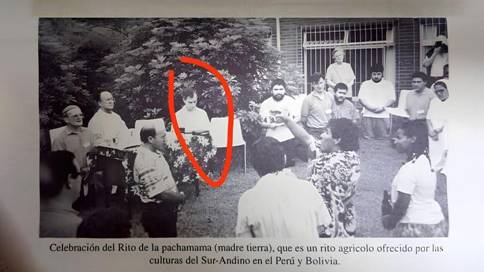 The story was first brought to light by Fr. Murr, who has spent months
meticulously compiling documentation for his upcoming book on Leo XIV. Three
Augustinian priests have now independently confirmed to Fr. Murr that Robert
Prevost is clearly visible among the kneeling participants in the central
photograph. Although none of the three were present at the 1995 ritual itself,
they immediately and unmistakably recognized their confrere from the published
image.
The story was first brought to light by Fr. Murr, who has spent months
meticulously compiling documentation for his upcoming book on Leo XIV. Three
Augustinian priests have now independently confirmed to Fr. Murr that Robert
Prevost is clearly visible among the kneeling participants in the central
photograph. Although none of the three were present at the 1995 ritual itself,
they immediately and unmistakably recognized their confrere from the published
image.
The image
appears in the official proceedings of the IV Simposio-Taller
“Lectura de San Agustín desde América Latina” (São Paulo,
January 23-28, 1995), published as the book Ecoteología: Una
Perspectiva desde San Agustín (México, 1996). The
official caption beneath the photo of kneeling participants reads:
Celebración del Rito de la pachamama (madre tierra), que
es un rito agrícola ofrecido por las culturas del Sur-Andino en el Perú y
Bolivia.
Celebration of the Rite of Pachamama (Mother Earth),
which is an agricultural rite offered by the cultures of the South-Andean
region in Peru and Bolivia.
The same
volume includes a large group photograph explicitly captioned “Foto
de todos los participantes del Simposio Sao Paulo Brasil,” placing the future Pope squarely among the attendees of an event
that openly celebrated the Pachamama ritual as part of its “ecotheology”
program.
Fr. Murr told Faith
& Reason: “The man who is now Leo
XIV was documented kneeling in a pagan earth goddess ritual in an official
gathering of his own religious order. The implications for the direction of the
Church under this pontificate are profound.”
Fr. Murr has
obtained high-resolution scans of the proceedings (including the clear kneeling
Pachamama photograph) from the Salesian Central Library in Buenos Aires,
Argentina (stamped call number 276.04 ACU :504 / 30.161, Biblioteca
Central Salesiana, No. 30161).
Yet another
photo from the event, showing all the participants of the symposium, also
confirms Prevost’s attendance.
LifeSite
confirmed the photos of Leo at the ritual were in fact him by comparing images
from the same period found in the Augustinian Spanish-language magazine OALA, where he is named “Roberto Prevost.”
On the Faith
& Reason episode today, Fr. Murr noted
how this violates the First Commandment and how the martyrs of the Church gave
their lives rather than participate even slightly in ceremonies to false gods.
COMMENT: Everyone
has know that Leo/Prevost was cut from the same cloth as Francis/Bergoglio: they
are both worshipers of the pagan earth goddess, Pachamama. And every faithful
Catholic knows that "All the gods of the gentiles are devils" (Psalm
95:5). And every faithful Catholic who is familiar with knows that the
punishment of God that is now upon us will soon cleanse His Church of all the
devils and their worshipers.
Pope Leo, like his
predecessor Francis, is a member of the "gay mafia," a Defender of
the Homosexual Heresy
The Homoheresy
in the Church Today -- Benedict XVI Established a Clear Ban for Their
Ordination
Homoheresy is
the Rejection of the Church's Teaching on Homosexuality
Introduction / Translation: Giuseppe Nardi
(Rome) The Polish Catholic journal Fronda several years abo published a
long essay, which was also taken up by the German Catholic
journal Theologisches. The subject of the review was the
"Homohäresie" and the existence of a "gay mafia" in the
Catholic Church. The author described the existence of a network of homosexual
priests at all levels of the Church hierarchy, including the Roman Curia, who
cover for each other.
The author of the explosive essay is the Polish priest Fr. Dariusz Oko,
assistant professor of philosophy at the Pontifical Theological Academy
of Cracow and the Pontifical University of John Paul
II of Krakow and pastor at St. Hedwig's parish in this city. In his
essay, Oko recalled that more than 80 percent of the so-called pedophilia cases
of clerics in the US are in reality cases of ephebophilia and are aimed at male
adolescents. The numbers coincide with those of the CDF, which speaks of
90 percent, facts that had been systematically suppressed in
public. "Factual investigations show that the extent of the problem
in the Catholic Church is still the lowest. Why then is she the one mainly
spoken of? According to research, in a thousand cases of pedophila
or ephebophilia there is only one is related to the Catholic Church in the
United States, about 3-5 per ten thousand," says Oko in Theologisches (42)
9-10/2012.
However Fr. Oko also showed the difficulties of priests and
seminarians, who oppose the homosexual network in the church: "If the
rector or other supervisor try to expel one, then it may be that they
themselves are expelled and not the homo-cleric. Or should a vicar try to
defend young people from the parish from a priest who commits sexual assault,
he is harassed, disciplined and treated and not the priest, because the
decisions makers to whom they refer, are themselves part of the gay lobby."
"If some indiscretions are verified, which is leaked from
the Vatican palaces, it would be an international network with hundreds of
clerics of all rank levels," said the Vatican expert Marco
Tosatti. Tosatti conducts an interview with, Dariusz Oko on this
subject. The pontificate of Benedict XVI was kept under continuous
bombardment with the pedophile scandal. With the new pontificate it was
"completely forgotten", says Tosatti.
Marco Tosatti: Two
years ago you had mapped the situation in the Church in your thorough
study. Has something changed since then?
Fr. Dariusz Oko: Certainly
my study has touched on a widespread problem that exists almost
everywhere. Only in this way can it be explained that they made the rounds
around the world within a few weeks. In many countries, translations were
made: from English to German, Italian and Czech, Slovak and Estonian ... It
seems to me that the problem is addressed in my study is perceived more
consciously.
Marco Tosatti: You
talk in your work of Homoheresy. What are their characteristics?
Fr. Dariusz Oko: The
Homoheresy is a rejection of the Magisterium of the Catholic Church on
homosexuality. The representatives of Homoheresy do not accept that the
homosexual inclination is a personality disorder. They doubt that
homosexual acts are unnatural. The defenders of Homoheresy are for the
ordination of homosexuals. The Homoheresy is an ecclesiastical version of
homosexualism.
Marco Tosatti: In
2005 the Congregation for Catholic Education published an important document
by Pope Benedict XVI that prohibits the ordination of
homosexuals. Why this document?
Fr. Dariusz Oko: Since
the 70s of the 20th century, a new type has entered in many seminars and
monasteries around the world, who view human sexuality contrary to the
traditional teaching of the Catholic Church on homosexuality. The
consequence was that it started on all continents in so many diocesan
seminaries and monasteries, to represent the idea that there are two equivalent
sexual orientations: a heterosexual and a homosexual. Thus, it was that
clerics were only chaste, to be understood as abstaining from unclean actions,
and demanded the ability to live celibacy, without further asking about
their sexual orientation or their inclinations. In this way, it became
necessary to define homosexuality as an inclination and personality structure
explicitly as an objective obstacle to the ordination.
Marco Tosatti: Was
this requirement from 2005, which prohibits the priesthood for homosexuals,
used to your knowledge?
Fr. Dariusz Oko: I
am not responsible for training at seminaries. Therefore, I do not know
how this ban is handled in different countries. This question should be
directed to those responsible for the formation of future priests.
Marco Tosatti:
Since you have published your survey, the Pope has changed. Do you see any
difference in attitude between the two popes in connection with the problem?
Fr. Dariusz Oko: It
is difficult to speak of any difference. Fundamentally, the Magisterium of
the Catholic Church does not change and the forbids the ordination of
homosexuals. The Magisterium in force led to a contrast to previous
distinction between active and passive homosexuality a distinction between a
temporary homosexual inclination, which occurs in late puberty, and the
deep-rooted inclination. Both forms of homosexuality and not only active
homosexuality represent an obstacle for the priesthood. Homosexuality is
incompatible with the priestly vocation. Therefore, not only the
ordination of men with homosexual inclination, even if only temporarily, is
strictly forbidden, but their admission to the seminary as well.
Anti-Semitism’s
“Working Definition”
The International Holocaust Remembrance Alliance (IHRA) (until January 2013, known as
the Task Force for International
Cooperation on Holocaust Education, Remembrance, and Research or ITF) is
an intergovernmental organization founded in 1998 which unites governments and
experts to strengthen, advance and promote Holocaust education, research and
remembrance worldwide and to uphold the commitments of the Declaration of the
Stockholm International Forum on the Holocaust. The IHRA has 34 member
countries, one liaison country and seven observer
countries. (Wikipedia)
The IHRA’s working definition for
Antisemitism that has been adopted by member countries:
“Antisemitism is a certain perception
of Jews, which may be expressed as hatred toward Jews. Rhetorical and physical
manifestations of antisemitism are directed toward Jewish or non-Jewish individuals
and/or their property, toward Jewish community institutions and religious
facilities.” Such as:
· Denying the Jewish people their right to self-determination, such as by claiming that the existence of a State of Israel is a racist endeavor.
·
Applying
double standards by requiring of Israel behavior not expected or demanded of
any other democratic nation.
· Comparing contemporary Israeli policy to
that of the Nazis.
This
“working definition,” although worded a little differently in light of their differing
perspectives, is very close to the definition coined by Joe Sobran who said: “An
anti-Semite used to mean a man who hated Jews. Now it means a man who is hated
by Jews.” The IHRA’s definition it not grounded on any objective standard but
solely on the subjective “perception of Jews.” You can expect this “working
definition,” which has been adopted by U.S. government agencies to work its way
into the United States legal code notwithstanding any legal niceties such as
freedom of speech, equal protection under the law, etc. The Jewish religion is
a race base belief that Jews possess a special salvific relationship with God
because of their DNA irrespective of what they believe or what they do. Jesus
Christ was killed by the Jews in part because he told them that this was not
so. And like Jesus our Lord, the Catholic Church will necessarily fall under
this definition of Anti-Semitism as well. Soon enough, the Novus Ordo Church of
the New Advent will be calling faithful Catholics anti-Semites.
U.S.
Politics: Jewish revolutionary, Saul Alinsky, died 6-12-1972 and will soon be
celebrating his 54th year in hell. His book, Rules for Radicals,
enumerates twelve rules for effective political organization:
RULE 1: “Power is not only what you have, but what the enemy thinks you
have.”
RULE 2: “Never go outside the expertise of your people.”
RULE 3: “Whenever possible, go outside the expertise of the enemy.”
RULE 4: “Make the enemy live up to its own book of rules.”
RULE 5: “Ridicule is man’s most potent weapon.”
RULE 6: “A good tactic is one your people enjoy.”
RULE 7: “A tactic that drags on too long becomes a drag.”
RULE 8: “Keep the pressure on. Never let up.”
RULE 9: “The threat is usually more terrifying than the thing itself.”
RULE 10: “If you push a negative hard enough, it will push through and
become a positive.”
RULE 11: “The price of a successful attack is a constructive
alternative.”
RULE 12: “Pick the target, freeze it, personalize it, and polarize it.”
The
purpose of the “rules” is to impose the eight levels of control that must be
accomplished in the formation of a Godless socialist state.
1. Healthcare — Control healthcare and you
control the people.
2. Poverty —Increase the Poverty level as high
as possible:’ poor people are easier to control and will not fight back if you
are providing everything for them to live.
3. Debt — Increase the debt to an
unsustainable level. That way you are able to increase taxes, and this will
produce more poverty.
4. Gun Control— Remove the ability to defend
themselves from the government. That way you are able to create a police state.
5. Welfare — Take control of every aspect of
their lives (Food, Housing, and Income).
6. Education — Take control of what people
read and listen to — take control of what children learn in school.
7. Religion — Remove the belief in the God
from the government and schools.
8. Class Warfare – Divide the people into the
wealthy and the poor. This will cause more discontent, and it will be easier to
take (tax) the wealthy with the support of the poor.
The new kill
chain: America is using AI to bomb targets in Iran
ET Online |
Mar 07, 2026
 When
the US launched its military campaign against Iran, called Operation Epic Fury,
the conflict quickly became something more than a conventional war. The operation is emerging as one
of the most consequential real-world tests of artificial intelligence (AI) in
modern warfare.
When
the US launched its military campaign against Iran, called Operation Epic Fury,
the conflict quickly became something more than a conventional war. The operation is emerging as one
of the most consequential real-world tests of artificial intelligence (AI) in
modern warfare.
In the Iran campaign, AI
technology has played a critical role by supporting the initial screening of
incoming data, allowing human analysts to focus on higher-level analysis and
verification, according to Captain Timothy Hawkins, a Central Command
spokesperson. “Centcom uses a variety of AI tools, and that is exactly what
they are, tools, to assist human experts in a rigorous process aligned with US
policy, military doctrine and the law,” Hawkins said in an interview with
Bloomberg News. He
declined to name the tools or the companies that provide them to the military.
[.....]
“Bottom line, these tools help
leaders -- humans -- make smarter decisions faster. The tools do not replace
them or make targeting decisions,” said Hawkins, adding that target selection
relies on a very specific, rigorous, legal process that involves commanders and
leaders.
COMMENT: The primary company providing the AI
"tool" is Palantir. Palantir's CEO is Alex Karp, a Jewish Zionist,
who said in a recent interview, "What makes America special right now is
our lethal capabilities, our ability to fight war... and the AI revolution is
uniquely American." Karp said his company's tools are uniquely links the
"U.S. and Middle East partners that were hit by Iranian airstrikes."
That "Middle East partners" is Israel. This AI tool of Palantir was
responsible for identifying Gaza targets for the Israeli IDF which included
killing tens of thousands of women, children and the elderly. Karp vigorously
opposed the college protesters against the Gaza genocide calling their
views a "pagan religion" and "an infection inside of our
society." At the AI Expo for National Competitiveness, he remarked that
"the peace activists are war activists" and said that
"protestors should be sent to North Korea" (WIKI).
It is the AI tool of Palantir
that selected the mostly girls school in Minab, Iran as an acceptable target
that was struck by two Tomahawk missiles killing 164 adolescent girls, 14
teachers on the first strike and the killing rescue personal and volunteered
helpers on the second strike forty minutes after the first. The school is
adjacent to a military complex and most likely the children where the daughters
of military personal. A few hours after the Minab strike a missile struck a
girls gymnasium in Lamerd, Iran where "dozens of teenage girls were
attending their regular training sessions of volleyball, basketball, and
gymnastics in the main sports hall in Lamerd, a city near the Persian
coast" killing 18. Other targets include Shahid Bahonar Middle School,
Parand, Arian Pouya Elementary School, Parand, Kindergarten,
Narmak neighbourhood, and a Children's park
(called "Police Park"), Tehran. There are 13 hospitals and
other health facilities verified by the World Health Organization (WHO) that
were targeted by the US-Israeli attacks. Also struck by missiles were common
public facilities including Tehran Grand Bazaar, Ba'ath Stadium,
Tehran, and the Azadi sports complex, Tehran.
What is now evident is that the
U.S. is using Israeli programmed AI by Zionists to implement terror on the
Iranian people. These targets have no
military value. These attacks are total violations of Catholic moral teaching,
international law and U.S. law. Trump's war on Iran was launched without any
moral justification whatsoever and is being conducted without any moral
constraints.
JUST
WAR RULES
"It is not
to be doubted that the world is in a certain sense a single community, and
possesses the right to prescribe equitable and appropriate laws for its
members, like those which constitute the law of nations.... It is unlawful to
kill the innocent in war.... Slavery is not a legitimate consequence of war,
that hostages cannot rightfully be put to death because of a breach of faith by
an enemy.... The violators of
international law sin mortally as well in peace as in war and that it is not
lawful for any nation to refuse to observe the law of nations."
Fra Francisco
de Vitoria, O. P. notes from his lectures
Fra Francisco
de Vitoria, O. P., a Spanish Dominican friar, Father of International Law, held
the chair of theology at the University of Salamanca where he died 1546. Fra
Francisco is credited with establishing the Three Rules of a Just War developed
from the works of St. Thomas Aquinas and St. Augustine and applying them during
the Age of Exploration, which often became under the unscrupulous, the Age of
Exploitation. He accepted without question that legitimate armed defense of
property, life and honor, but taught that offensive war must fulfill the
conditions of being declared by the right authority, being carried out in the
right manner, and having a just cause.
The unprovoked
war against Iran started by Israel and the United States fails with respect to
every criteria.
It is, therefore,
a strict duty for every priest wanting to remain Catholic to separate himself
from the Conciliar Church for as long it does not rediscover the Tradition of
the Church and of the Catholic Faith.
Bishop Tissier
de Mallerais, January 1, 2015
Bishop
Williamson explains why the “XSPX,” is called the “New Society,” - “Novus
Societas”
"The Catholic Church is much broader than just the Traditional
movement. [….] We will never make Tradition attractive or convincing if we
remain stuck in the 1950’s or 1970’s. [….] Tradition cannot be confined within
the 19th and 20th century Church condemnations of liberalism. […..] Our time is
different, we cannot stand still, much that is modern is not immoral. […..] So
we must re-position ourselves, which is a practical problem and not a question
of Faith. […..] The “Resistance” movement has fabricated its own “faith” by
which to condemn the Newsociety.
[…..] SSPX HQ never betrayed Tradition
in 2012 because its actions were attacked from both sides. […..] The official Newsociety texts of 2012
were not dogmatic. […..] Rome was much less aggressive in 2012 to the XSPX than
it was in 2006. [……] The Newsociety
follows the Spirit and draws
on Tradition."
Fr. Niklaus Pfluger, SSPX First Assistant to Bishop Bernard Fellay,
critical comments addressing the “resistance” that has risen against the SSPX’s
accommodations with modernist Rome. Quotations taken from commentary by Bishop
Williamson
VATICAN
II COUNCIL: WHAT IS ITS AUTHORITY?
Vatican II Council was a "pastoral council." It was a council
of churchmen teaching by their grace of state. At no time before, during or
after the council did anyone ever teach anything by virtue of the Divine
Magisterium of the Church, that is, teach by the Holy Ghost. Every Catholic is
obligated to reject anything from this council that so much as equivocates or
undermines any Catholic dogma. The Vatican II Council is to judged by its
pastoral success or failures. The implementation of the pastoral corruptions of
this council have directly lead to the greatest apostasy in the history of the
Catholic Church. Those that claim that the "teaching of Vatican II"
is good are those whose intention is to destroy the Church.
"No
matter what may happen, since no one may justifiably command another to sin, and
since no one is permitted to obey such a command, no one may ever blame
another—even an errant pope—for his sins. Conversely, the failure of any
person—even the pope—to keep God's law or to preserve his own faith, does not
excuse any other person for his failure to do the same. Ignorance of the law or
ignorance of the Faith is never an excuse for sinning; one is bound to know
when he is being commanded to sin." -
Fr. James F.
Wathen, The Great Sacrilege
On Penance
St. Paul says: I beseech you to offer your bodies to God as a sacrifice
of mortification and penance, but in such wise that this sacrifice may be holy
and acceptable in His sight. That it may become so, he adds, this painful
sacrifice of mortification must be reasonable, that is, made with discretion
and without excess....
However, to the effect that penance may be discreet and reasonable,
conformably with the instruction left us by the Apostle of the Gentiles, it
must fulfill two conditions, according to the rules which the Holy Fathers have
prescribed for its practice. First, it should mortify the body, but not injure
the health. Secondly, it must not hinder our fulfillment of the duties attached
to our state of life. St. Basil expresses himself clearly in his Constitutions
as to the former of these conditions; he will have penance taken in a measure
proportioned to the strength of the body. Notice that by continence the holy
Doctor here means bodily austerities. We should imitate the camel, which kneels
to receive its burden, but which, when sufficiently laden, rises to its feet,
and refuses to take more. As St. Bernard says, the body must be afflicted by
penance in such degree as to prevent its unruly turning against the spirit; but
it is not to be disabled or annihilated, so as to hinder it contributing to the
exercise of the inner virtues, which are by far the most useful. St. Gregory
the Great is of the like mind, when he says that in the use of penance we
should keep within these bounds: we should not slay the flesh, but only its
unruly passions.
Rev. John Baptist Scaramelli, S.J., Guide
to the Spiritual Life
Because the
life of prayer and union with God is what I love most of all;
because I find it the most perfect; because it is a life of heaven, in a
certain way, since a Carmelite is concerned only with being united to God and
contemplating Him always and singing His praises. That thirst for prayer continually grows in
me; my recollection is always continuous now, because whatever I do, I do with
my Jesus and offer it to Him with love. When, for any reason whatever I am
unable to make my prayer, I suffer at not being able to be with my God.
The solitude of Carmel helps recollection. That isolation from
creatures helps Carmelites exchange with God alone and, as a result, to attain
greater union with Him, because this is the heart of perfection. I believe that
solitude won't tire me, as I'm always searching for it. I often become troubled
when dealing with creatures, because I’m with God when I’m alone.
The poverty of a Carmelite is very great. She can possess nothing,
which means that her whole capacity for possessing things is filled by God
alone. By being poor, she is made even more like to her Divine Spouse who had
nowhere to lay His head. A Carmelite must possess God alone.
The penance to which she submits herself and the austerity of her life
are a greater means of having her body made submissive to the soul in order to
become more like her Divine Spouse who became a victim for our sins. She does
penance for her own sins and for those of the world. And in this way she shows
her love for God who has filled her with so many favors.
Her sacrifice is perpetual, without mitigation, from the time her
religious life begins until she dies as a victim according to the example of
Jesus Christ. And she does all this in silence with no one aware of it. Yet how
many are there who think of this life as useless. Nevertheless, she’s like the
Lamb of God. She removes the sins from the world. She sacrifices herself to
bring back to the sheepfold those sheep who have gone astray. But just as
Christ did not know the world, neither does she know it. This abnegation
enchants me completely. There is no room for self-love. She doesn’t even see
the fruit of her prayer. In heaven alone will she know this.
The goal she proposes to herself is very great: to pray and sanctify
herself so that the divine sap may be communicated through the union that
exists between the faithful and all the members of the Church. She immolates
herself on the cross, and her blood falls on sinners, pleading for mercy and
repentance, for on the cross she is intimately united to Jesus Christ. Her
blood, then, is mixed with His Divine Blood.
All these consideration that I make, Father, are the ones that induce
me to prefer Carmel, since I believe that in that life, I will attain holiness.
I have chosen the Carmelite life because I see that, in choosing it, I will
find the cross; and I would travel, I believe, through the whole world with
God's grace in search of it and to possess it, because on the cross is Jesus
Christ.
Juana Fernández Solar (St. Teresa of the Andes), letter written at
fifteen years of age to a priest explaining why she wanted to become a
Discalced Carmelite nun.
Hermeneutics
of Continuity/Discontinuity
Modernist
Heresy
“The medieval concept of
substance has long since become inaccessible to us. In so far as we use the concept of
substance at all today we understand thereby the ultimate particles of matter,
and the chemically complex mixture that is bread certainly does not fall into
that category.” Benedict/Ratzinger, Faith and the Future
Catholic
Truth
If anyone does not confess that the world and all things which are
contained in it, both spiritual and material, were produced, according to their whole
substance, out of nothing by God; or holds that God did not create by
his will free from all necessity, but as necessarily as he necessarily loves
himself; or denies that the world was created for the glory of God: let him be
anathema
Vatican Council I, Dogmatic
Constitution on the Catholic Faith
Modernist
Heresy
“At this time the idea of salvation
history had moved to the focus of inquiry posed by Catholic theology and this
had cast new light on the notion of revelation, which neo-scholasticism had kept
too confined to the intellectual realm. Revelation now appeared no longer simply as a
communication of truths to the intellect but as a historical action of God in
which truth becomes gradually unveiled.”
Benedict/Ratzinger, Milestones
(Memoirs 1927-1977), published 1998
Catholic
Truth
For the doctrine of faith which God has revealed has not been
proposed, like a philosophical invention, to be perfected by human ingenuity;
but has been delivered as a divine deposit to the Spouse of Christ, to be faithfully
kept and infallibly declared. Hence also, that meaning of the sacred dogmas is
perpetually to be retained which our holy Mother the Church has once declared;
nor is that meaning ever to be departed from, under the pretext of a deeper
comprehension of them.
Vatican I
“Fourthly, I sincerely hold that the doctrine of faith was
handed down to us from the apostles through the orthodox Fathers in exactly the
same meaning and always in the same purport. Therefore, I entirely reject the
heretical misrepresentation that dogmas evolve and change from one meaning to
another different from the one which the Church held previously. I also condemn
every error according to which, in place of the divine deposit which has been
given to the spouse of Christ to be carefully guarded by her, there is put a
philosophical figment or product of a human conscience that has gradually been
developed by human effort and will continue to develop indefinitely.”
Oath Against Modernism
DOGMA
is the proximate "rule of faith"!
When
the Pope personally falls from the faith, the "Catholic religion (is
still) preserved ever immaculate in the Apostolic See" in her Magisterial
documents.
The first means of safety is to guard the rule of strict faith and to
deviate in no way from those things that have been laid down by the Fathers.
And indeed the words of Our Lord Jesus Christ: "Thou art Peter; and upon
this rock I will build my church" [Matthey 16:18], cannot be disregarded;
these things which were spoken are demonstrated by the results, for the
Catholic religion has been preserved ever immaculate in the Apostolic See.
Opening sentence of the "Formula Hormisdae", the decree of
Pope Hormisdas to the Eastern Churches that had followed the Acacian Schism,
516 A.D., for their correct profession of faith. The document was cited at
Vatican I.
Synod Office
releases first two Final Reports of the Study Groups
The General
Secretariat of the Synod publishes the first two Final Reports of the Study Groups
established by Pope Francis following the First Session of the XVI Ordinary
General Assembly of the Synod of Bishops: that of Study Group No. 3 on 'The
mission in the digital environment' and that of Study Group No. 4 on 'The
revision of the Ratio Fundamentalis Institutionis Sacerdotalis in a missionary
synodal perspective.'
Vatican News | March 3, 2026
 The General Secretariat of the Synod has
today released the first two Final Reports of the Study Groups established by
Pope Francis following the First Session of the XVI Ordinary General Assembly
of the Synod of Bishops.
The General Secretariat of the Synod has
today released the first two Final Reports of the Study Groups established by
Pope Francis following the First Session of the XVI Ordinary General Assembly
of the Synod of Bishops.
The reports published were that of Study Group No. 3 on 'The Mission in
the Digital Environment' and Study Group No. 4 on 'The Revision of the Ratio
Fundamentalis Institutionis Sacerdotalis in a Missionary Synodal Perspective.'
Pope Leo XIV has
directed the publication of these Final Reports to share with the entire People
of God the fruits of the reflection and discernment undertaken during the
Synod, in a spirit of transparency and accountability. The Final Reports
are published in English and Italian, with an indication of the original
language and the working translation.
A summary, available in various languages, accompanies each Report to
facilitate access. With the presentation of their Final Reports, Study Groups
No. 3 and No. 4 conclude their mandate and are therefore to be considered
dissolved.
The General Secretariat will continue to release the Final Reports
progressively, with the next publication scheduled for 10 March 2026.
Cardinal Mario Grech, Secretary General of the Synod, said that the
Reports, “beyond the value of their content," "testify to the shared
journey undertaken with the Dicasteries.
"It is not
the first time that the Dicasteries have collaborated on a common project, but
here," he added, "there is something more: an authentic exercise of
shared listening, reflection, and discernment. It is synodality put into
practice, not merely bureaucratic cooperation.”
The Mission in the Digital Environment
The Report of Study Group No. 3 addresses a central question that
emerged during the XVI Assembly, namely how to live the Church’s mission within
a culture increasingly shaped by the digital sphere.
The Group, drawing on a broad consultation involving pastoral workers,
experts, and ecclesial realities from all continents, gathered experiences,
analyzed challenges, and formulated concrete recommendations.
Key themes include
the need to integrate digital mission into the Church’s ordinary structures, an
in-depth analysis of territorial jurisdiction in light of online communities,
and the formation of pastors and pastoral workers in digital culture.
The Report concludes with a series of operative proposals articulated
at three levels: the Holy See, Episcopal Conferences, and dioceses. It also
includes an extensive section on the methodology adopted and the entities
consulted.
Formation to the Priesthood
Rather than proceeding with a revision of the Ratio Fundamentalis
Institutionis Sacerdotalis (2016), which is still considered valid in its
fundamental principles, Study Group No. 4 opted to elaborate a Proposal for a
Guiding Document for its implementation in a missionary synodal key, in line
with the Final Document of the XVI Assembly.
The document is
structured in two parts. The Preamble offers an ecclesiological-pastoral
framework and identifies a series of necessary conversions in priestly
formation: relational, missionary, toward communion, toward service, and toward
a synodal style. At its heart lies a central insight: the identity of the
priest is formed “in and from” the People of God, not in separation from it.
The Guidelines in the second part translate these conversions into
concrete operative pathways.
Some of the most
significant proposals include alternating residence between the seminary and
parish communities or other ecclesial contexts; shared formative experiences
and moments with lay faithful, consecrated persons, and ordained ministers,
starting from the propaedeutic stage; the inclusion of qualified and competent
women as co-responsible at all levels of formation, including within formation
teams; and the acquisition of skills for co-responsibility and communal
discernment.
The Group also proposed a pathway for the dissemination and
implementation of the operative directions offered.
Nature and publication of the Final Reports
Along with the Final Report of Study Group No. 3, the General
Secretariat also published a Note outlining the origin and mandate of the Study
Groups, the nature of the Reports, and the envisaged operational follow-up.
In the note, it highlights that the Final Reports are the fruit of a
structured process: the listening to diverse competencies and professional
expertise, the analysis of numerous contributions, academic research, dialogue
with various ecclesial bodies, from Episcopal Conferences to Catholic
universities, and, above all, discernment and prayer.
They are to be understood as working documents.
Pope Leo XIV, has directed that the Final Reports be published
progressively, as they are presented to the General Secretariat of the Synod,
in a spirit of transparency.
In order that the content that has emerged may be translated into
concrete orientations, decisions and processes, the Holy Father has requested the
competent Dicasteries and the General Secretariat of the Synod to draw up, on
the basis of the Final Reports, operative proposals, also giving an
account of the choices made and of any elements not received.
This joint effort, the General Secretariat's note continues, ensures
coherence with the synodal dynamism and rootedness in the Church’s missionary
perspective.
The operative proposals thus formulated will be submitted to the Holy
Father, who will evaluate and may approve them.
With the submission of the Final Report to the General Secretariat of
the Synod, the Study Groups that have delivered it conclude the mandate
entrusted to them and are therefore to be considered dissolved.
COMMENT: This article is reproduced as a penitential offering for Lent. It
is a collection of bureaucratic drivel but its purpose is in fact malignant.
Vatican II, the pastoral council, that from a faithful Catholic's perspective
is a pastoral failure because since its implementation the Church has suffered
the greatest apostasy in the history of the Church. For Leo, the Vatican II
Council is in fact a wonderful success because his purpose is the destruction
of the Church. That is why for the Novus Ordites, Vatican II Council
"cannot be questioned." The important point of this publication on
Synodality is the fundamental change in the conception of the priesthood. The heart of the Catholic priesthood is
nicely summed up by St. Paul:
For every high priest taken from among men, is ordained for men in the
things that appertain to God, that he may offer up gifts and sacrifices for
sins: Who can have compassion on them that are ignorant and that err: because
he himself also is compassed with infirmity. And therefore he ought, as for the
people, so also for himself, to offer for sins. Neither doth any man take the
honour to himself, but he that is called by God, as Aaron was. So Christ also
did not glorify himself, that he might be made a high priest: but he that said
unto him: Thou art my Son, this day have I begotten thee.
As he saith also in another place: Thou art a priest for ever,
according to the order of Melchisedech. Who in the days of his flesh, with a
strong cry and tears, offering up prayers and supplications to him that was
able to save him from death, was heard for his reverence. And whereas indeed he
was the Son of God, he learned obedience by the things which he suffered: And
being consummated, he became, to all that obey him, the cause of eternal
salvation. Called by God a high priest according to the order of Melchisedech (Heb 5;1-10).
There is nothing from St. Paul that calls for a "necessary conversions in priestly formation:
relational, missionary, toward communion, toward service, and toward a synodal
style." Don't forget that the Novus Ordo "missionary"
believes that proselytism is "solemn nonsense" and therefore, a Novus
Ordo "missionary" has no mission from God. There is nothing from St.
Paul that calls for "inclusion
of qualified and competent women as co-responsible at all levels of (priestly)
formation, including within formation teams; and the acquisition of skills for
co-responsibility and communal discernment" What is entirely absent from
the Novus Ordo synodal priest is his essence
and that is the power in "offering up gifts and sacrifices for sins."
The Novus Ordo priest is not "called by God, as Aaron was." He is not
called upon to share in the sacrificial priesthood of Jesus Christ that is in
its essence is a sacrificial and
sacrificing priesthood. This synodal intent in ordination cannot make a man a
priest any more than it can make a lady priestettes.
Explains
why Newman is now a "Doctor" of the Novus Ordites
He (Henry Cardinal
Newman) was led into his error by the false philosophy of the age, which
asserts that the mind apprehends truth only under subjective forms, and by
his Protestantism, which misapprehends the real character of those new
definitions and further explications of the faith opposed by the Church to
novel heresies and errors as they arise (i.e.:DOGMA). Confounding the
simple belief of the truth with the intellectual process of comprehending it,
he fell into the mistake of supposing that heresy has always an honest origin,
that it always springs from the necessary and laudable effort of the mind, an
effort which every true believer must make, to ascertain and comprehend the
truth, and that it always presupposes the faith on the point it contradicts was
previously unknown even to the pastors of the Church; — a sad mistake, for the
Church has never hesitated as to the faith to be opposed to the novel heresy,
which proves that she knew it prior to the heresy, and the heresy never
originates in ignorance of the faith or in an honest endeavor to ascertain it,
but in the desire to establish a favorite theory, or to follow one's own
private judgment.
Orestes Brownson,
on the fundamental err of Cardinal John Henry Newman, who Modernist Heretics
regard as their principle inspiration, from Newman's theory, written as a
Protestant, Essay on the Development of Christine Doctrine
The
SINS of the Novus Ordo Church:
Characterized
first and foremost by its SINS against the Theological Virtues and its SINS
against the Virtue of Religion - the most Malicious of all SINS because they
have God as their direct objects!
From a theological point of view, evils may be divided into two classes
: Voluntary evils (Sins) and Involuntary evils (Pain and Suffering). The evils
of the first class are really "the" evil, that is, objects to be
avoided and hated. They are also the greatest evils, because they injure at the
same time their own author and the Author of nature. God cannot cause, but only
permit and oppose them. The evils of the second class are only evils of the
subject which naturally abhors them, yet they are not so detestable as to be
avoided in all cases. God may cause them and use them as means to His ends;
notably, as a penalty for sin. In the original order established by Him, there
was no room for evils of this class. They came into the world with sin. As a
matter of fact, then, all evils existing in this world spring from sin, the
greatest and original evil. Hence the above division is equivalent to another
which distinguishes "Evils of Guilt" and "Evils of Penalty"
(mala culpae, mala poenae). Many
evils may, however, be at the same time a guilt and a penalty. Sin in its
theological and proper sense, consists in the conscious and voluntary
transgression, lesion, or denial of the moral order imposed upon the creature
by Divine Law. The philosophical notion of sin does not contain the element of
Divine command. What to the theologian is a voluntary transgression of the law
of God is looked upon by the philosopher as a transgression of the rational and
natural order. Yet even in sound philosophy the notion of sin ought not to be
dissociated from disobedience to the Lawgiver, for sin is always an action
against the dictates of conscience, and these are but the commanding voice of
God (Rom. ii. 14-16).
Hence the essence of sin consists in the more or less express
opposition of the human will against the Divine Will, an opposition which
implies a certain neglect or contempt of the Divine Will itself. This contempt
involves an "aversion from God as the ultimate End," that is, a
refusal of the submission and love which are His due. Sin averts or turns away
the creature from God as the Highest Good in Himself, and from God as the
Highest Good of the creature itself, in Whom alone it can find perfect
beatitude. It seeks outside God a satisfaction or pleasure incompatible with
the possession and fruition of God. On God's side, the contempt of His will by
the creature constitutes an offence and an insult, according to the saying,
"The lawbreaker offends the lawmaker." And this offence always
includes an "injury;" that is, it injures or damages the external
glory of God. For this reason, Holy Scripture describes sin as injustice, and
iniquity. Again, sin being always committed under the very eyes or in the face
of God, it must needs excite His displeasure, abhorrence, indignation, and
anger. These affections in God are not accompanied by the same feelings as in
man, yet they exist in Him eminently; and it is not the defect of malice in
sin, but God's own immutability, which prevents Him from being affected with
infinite pain by the sinner. In
sins against the theological virtues, and against the virtue of religion, the
aversion and offence assume a direct character, because God is the immediate
object of these virtues. Sin is clearly the greatest of evils — and an
absolute evil, because it deprives the Greatest and Absolute Good of the honour
due to Him.
Scheeben's Manual of Catholic Theology by Rev. Joseph Wilhelm, D.D.,
Ph.D. and Rev Thomas B. Scannell, D.D.
Separation
of Church and State is impossible. Every
state has an established religion with a creedal profession containing articles
of faith that it demands its citizens profess.
These articles of faith cannot be proven to be true or even demonstrated
as consistent with natural law. The
U.S.A. is no exception to this rule. We have a state religion but it is called
by another name. The secular dogma,
‘Separation of Church and State’, is nothing more than a tool to prevent
competition against the state religion in the public forum. The state demands a “faith” in “general
values” that are always “relative and changing.”
All organization is action and all action is rude. […..] There is a
hierarchy of values which have been expressed in nearly every revolutionary
slogan in history…. These values are up
on top. The democratic way of life is nothing more than a process, a device, a modus operandi, designed as the best
way, we believe, of achieving those values, of growing into them so to speak.
Now, those values that I have mentioned cannot be discussed, they cannot be
argued, they cannot be debated, they are articles of faith. [..…] In a free and
open society, equality is a value you cannot discuss or debate or put on a
ballot. If you do not accept our values then you can have no voice in a
democratic process. Then get out of our system and go someplace else. [……]
These values and goals, out of necessity, are always stated in general
terms. Every literate revolutionary
knows that you cannot be any more than general (in your) terms because all
values are relative and are changing.
Saul Alinsky, Jewish revolutionary, explaining the ‘religion’ of the
modern democratic state, 1/17/69, UCLA
Society
has already reached a sense of being “defeated” and “futureless.” The Novus Ordo Church is an essential cause
and contributor to this sense rather than a light of hope of union with Jesus
Christ!
[You must help] the people in the community… feel so frustrated,
so defeated, so lost, so futureless in the prevailing system that they are
willing to let go of the past and chance the future. [An] organizer must
shake up the prevailing patterns of their lives –agitate, create disenchantment
and discontent with the current values, to produce, if not a passion for
change, at least a passive, affirmative, non-challenging climate. [You
must] fan the embers of hopelessness into a flame of fight.
Saul Alinsky, Rules for Radicals
Traditionalist
Catholic group doubles down on illicit consecrations, setting course for
potential schism
Vatican News |
Vatican City | Justin McLellan | February 19, 2026
 The traditionalist Catholic society long a
thorn in the side of the Vatican will move forward with plans to create its own
bishops without approval from the pope. The plan escalates its standoff with
Rome and sets the group on a path toward an outright break from the Catholic
Church.
The traditionalist Catholic society long a
thorn in the side of the Vatican will move forward with plans to create its own
bishops without approval from the pope. The plan escalates its standoff with
Rome and sets the group on a path toward an outright break from the Catholic
Church.
The Feb. 19 announcement marks the latest turn in a back-and-forth
between the Society of St. Pius X and the Vatican that sought to avoid a
full-blown rupture between the two. Now, the situation poses a major test for
Pope Leo XIV, who has made church unity a priority of his pontificate.
Fr. Davide Pagliarani, superior general of the Society of St. Pius X,
said in a letter that the society would not postpone its announced bishop
consecrations. The letter was sent to Cardinal Víctor Manuel Fernández, prefect
of the Dicastery for the Doctrine of the Faith, which oversees the Vatican's
relationship with the group.
The two met one-on-one on Feb. 12 to discuss a resolution to the
society's threat of consecrating new bishops in defiance of Rome.
In their meeting, the cardinal offered to engage in a theological
"path of dialogue" with the society to establish "the minimum
requirements necessary for full communion with the Catholic Church" on the
condition the society suspend their planned episcopal consecrations.
Notably, Fernández met with the pope on Feb. 19, the day the letter was
made public.
The Society of St. Pius X has long operated in a canonical gray zone.
While its priests have been granted faculties in certain cases, including
permission for the valid administration of confession and marriage, the society
continues to function without full canonical recognition and in open defiance
of church authorities.
Pagliarini wrote that the society is not seeking canonical regularity
in the church,which he said "in the current state of affairs, is
impracticable due to doctrinal divergences."
The Society of St. Pius X, which counts 733 priests worldwide according
to its latest figures, rejects key teachings of the Second Vatican Council.
That includes the church's teaching on interreligious dialogue and the
postconciliar liturgical reform promulgated in 1970 and now celebrated by
nearly all Latin-rite Catholics.
Among the topics Fernández proposed for discussion with the Society of
St. Pius X were "the different degrees of assent required by the various
texts of the Second Vatican Ecumenical Council and their interpretation."
In response, Pagliarani wrote that the society and the Vatican
"cannot agree doctrinally" in light of the insistence that "the
texts of the Council cannot be corrected, nor can the legitimacy of the
liturgical reform be challenged."
The society's decision sets up a direct confrontation with the Vatican
ahead of its planned July 1 bishop consecrations, a move widely interpreted as
an attempt to pressure Rome into addressing the Society of St. Pius X's
shrinking number of bishops. [......]
COMMENT:
It is unfortunate that the SSPX is incapable of effectively defending
the Catholic Faith against the Neo-Modernists that control the Vatican. It is
absurd to say, "we 'cannot agree doctrinally' in light of the insistence
that 'the texts of the Council cannot be corrected, nor can the legitimacy of the
liturgical reform be challenged.'" It is not a question of exchanging
legitimate theological opinions on open questions. It is question defending the
faith against the claims of heretics. Vatican II and the Novus Ordo communion
service are heretical. SSPX should confront aberrant theological opinions and
the corruption of divine worship of the Neo-Modernists with Catholic dogma.
They should begin by asking how is it possible that a pastoral council of
churchmen teaching merely by their grace of state that called everything in the
Church into question itself cannot be questioned, especially when its
implementation has caused the greatest destruction of faith and worship in the
history of the Church? Their reason for this is no mystery. It is perfectly
legitimate to conclude that the destruction of the Church is the intention of
the Neo-Modernists. That is why they will not question Vatican II is because,
in their estimation, it is magnificent success! It is doing exactly what it was
intended to do.
Pope Leo has begun a series of Vatican II "catechesis." The
most recent on February 18 was on the document, Lumen gentium, the constitution
on the Church, and subtitled, "The
mystery of the Church, sacrament of the union with God, and the unity of all
humanity," wherein he cited this Lumen gentium teaching:
"The Church
is in Christ like a sacrament or as a sign and instrument both of a very
closely knit union with God and of the unity of the whole human race."
Vatican II, Lumen Gentium
Is this true? No it is not. The Church is the Mystical Body of Christ. This is an identity and it is heresy to obfuscate this truth by claiming, as Lumen Gentium did, that the "Mystical Body of Christ subsists in the Catholic Church" implying there are other members of the Church of Chrst that are not Catholics. The members of the Catholic Church, and therefore, the Mystical Body of Christ, profess the one, holy, Catholic, and Apostolic faith; they have, while professing this faith, by the sacrament of Baptism been made members of this Body; and they as members of this Body are subject to her ecclesiastical superiors. Those that have not been baptized are not members of the Church; those that are baptized and reject the truths revealed by God are apostates and/or heretics and are not members of the Church; those that reject the universal jurisdiction of the pope are schismatics and are not members of the Church. The Church is NOT a "sign.... of a very close knit union.... of the whole human race" because the "whole human race" is not a member of the Church. There is no salvation outside the Catholic Church. Those members of the "whole human race" who reject the Catholic faith stand only in potentia to this membership and the possibility of salvation. The duty of the pope is to preach the gospel message for the purpose bringing those in potentia to membership in the Church to being members in actu. This is why for the post Vatican II Novus Ordo popes proselytism is "solemn nonsense" because if the "whole human race" is somehow already united to the Church they do not need to be converted. Pope Leo in affirming this corrupt pastoral opinion from Vatican II is joining himself with its heresy, and as St. Thomas made perfectly clear, "all heretics are schismatics." Furthermore, it is an absurdity, a violation of the first principles of the understanding, to affirm that disobedience to the pope who is a heretic, and therefore a schismatic, is a schismatic act! It would be to claim that a schismatic pope makes the entire Church schismatic.
For
the Indult Catholic Community: This is who they are dealing with!
Is church
unity worth a Latin Mass?
 Religion News Service |Thomas Reese | February 6, 2026
"Paris is well worth a Mass" was reportedly the attitude of King
Henry IV when he was trying to secure the French throne. As a result, he
converted from Protestantism to Catholicism in 1593.
Today, the Eucharist, which is supposed to be the sacrament of unity,
is too often a battlefield between Catholics who support the Traditional Latin
Mass and those who want to see it disappear. Both sides need to ask themselves
whether the fight is worth something more important than Paris: the unity of
the church.
You must be my age to remember before the Second Vatican Council, when
the liturgy was entirely in Latin in Catholic churches, except in those using
Eastern Rite liturgies, where it was often in Greek. In Rome, it had been
changed from Greek into Latin in the third and fourth centuries so the common
people could understand it — a pragmatic decision, not a theological one.
When I was young, we took it for granted that the Mass was in Latin. It
was something that made us different from Protestants. We could go to the same
Mass anywhere in the world. The Scripture readings were in Latin, although on
Sunday the priest would reread the Gospel in English before giving his sermon.
Otherwise, unless you had a translation, you had no idea what the readings
were.
The Eucharistic prayer was the priest' s prayer, which he said with his
back to us. The altar boy would ring the bells to notify us when the priest
raised the host and chalice for us to adore. The bell also rang to call us to
Communion.
Other than that, the priest did his thing and the congregation
passively watched or prayed in silence.
In high school from 1958 to 1962, I had a St. Joseph's Missal with
Latin on one side of the page and English on the other so that I could follow
what the priest was praying when I went to daily Mass, but that was not the
norm. My parents had prayerbooks they read during Mass that had no connection
to what the priest was doing. Others in the church silently said their rosaries
during Mass.
And prior to the 20th century, Communion was infrequent. My parents
were among the first children allowed to go to Communion. Those who want to bring back the
Tridentine liturgy, if they want to be truly traditional, should go to
Communion less frequently and not allow their children to go to Communion.
Otherwise they are accepting early 20th-century innovations.
Although I entered the Jesuits prior to the Second Vatican Council and
went through a very traditional novitiate, I did not find the liturgical
changes difficult to accept. Our
conservative novice master taught us a course on the history of the Mass using
Josef A. Jungmannn's "Mass of the Roman Rite," which was published in
English in 1951. It taught us that the Mass was always changing throughout
history.
The transition was
also made easier by our traditional novitiate's emphasis on obedience. If the
church decided to change the liturgy, we were to accept it without question. To
do otherwise would be disobedient.
The Jesuits in
charge of formation were no help during the transition. They were clueless
about what was happening. The classics professors argued about how we
should pronounce "Amen" in English. The first time our superior said
the Eucharistic prayer in English, he got as far as the institutional narrative
and switched to "Hoc est enim corpus meum." The next day, he was able
to do it all in English.
Some of my
classmates had problems with the transition. Before ordination in 1973, one
confessed that it just wasn't the same because in the old church, after
ordination, he would be allowed to touch the consecrated bread for the first
time. Now anyone could receive Communion in the hand. It was as if part of his
priesthood had been taken away.
But for the most
part, the liturgical changes were accepted and implemented with excitement and
joy. They were the most visible reforms of Vatican II. And after a bit
of confusion, they were accepted overwhelmingly by Catholics in the pews.
But there were two
groups of holdouts.
First, there were
those who found the change difficult because they were used to the old ways and
the reforms were not well explained. Popes Paul VI and John Paul II wanted to
deal with these people with pastoral sensitivity and patience, but the popes
made clear that eventually, the old Mass was to fade away.
The other group of
holdouts was more problematic. They objected to the new liturgy in principle
and felt it was blasphemous. In truth, these ideologues objected to all the
reforms of the council, not just liturgy. They were divisive and contentious.
Some of these
dissenters were led into schism by French Archbishop Marcel Lefebvre, despite
all the Vatican's efforts to appease him. To undermine Lefebvre and win
back schismatics to the church, the Vatican permitted more frequent celebration
of the Traditional Latin Mass. This strategy was partially successful, as
exemplified by Priestly Fraternity of St. Peter, which celebrates the old Mass
but is in unity with the pope.
But there was an
unanticipated side effect: Some who grew up after Vatican II began to attend
these Latin Masses. Most were not ideologues, but pious, theologically
unsophisticated Catholics who were attracted by the ritual and mysterious
ceremony that allowed them to focus on adoration and private prayer without the
distraction of communal participation.
It is a mistake for liturgical reformers to lump this third group in
with the ideologues who reject Vatican II. These are good, devout people who
want to come closer to Jesus and find spiritual nourishment in the old liturgy.
Their existence is a
result of our failure to better explain the reforms and to make the new liturgy
more appealing to them. We should have encouraged them to go to Benediction and
explained how it is different form Mass.
Pope Benedict XVI
erred in taking away the local bishop's control over the Latin Mass and allowing
any priest to celebrate the Traditional Latin Mass anywhere, any time. Pope
Francis erred in seeing only the ideologues and not the pious Catholics who
liked the old Mass.
Now, poor Pope Leo
XIV must figure out how to deal with this mess in a pastoral way that does not
empower the ideologues and affirms that the Traditional Latin Mass must
eventually fade away. This is why he gets the big bucks.
Leo should keep in
place the Francis mandate that seminarians are to be trained and ordained for
the reformed liturgy. If they prefer the old Mass, they should not be ordained.
On the other hand, Francis' ban on the Latin Mass in parishes could
have more flexibility. It might make sense to return the authority over this to
diocesan bishops, although some may prefer to blame the Vatican for not
allowing it. And yet, this is exactly the kind of issue that should be handled
in a synodal fashion at the local level. And diocesan bishops can more easily
determine whether those asking for the Latin Mass are pious Catholics or
ideologues, and respond accordingly.
In any case, I
would keep some limits on the availability of the Latin Mass. It should be
banned on major feasts like Christmas, Holy Week, Easter and holy days, so that
the entire community can gather for and take part in these feasts. And, the
Latin Mass should not be available every Sunday. Everyone should experience the
new liturgy on a regular basis, at least once a month, especially families with
children. If one totally rejects the reformed liturgy, then one is out of step
with the church.
Meanwhile, Leo
should relaunch liturgical reform. The 1998 English translation of the Roman
missal by the International Commission on English in the Liturgy should be
permitted. Individual prefaces should be written for each Sunday in the A, B
and C cycles of Scripture readings. New Eucharistic prayers that are more
scriptural should be written.
Henry IV compromised his faith to win Paris. Catholics of all stripes
should be able to compromise on the liturgy to maintain the unity of the
church. We must respect and love one another, despite our liturgical
differences. And everyone should know that we are Christians by our love, not
know that we are Catholics by our fights.
COMMENT: Thomas Reese, S.J., the author of this editorial,
is a progressive liberal Jesuit who is about 81 years of age. His entire
religions life directly tied to liberal causes. For example, he is involved
with the Markkula Center for Applied Ethics at the Jesuit Santa Clara
University which holds as a first principle the Vatican II humanistic
philosophy of the dignity of the human person which ends up in defending
abortion rights. He is also the former editor-in-chief from 1998 to 2005 of the
Jesuit magazine America. The Jesuit
order he is a member of during his religions life has become largely a
homosexual collective.
His recounting of his liturgical formation is interesting. He was
formed by his Jesuit novice master at the beginning of Vatican II. His novice
master, using Josef Jungmann, S. J. as his authority, is credited for his
liturgical views. Jungmann was a professor of pastoral theology in Austria who
wrote the two-volume The Mass of the
Roman Rite, Its Origin and Development. He held that the primary purpose of
the liturgy from the beginning of the Church was pastoral. He was active in the
liturgical reform with Rev. Annibale Bugnini from the beginning of the
liturgical commission in 1948. He envisioned a Novus Ordo Mass with a primary
pastoral purpose. He was largely a self instructed liturgical
"expert" who functioned as a peritus
at Vatican II and the major contributor
to its Constitution on the Liturgy.
Jungmann's idea of a pastoral liturgy was to return to the liturgical practices
around the 4th to the 6th century. Over the last 40 years beginning in the
1980s, there has been a tremendous amount of liturgical academic research and
publications as well as the reprinting of liturgical works. The upshot of this
is that Jungmann was exposed as a fraud selective picking and choosing
anecdotal historical elements that served his ideology and not the Catholic
faith or true liturgical development.
One example, he wrote that the ancient Roman rite was offered versus populum and not ad orientem. When real liturgical
scholars demonstrated his error he argued that versus populum may not be what was done but should be done now for
pastoral reasons. Msgr. Klaus Gamber made it clear in his work on the Roman
rite that this practice can be traced to Luther and the Protestant reformation
and nowhere before. Jungmann was an ecumenical ideologue and not ashamed to
publish lies if they helped his cause.
An ideology is a man conceived intellectual system pertaining to some
specific form of thought and/or action based upon human presuppositions that
are held be faith alone, that is, they cannot be demonstrated or proved. A
Catholic is not an ideologue because his presuppositions rest upon divine
authority. Reese, like the former Jesuit pope, holds traditional Catholics as
ideologues while it is Reese himself, like Francis/Begoglio, who is tied to a
hopeless, loosing, antiquated, boring ideology. Francis/Bergoglio is the only
one who ever tried to identify the "traditional" ideology as a form
of the Pelagian heresy. That was so
stupid it merited no intellectual exposition by anyone. Liberals like Reese
effectively deny original sin. They are faced with the reality of a fallen
human nature and thus constantly spend themselves on determining its causes and
proposing their remedies. Since their diagnosis excludes the need for divine
redemption and salvation, it is always wrong and their remedies always fail.
Yet the liberal never repents his folly. The failures are always attributed to
others who did not implement the plan with sufficient rigor, for sufficient
time, and with sufficient purity. They
never take responsibility for the ruin they cause in countless lives.
Reese is a shining example of this. He has been a Catholic religious
with the Jesuits from the beginning of Vatican II Council and standing in the
worst collapse in Catholic faith and morals in the shortest period of time
recommends a "relaunch" (of the) liturgical reform." The PEW
pole that Reese sites determined that only about 30% of those who identify as
Catholics believe in the dogma of transubstantiation. The purpose of the
American bishops poll was to bump these numbers up. They did this by avoiding
any technical terminology that would be found in a grade school catechism and
asking multiple questions to arrive at the conclusion that the respondent, who
were restricted to those who actually attended a weekly communion service, had
some sense of Catholic teaching. Reese is responsible for this as much as any
of his fellow religious and yet he still thinks his opinions have value! This
idiot will soon follow Francis/Bergoglio to his eternal judgment. At that
judgment the fruits of Vatican II and the Novus Ordo service will condemn him
because it is by these fruits that he is known. He will plead to the just Judge
that he was only being
"obedient" religious and anyway, since Francis/Bergoglio pointed out,
"time greater than space", he just did not have enough time to see
that things were going wrong? He will be told, 'No, space is greater than
time', for you, "time" is over and your "space" is awaiting
and prepared for you and it is not with the blessed.
Letter from
Father Pagliarani to Cardinal Fernández
February 19, 2026
Source: FSSPX News
Response of the General Council
of the Society of Saint Pius X to the Prefect of the Dicastery for the
Doctrine of the Faith.
Menzingen, 18 February 2026
Ash Wednesday
Most Reverend Eminence,
First of all, I thank you for receiving me on 12 February, and for
making public the content of our meeting, which promotes perfect transparency
in communication.
I can only welcome the opening of a doctrinal discussion, as signalled
today by the Holy See, for the simple reason that I myself proposed it exactly
seven years ago, in a letter dated 17 January 2019. At that time, the Dicastery
did not truly express interest in such a discussion, on the grounds—presented
orally—that a doctrinal agreement between the Holy See and the Society of Saint
Pius X was impossible.
For the Society’s part, a doctrinal discussion has always been—and
remains—desirable and useful. Indeed, even if we do not reach an agreement,
fraternal exchanges allow us to better know one another, to refine and deepen
our own arguments, and to better understand the spirit and intentions behind
our interlocutor’s positions—especially their genuine love for the Truth, for
souls, and for the Church. This holds true, at all times, for both parties.
This was precisely my intention in 2019, when I suggested a discussion
during a calm and peaceful time, without the pressure or threat of possible
excommunication, which would have undermined free dialogue—as is,
unfortunately, the situation today.
That said, while I certainly rejoice at a new opening of dialogue and
the positive response to my proposal of 2019, I cannot accept the perspective
and objectives in the name of which the Dicastery offers to resume dialogue in
the present situation, nor indeed the postponement of the date of 1 July.
I respectfully present to you the reasons for this, to which I will add
some supplementary considerations.
1. We both know in advance that we
cannot agree doctrinally, particularly regarding the fundamental orientations
adopted since the Second Vatican Council. This disagreement, for the Society’s
part, does not stem from a mere difference of opinion, but from a genuine case
of conscience, arising from what has proven to be a rupture with the Tradition
of the Church. This complex knot has unfortunately become even more
inextricable with the doctrinal and pastoral developments of recent
pontificates.
I therefore do not see how a
joint process of dialogue could end in determining together what would
constitute “the minimum requirements for full communion with the Catholic
Church”, since—as you yourself have recalled with frankness—the texts of the
Council cannot be corrected, nor can the legitimacy of the liturgical reform be
challenged.
2. This dialogue is supposed to clarify
the interpretation of the Second Vatican Council. But this interpretation is
already clearly given in the post-Conciliar period and in the successive
documents of the Holy See. The Second Vatican Council is not a set of texts
open to free interpretation: It has been received, developed, and applied for
sixty years by successive popes, according to precise doctrinal and pastoral
orientations.
This official reading is
expressed, for example, in major texts such as Redemptor hominis, Ut
unum sint, Evangelii gaudium, or Amoris
lætitia. It is also evident in the liturgical reform, understood in
the light of the principles reaffirmed in Traditionis custodes.
All these documents show that the doctrinal and pastoral framework within which
the Holy See intends to situate any discussion has already been firmly
established.
3. One cannot ignore the context of the
dialogue proposed today. We have been waiting for seven years for a favourable
response to the proposal of doctrinal discussion made in 2019. More recently,
we have written twice to the Holy Father: first to request an audience, then to
clearly and respectfully explain our needs and the real-life situation of the
Society.
Yet, after a long silence, it is
only when episcopal consecrations are mentioned that an offer to resume
dialogue is made, which thus seems dilatory and conditional. Indeed, the hand
extended to open the dialogue is unfortunately accompanied by another hand
already poised to impose sanctions. There is talk of breaking communion, of schism,
and of “serious consequences”. Moreover, this threat is now public, creating
pressure that is hardly compatible with a genuine desire for fraternal
exchanges and constructive dialogue.
4. Furthermore, to us
it does not seem possible to enter into a dialogue to define what the minimum
requirements for ecclesial communion might be, simply because this task does
not belong to us. Throughout the centuries, the criteria for belonging to the
Church have been established and defined by the Magisterium. What must be
believed in order to be Catholic has always been taught with authority, in
constant fidelity to Tradition.
Thus, we do not see how these
criteria could be the subject of joint discernment through dialogue, nor how
they could be re-evaluated today so as not to correspond to what the Tradition
of the Church has always taught—and which we desire to observe faithfully in
our place.
5. Finally, if a dialogue is envisaged with
the aim of producing a doctrinal statement that the Society could accept
regarding the Second Vatican Council, we cannot ignore the historical
precedents of efforts made in this direction. I draw your attention to the most
recent: the Holy See and the Society had a long course of dialogue, beginning
in 2009, particularly intense for two years, then pursued more sporadically
until 6 June 2017. Throughout these years, we sought to achieve what the
Dicastery now proposes.
Yet, everything ultimately ended
in a drastic manner, with the unilateral decision of Cardinal Müller, the
Prefect of the Congregation for the Doctrine of the Faith, who, in June 2017,
solemnly established, in his own way, “the minimum requirements for full
communion with the Catholic Church”, explicitly including the entire Council
and the post-Conciliar period. This shows that, if one persists in a
doctrinal dialogue that is too forced and lacks sufficient serenity, in the
long term, instead of achieving a satisfactory result, one only worsens the
situation.
Thus, in the shared recognition that we cannot find agreement on doctrine,
it seems to me that the only point on which we can agree is that of charity
toward souls and toward the Church.
As a cardinal and bishop, you are above all a pastor: allow me to
address you in this capacity. The Society is an objective reality: it exists.
That is why, over the years, the Sovereign Pontiffs have taken note of this
existence and, through concrete and significant acts, have recognised the value
of the good it can accomplish, despite its canonical situation. That is also
why we are speaking today.
This same Society asks you only to be allowed to continue to do this
same good for the souls to whom it administers the holy Sacraments. It asks
nothing else of you—no privileges, nor even canonical regularisation, which, in
the current state of affairs, is impracticable due to doctrinal divergences.
The Society cannot abandon souls. The need for the sacraments is a concrete,
short-term need for the survival of Tradition, in service to the Holy Catholic
Church.
We can agree on one point: neither of us wishes to reopen wounds. I will
not repeat here all that we have already expressed in the letter addressed to
Pope Leo XIV, of which you have direct knowledge. I only emphasise that,
in the present situation, the only truly viable path is that of charity.
Over the last decade, Pope Francis and yourself have abundantly
advocated “listening” and understanding of non-standard, complex, exceptional,
and particular situations. You have also wished for a use of law that is always
pastoral, flexible, and reasonable, without pretending to resolve everything
through legal automatism and pre-established frameworks. At this moment, the
Society asks of you nothing more than this—and above all it does not ask it for
itself: it asks it for these souls, for whom, as already promised to the Holy
Father, it has no other intention than to make true children of the Roman
Church.
Finally, there is another point on which we also agree, and which should
encourage us: the time separating us from 1 July is one of prayer. It is a
moment when we implore from Heaven a special grace and, from the Holy See,
understanding. I pray for you in particular to the Holy Ghost and—do not take
this as a provocation—His Most Holy Spouse, the Mediatrix of all Graces.
I wish to thank you sincerely for the attention you have given me, and
for the interest you will kindly take in the present matter.
Please accept, Most Reverend Eminence, the expression of my most sincere
greetings and of my devotion in the Lord.
Davide
Pagliarani, Superior General
+ Alfonso de Galarreta, First Assistant General
Christian Bouchacourt, Second Assistant General
+ Bernard Fellay,
First Counsellor General, Former Superior General
Franz Schmidberger,
Second Counsellor General, Former Superior General
COMMENT: Among Protestants there are a few doctrinal
positions that unite them all: They without exception profess that God did not
establish His Church with the divine attributes of infallibility,
indefectibility and authority. Beyond this level of agreement Protestants differ
radically from one another in doctrine, worship, and morality. The Protestant modus vivendi then is to respect the
errors of each other since none claim the attribute of infallibility regarding
truth in belief and practice. Christ's Church is altogether different. The
Church speaks with authority the truth of God's revelation and of this truth
will not be compromised one iota. The Novus Ordo Church, like all Protestants,
seeks an accommodation with the world and its lies. The only thing they hate
with one voice is the Catholic Church because it does not. G.K. Chesterton
said, 'The Catholic Church is intolerant in principle because she believes; she
tolerant in practice because she loves. The world is tolerant in principle
because it does not believe; it is intolerant in practice because it does not
love.' The Novus Ordo Church, like the Protestants, is of the world that Jesus
Christ said, "I pray not for the world" (John 17:9). It is complete
folly for the SSPX to beg from the Novus Ordites a tolerance in belief based
upon a charity in practice because without faith, there is, and never can be,
charity. The dialogue with the SSPX began in 1997 and will go on as long as the
SSPX stands upon opinion and not on God's revealed truth.
Hermeneutics of Continuity/Discontinuity
Explains why Novus Ordo Catholics have dumped the
season of Septuagesima and do not do penance for Lent – they have ‘dialogued’
themselves out of Original Sin!
Original Sin:
Benedict/Ratzinger teaches:
 The account (of Genesis 3) tells us that sin begets sin, and that
therefore all the sins of history are interlinked. Theology refers to this
state of affairs by the certainly misleading and imprecise term ‘original sin’. What does this mean?
Nothing seems to us today to be stranger or, indeed, more absurd than to insist
upon original sin, since, according to our way of thinking, guilt can
only be something very personal, and since God does not run a concentration
camp, in which one’s relatives are imprisoned because he is a liberating God of
love, who calls each one by name. What
does original sin mean, then, when we interpret it correctly?
The account (of Genesis 3) tells us that sin begets sin, and that
therefore all the sins of history are interlinked. Theology refers to this
state of affairs by the certainly misleading and imprecise term ‘original sin’. What does this mean?
Nothing seems to us today to be stranger or, indeed, more absurd than to insist
upon original sin, since, according to our way of thinking, guilt can
only be something very personal, and since God does not run a concentration
camp, in which one’s relatives are imprisoned because he is a liberating God of
love, who calls each one by name. What
does original sin mean, then, when we interpret it correctly?
Finding an answer to this
requires nothing less than trying to understand the human person better. It must once again be stressed that no human being is closed in upon
himself or herself and that no one can live of or for himself or herself alone.
We receive our life not only at the moment of birth but every day from without
– from others who are not ourselves but who nonetheless somehow pertain to us.
Human beings have their selves not only in themselves but also outside of
themselves: they live in those whom they love and in those who love them and to
whom they are ‘present.’ Human beings are relational, and they possess their lives – themselves – only by way of relationship. I alone am not myself, but only in and with you am I myself. To be
truly a human being means to be related in love, to be of and for. But sin means the damaging or the
destruction of relationality. Sin is a rejection of relationality because it wants to make the human being a god. Sin is loss of relationship, disturbance of relationship, and therefore it is not
restricted to the individual. When I destroy a relationship, then this event – sin – touches the other person involved in the relationship. Consequently sin is always an offense that touches others, that
alters the world and damages it. To the extent that this is true, when the
network of human relationships is damaged from the very beginning, then every human being enters into
a world that is marked by relational damage. At the very moment that
a person begins human existence, which is a good, he or she is confronted by a
sin- damaged world. Each of us enters into a situation in which relationality has been hurt. Consequently each person is, from the very start,
damaged in relationships and does not engage in them as he or she ought. Sin pursues the human
being, and he or she capitulates to it.”
Benedict XVI/Ratzinger, Catholic
Understanding of the Story of Creation and the Fall
(1995)
Catholic
Church teaches divine Truth with precision and clarity:
“For that which the Apostle has said, ‘By one man, sin entered into this world, and by sin death, and so death passed upon all men in whom all have sinned.’ (Rom 5:12), is not to be understood otherwise than as the Catholic Church spread everywhere hath always understood it. For, by reason of this rule of faith, from a tradition of the Apostles, even infants who could not as yet commit any sin of themselves, are for this cause truly baptized for the remission of sins, that in them that may be cleansed away by regeneration which they have contracted by generation. For, ‘unless a man be born again of water and the Holy Ghost, he cannot enter into the kingdom of God.’” (John 3:5).
Council of Trent, Decree on Original Sin
“I was
under a necessity to write unto you: to beseech you to contend earnestly for
the faith once delivered to the saints” (Jude 1:3).
COMMENT:
Benedict/Ratzinger’s (B/R) heretical theology presupposes modern
doctrine of scientism that material reality consists of atoms and the void in
constant evolutionary progress. He therefore denies the existence of substantial reality in the place of substance, he offers the accident of relationship as the fundamental essence
of all reality beginning with the reality of God. Being is rejected for becoming.
The pursuit of Truth is favored over its possession. This theology of B/R is
applied to man and sin including Original Sin. For the Catholic, sin is a
transgression of the will of God in a more or less serious degree. A serious
violation of God’s will is a mortal sin ending the life of grace in the substantial soul of an individual man.
The relationship of friendship with God is ended but God remains in a
relationship with all creatures including sinners because without a
relationship with God they would not exist. But while sin ends the life of
grace in the soul, the sin itself does not touch God.
And where does “relationality” lead? B/R’s “essential” Christianity? It
is a religion of fantasy that has no real doctrinal or moral impediments and
offers ‘dialogue’ as a nostrum for healing all problems of “relationality.”
But who in their right mind would want to join the ‘Church of
Relationality’, which explains why the Novus Ordo Church has massive defections
and few conversions. It also explains why for Francis/Bergoglio “proselytism is
solemn nonsense.” How can you “proselytize”
for a religion that does not know what it believes or for what end it was
established?
As for “relations,” if we want to “essentialize our faith,” Jesus
Christ makes perfectly clear just what is really “essential”: “If any man come to me, and hate
not his father, and mother, and wife, and children, and brethren, and sisters,
yea and his own life also, he cannot be my disciple” (Luke 14:26). The
“essential… relation” is with Jesus Christ, not man, and this “relation” is
only possible by believing what Jesus Christ has revealed and doing what Jesus
Christ commands.
Seewald: “The Church prays for Christians to be reunited. But who ought
to join up with whom?”
Benedict/Ratzinger:
“The formula that the
great ecumenists have invented is that we go forward together. It’s not a
matter of our wanting to achieve certain processes of integration, but we hope
that the Lord will awaken people’s faith everywhere in such a way that it
overflows from one to the other, and the one Church is there. As Catholics, we
are persuaded that the basic shape of this one Church is given us in the
Catholic Church, but that she is moving toward the future and will allow
herself to be educated and led by the Lord. In that sense we do not picture for
ourselves any particular modes of integration, but simply look to march on in
faith under the leadership of the Lord – who knows the way.”
“We can only humbly seek to essentialize our faith, that is, to
recognize what are the really essential elements in it – the things we have not
made but have received from the Lord – and in this attitude of turning to the
Lord and to the center, to open ourselves in this essentializing so that he may
lead us onward, he alone.”
Benedict/Ratzinger, God and the
World, interviewed by Peter Seewald, pp 452-453
Lastly,
if there is no Original Sin and the Church of Jesus Christ lies somewhere in
the unknown future, the sacrament of Baptism becomes meaningless! What the
Church has taught always and everywhere is now regarded as “unenlightened” and
“problematic” for him.
Mr.
Seewald: “In canon 849 of
Church canon law it says: ‘Baptism… [is] necessary to salvation in fact or at
least in intention.’ But what happens, when a man dies unbaptized? And what
happens to the millions of children who are killed in their mothers’ wombs?”
Benedict/Ratzinger:
“The question of what
it means to say that baptism is necessary for salvation has become ever more
hotly debated in modern times. The Second Vatican Council said on this point
that men who are seeking for God and who are inwardly striving toward that
which constitutes baptism will also receive salvation. That is to say that a
seeking after God already represents an inward participation in baptism, in the
Church, in Christ.
To that extent, the
question concerning the necessity of baptism for salvation seems to have been
answered, but the question about children who could not be baptized because
they were aborted then presses upon us that much more urgently.
Earlier ages had devised a teaching that seems to me
rather unenlightened. They said that baptism endows us, by means of sanctifying
grace, with the capacity to gaze upon God. Now, certainly, the state of
original sin, from which we are freed by baptism, consists in a lack of
sanctifying grace. Children who die in this way are indeed without any personal
sin, so they cannot be sent to hell, but, on the other hand, they lack
sanctifying grace and thus the potential for beholding God that this bestows.
They will simply enjoy a state of natural blessedness, in which they will be
happy. This state people called limbo.
In the course of our century, that has gradually come to
seem problematic to us. This was one way in which people
sought to justify the necessity of baptizing infants as early as possible, but
the solution is itself questionable. Finally, the Pope made a decisive turn in the encyclical Evangelium Vitae, a change already
anticipated by the Catechism of the Catholic Church (Note: Not so, even the
compromised CCC teaches the necessity of Baptism for salvation), when he
expressed the simple hope that God is powerful enough to draw to himself all
those who were unable to receive the sacrament.”
Benedict/Ratzinger, God and the World, interviewed by Peter Seewald, pp
401-402
Catholic
Church teaches divine Truth with precision and clarity:
Amen, amen I say to thee, unless a man be born again, he cannot see the
kingdom of God….. Amen, amen I say to thee, unless a man be born again of water
and the Holy Ghost, he cannot enter into the kingdom of God.” Jesus Christ, (John
3:3, 5)
If any one saith, that true and natural water is not of necessity for
baptism, and, on that account, wrests, to some sort of metaphor, those words of
our Lord Jesus Christ; Unless a man be born again of water and the Holy Ghost;
let him be anathema.
Council of Trent, Canon II on the sacrament of Baptism
If anyone saith, that Baptism is optional, that is, not necessary for
salvation, let him be anathema.
Council of Trent, Canon V on the sacrament of Baptism
Limits
of Papal Authority imposed by the Faith itself!
“The gravity of sin is
determined by the interval which it places between man and God; now sin against
faith, divides man from God as far as possible, since it deprives him of the
true knowledge of God; it therefore follows that sin against faith is the
greatest of all sins.”
St. Thomas Aquinas
“If the Faith were endangered, a subject ought to rebuke his prelate
even publicly.”
St. Thomas Aquinas
“Were the pope to command anything
against Holy Scripture, or the articles of faith, or the truth of the
Sacraments, or the commands of the natural or divine law, he ought not to be
obeyed, but in such commands is to be ignored.”
Juan Cardinal de Torquemada (1388–1468)
“You must resist, to his face, a pope who is openly tearing the Church
apart—for example, by refusing to confer ecclesiastical benefices except for
money, or in exchange for services… A
case of simony, even committed by a pope, must be denounced.”
Thomist Cardinal Cajetan (1469–1534)
“If the Pope lays down an order contrary to right customs one does not have to
obey him; if he tries to do something manifestly opposed to justice and to the
common good, it would be licit to resist him; if he attacks by force, he could
be repelled by force, with the moderation characteristic of a good
defense.”
Francisco Suárez, S.J. (1548–1617)
“In answer to the question, ‘What should be done in cases where the Pope
destroys the Church by his evil actions?’ [I reply]: ‘He would certainly sin;
he should neither be permitted to act in such fashion, nor should he be obeyed
in what was evil; but he should be resisted with a courteous reprehension.… He
does not have the power to destroy; therefore, if there is evidence that he is
doing it, it is licit to resist him. The result of all this is that if the Pope
destroys the Church by his orders and acts, he can be resisted and the
execution of his mandate prevented. The right of open resistance to prelates’
abuse of authority stems also from natural law.’”
Sylvester Prieras, O.P. (1456–1523), Dominican theologian, appointed
master of the Sacred Palace by Pope Leo X who wrote the rebuttal to Luther’s 95
Theses
“As it is lawful to resist the pope, if he assaulted a man’s person, so it is
lawful to resist him, if he assaulted souls, or troubled the state, and much
more if he strove to destroy the Church. It is lawful, I say, to resist him, by
not doing what he commands, and hindering the execution of his will; still, it
is not lawful to judge or punish or even depose him, because he is nothing
other than a superior.”
St. Robert Bellarmine (1542–1621), Doctor of the Church
And then, pure papalolatry!
“There is in the world … one man in whom the greatness of God is reflected in
the most outstanding way of all. He participates in the authority and in a
certain sense in the personality of Christ. This man is the Vicar of Jesus
Christ, the Pope. … His power extends to the ends of the world and is under the
protection of God, Who has promised to confirm in Heaven whatever he will
decree upon earth. His dignity and authority, then, are almost divine. Let us
bow humbly before such greatness. Let us promise to obey the Pope as we would
Christ. … We cannot dispute or murmur against anything which he teaches or
decrees. To disobey the Pope is to disobey God. To argue or murmur against the
Pope is to argue or murmur against Jesus Himself. When we are confronted with
His commands, we have only one choice—absolute obedience and complete
surrender.”
Cardinal Antonio Bacci (1885-1971), the Vatican’s chief Latinist under
four successive popes (Pius XI, Pius XII, John XXIII, and Paul VI) and the
co-author of the Ottaviani Intervention with Cardinal Alfredo Ottaviani, the
head CDF.
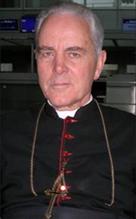 SSPX bid farewell to Bishop Richard Williamson as only
they could do!
SSPX bid farewell to Bishop Richard Williamson as only
they could do!
His defiance of the Society's authorities ultimately made a separation
inevitable. God forgive him for the errors and confusion he caused in the years
that followed with his Kyrie eleison
comments, and even more so for his episcopal
consecrations, which lacked and still lack any objective necessity and any sensus
ecclesiae.
Fr. Franz Schmidberger, former superior general of the SSPX, published
in his weekly newsletter, on the death of Bishop Richard Williamson on January
29, 2025
COMMENT: The good bishop Williamson has only been dead for a little over
one year. At the time of his death the SSPX judged him to be in need of God's
forgiveness for the sin of consecrating bishops
"which lacked and still lack any objective necessity and any sensus ecclesiae." They now
threaten Rome with doing their own episcopal consecrations because their own
"sensus ecclesiae" has now
discovered that there is in fact an existing "objective
necessity"! Nothing has changed
with regard to the Church but something has changed with regard to the SSPX.
They are concerned only with their "objective necessity"!
Dicastery for the Doctrine of the Faith issues statement
following today’s meeting at the Vatican between SSPX Superior General Fr.
Davide Pagliarani & DDF Prefect Cardinal Victor Manuel Fernández on
2-12-2026
STATEMENT OF THE DICASTERY FOR THE DOCTRINE
OF THE FAITH Regarding the Meeting between the Prefect of the Dicastery for the
Doctrine of the Faith and the Superior General of the FSSPX On 12 February
2026, a cordial and sincere meeting took place at the Dicastery for the
Doctrine of the Faith between the Prefect, His Eminence Cardinal Victor Manuel
FERNANDEZ, and the Superior General of the FSSPX, Reverend Don Davide
PAGLIARANI, with the approval of the Holy Father Leo XIV. After clarifying
certain points presented by the FSSPX in various letters, particularly those
sent between 2017 and 2019 — including, among other topics, the question of the
divine will concerning the plurality of religions — the Prefect proposed a
pathway of specifically theological dialogue, following a precise methodology,
on issues that have not yet received sufficient clarification. These include:
the distinction between an act of faith and the “religious submission of mind
and will,” as well as the differing degrees of adherence required by various
texts of the Second Vatican Ecumenical Council and their interpretation. At the
same time, he proposed addressing a series of topics listed by the FSSPX in its
letter of 17 January 2019. The aim of this dialogue is to highlight, in the
topics under discussion, the minimum requirements for full communion with the
Catholic Church, and consequently to outline a canonical statute for the Fraternity,
along with other aspects requiring further study. The Holy See reaffirmed that
the ordination of bishops without the mandate of the Supreme Pontiff, who
possesses ordinary, supreme, universal, immediate, and direct power (cf. CIC,
can. 331; Dogmatic Constitution Pastor aeternus, chs. I and III), would
constitute a decisive rupture of ecclesial communion (schism), with serious
consequences for the Fraternity as a whole (John Paul II, Apostolic Letter
Ecclesia Dei, 2 July 1988, nn. 3 and ff.; Pontifical Council for Legislative
Texts, Explanatory Note, 24 August 1996, n. 1). Therefore, the possibility of
undertaking this dialogue presupposes that the Fraternity suspend the announced
episcopal ordinations. The Superior General of the FSSPX will present the
proposal to his Council and will provide his response to the Dicastery for the
Doctrine of the Faith. In the event of a positive response, the steps, stages,
and procedures to be followed will be established by mutual agreement. The
Church is asked to accompany this process, especially in the coming times, with
prayer to the Holy Spirit, who is the principal agent of true ecclesial
communion willed by Christ.
Viganò
Urges SSPX To Cut Off 'Dialogue' With Fernandez, Proceed With Consecrations
'True ecclesial communion is not
measured by canonical recognition granted by a Hierarchy that has lost the
Faith, but by integral fidelity to divine Revelation.'
I cannot but note with sorrow and
indignation the Statement released today by the Dicastery for the Doctrine of
the Faith, signed by Cardinal Víctor Manuel Fernández, at the end of his
meeting with Father Davide Pagliarani, Superior General of the Priestly Society
of Saint Pius X. After decades of humiliation, inconclusive dialogues, partial
concessions revoked by “Traditionis Custodes,” deafening silences regarding
doctrinal and liturgical deviations widespread throughout the Church, and even
more serious doctrinal and moral errors promoted by the Supreme Throne, Rome
now claims to make the suspension of the episcopal consecrations announced by
the SSPX for next July 1st a preliminary condition for dialogue. These
consecrations are not acts of rebellion, but a supreme act of fidelity to the
One, Holy, Catholic, Apostolic, Roman Church, which has been deprived for
almost sixty years of Bishops who preach integral Doctrine and administer the
Sacraments without any compromise with error. The Dicastery’s Statement subtly
repeats the same modernist scheme seen in 1988: it offers a “theological
dialogue” on issues the Holy See has always refused to seriously
address—religious freedom, destructive episcopal “collegiality,” pan-heretical
ecumenism, the Nostra Ætate declaration that equates false religions with the
one true Faith, and the Abu Dhabi Document—while threatening “schism” for the
only gesture that is able to guarantee the certainty of Apostolic Succession.
But who wields “schism” as a weapon today? Who excommunicated the Bishops
consecrated in 1988 for defending Tradition and its beating heart, the Catholic
Mass? Who excommunicated me and silenced me, while promoting declared heretics
and covering up abuses of every kind? Who forced the faithful to submit to an
authority that has renounced immutable Catholic doctrine in the name of a “new
humanism” and a “synodality” that is nothing other than the cancer of democracy
applied to the Catholic Church in order to destroy from within its divine
hierarchical Constitution and Petrine Primacy? The true schism is not that of those who consecrate
Bishops to guard and transmit the Catholic Faith in its entirety, but rather
the schism of the conciliar and synodal Hierarchy, which has denied Apostolic
Tradition, replacing sound Doctrine with heretical ambiguities, true Catholic
Worship with a Protestantized liturgy, and legitimate Authority with a
totalitarian power exercised against the faithful who refuse to apostatize.
The Society of Saint Pius X does not need the permission of those who have
renounced the Faith to do what Providence asks of it: namely, to perpetuate the
episcopal line faithful to Tradition. Archbishop Marcel Lefebvre acted not out
of schism, but out of necessity – same state of necessity that persists today,
aggravated by the systematic persecution of the Traditional Mass and the
imposition of false doctrines that contradict the perennial Magisterium.
GENERAL
COMMENT: The SSPX is buried in the Neo-modernist
heresy that believes that the dogmas of our faith contain both divine and human
elements and must necessarily continually evolve by a distillation process
where the divine elements are progressively purified by removing the
historically dated human encrustations. This Neo-modernist heresy is the
unstated pre-supposition for the Vatican II pastoral council. For the
Neo-modernist, the proximate rule of faith is no longer Dogma, but however the
current pope interprets the dogma to mean. That being the case, the SSPX,
having abandoned dogma as their proximate rule of faith must turn to the
present pope to tell him the current version of the Catholic faith.
Neo-modernism is just a variation of the heresy of Modernism which St. Pius X
called "the synthesis of all heresies." It is the "synthesis of
all heresies" because it denies all dogmas as dogmas. It attacks the very
nature of what dogmas are. Dogma contains no human elements. They are divine
revelation that is formally defined by the infallible Magisterium of the
Church. They are the infallible word of
God in both the truth expressed and the words used to express that truth. The
pope is only the necessary but wholly insufficient material and instrumental
cause of dogma. It is God who is the formal and final cause of dogma.
Therefore, the pope is just as much a subject to dogma as any of the faithful.
Truth is the only weapon possessed against an abusive authority and the SSPX
has entered into a "dialogue" with an opponent that claims for itself
personally the divine attribute of infallibility and the right to dictate their
personal conceptions of truth even against the divine infallible revelation of
God. Archbishop Viganò is politely telling the SSPX that it is the FAITH
itself that is being attacked and they need to wake up. The SSPX has been in
constant interminable doctrinal discussions with Rome since 1997. The reason
Rome dialogues with the SSPX is because the SSPX is defenseless having
abandoned the infallible truth of Catholic dogma as their weapon. This dialogue
between Rome and the SSPX never raises above the level of exchanging opinions.
Because our Mission of Ss. Peter & Paul stands on the truth of Catholic
dogma, the local ordinaries will never enter into open discussions. Always
remember: A heretic is a baptized Catholic who rejects one or more Catholic
dogmas AND all heretics are schismatics! If the SSPX can learn this simple but
essential truth, then they will stop seeking a place at the table of apostates
and start defending the faith.
Modernism
vs. Neo-modernism: A difference in method, an agreement in ends
The heresy of Modernism denies dogma
directly. Neo-modernism is a more subtle heresy. The end remains the denial of dogma but the
method of denial is indirect. Dogma, the
revelation of God that forms the formal objects of divine and Catholic faith,
is formulated in categorical propositions that are always and everywhere true
or false. There are two methods the
Neo-modernist employs to destroy dogma. The first method is to change the
category of dogma from truth-falsehood to the category of authority-obedience. They treat dogma as if it were laws,
commands, precepts, injunctions, etc., etc., etc., and then limit the universal
truth with all the moral restrictions that apply to laws, etc. For example, the dogma that the sacrament of
baptism is necessary for salvation is treated as a law and therefore as a law,
it does not bind in cases of impossibility, necessity, unreasonable burden,
psychological impediment, etc., etc.
The second method is to corrupt
the dogmatic proposition be changing the meaning of the terms OR altering the
universality of the copula. An excellent example of this corruption of
terminology can be seen in Benedict/Ratzinger’s treatment of the word, substance.
“…the medieval concept of
substance has long since become inaccessible to us. In so far as we use the
concept of substance at all today we understand thereby the ultimate particles
of matter, and the chemically complex mixture that is bread certainly does not
fall into that category.”
Joseph Ratzinger, Faith and
the Future, p. 14
It is impossible to affirm the Catholic
dogma that “Lord Jesus Christ... is consubstantial with the Father” or the
Catholic dogma of Transubstantiation if the concept of “substance” is rejected
in the sense as used by scholastic theologians found in the perennial realist
philosophical tradition. And so we have
Benedict/Ratzinger writing:
“Eucharistic devotion such as
is noted in the silent visit by the devout in church must not be thought of as
a conversation with God. This would assume that God was present there locally
and in a confined way. To justify such an assertion shows a lack of
understanding of the Christological mysteries of the very concept of God. This
is repugnant to the serious thinking of the man who knows about the
omnipresence of God. To go to church on the ground that one can visit God who
is present there is a senseless act which modern man rightfully rejects.”
Joseph Ratzinger, Die Sacramentale
Begrundung Christliche Existenz
The
Catholic Church infallibly teaches:
“By the consecration of the
bread and wine there takes place a change of the whole substance of the bread into the substance of the body of Christ our Lord
and of the whole substance of the
wine into the substance of his blood. This change the holy Catholic Church has
fittingly and properly called transubstantiation.”
Council of Trent, Session XIII,
chapter IV
“If anyone denies that in the
sacrament of the most Holy Eucharist are contained truly, really and substantially the body and blood
together with the soul and divinity of our Lord Jesus Christ, and
consequently the whole Christ, but says that He is in it only as in a
sign, or figure or force, let him be anathema.”
Council of Trent, Session XII,
Canon I
Benedict/Ratzinger’s affirmation
of these dogmas is done within the corrupted context of mutilating the meaning
of the terms. The entire hermeneutic of discontinuity/rupture vs. the
hermeneutic of reform proposed by Benedict/Ratzinger is predicated upon
accepting or rejecting his false philosophy which ultimately elevates the
accident of relationship to overthrow
the concept of substance. Reciting
the Credo is no longer evidence of the Catholic faith without clearly defining
every term.
Cardinal
Henry Edward Manning – The true Revelation of God is both a Definite and
Certain participation in God’s own knowledge.
IT is this fundamental truth of revelation that our Neo-Modernist
hierarchy reject!
What, then, is the knowledge which God has restored to man through
revelation but a definite knowledge, a participation of His own? The
truth which has been revealed, what is it in the mind of God who reveals it,
but one, harmonious and distinct? What was that knowledge as revealed by the
Holy Spirit on the day of Pentecost, but one, harmonious and distinct? What was
the conception of that knowledge in inspired men, but one, harmonious and
distinct also? And what was that knowledge when communicated by those who were
inspired to those who believed, but one, harmonious and distinct as before? And what is this unity and
harmony and distinctness of knowledge, which God revealed of Himself through
Jesus Christ, but the faith we confess in our creed? Our baptismal faith, its
substance and its letter, the explicit and the implicit meaning, article by
article, is as definite, severe, and precise, as any problem in science. It is
of the nature of truth to be so; and where definiteness ends, knowledge ceases.
Observe, then, the distinction between finite knowledge and definite knowledge.
Is not science definite? And yet it is also finite. The theory of gravitation,
definite as it is, it is finite too. [……] Go through the whole range of
physical sciences, what is it but an example of the same condition of
knowledge, definiteness in conception with finiteness of reach? [….] If we have not a definite
knowledge of what we believe, we may be sure we have no true knowledge of it.
But, further, it is evident that knowledge must also be certain.
When we speak of certainty, we mean one of two things. Sometimes we say, that a
thing is certain; at other times, that we are certain. When we say a truth is
certain, we mean, that the proofs of that truth are either self-evident, or so
clear as to exclude all doubt. This is certainty on the part of the object proposed
to our intelligence. But when we say we are certain, we mean that we are
inwardly convinced, by the application of our reason to the matter before us,
of the sufficiency of the evidence to prove the truth of it. In us, certainty
is rather a moral feeling, a complex state of mind. As light manifests itself by its own nature, but
sight is the illumination of the eye; so certainty means truth with its
evidences illuminating the intelligence, or, in other words, the intelligence
possessed by truth with its evidences.
This we call certainty. I ask, then, is there not this twofold
certainty in the revelation which God has given? Was not the revelation
which God gave of Himself through Jesus Christ made certain on His part by
direct evidence of the divine act which revealed it? Is it not also certain on
our part by the apprehension and faith of the Church? Was not God manifest in
the flesh that He might reveal Himself? Did not God dwell on earth that He
might teach His truth? Has not God spoken to man that man might know Him? Did
not God work miracles that man might believe that He was present? What evidence
on the part of God was wanting that men might know that Jesus Christ was indeed
the Son of God? And if
there was certainty on the part of God who revealed, was there not certainty
also on the part of those that heard? Look back into the sacred history.
Had not Prophets and Seers certainty of that which they beheld and heard? […..]
What, then, is the first
condition of faith but certainty? He that has not certain faith has no faith.
We are told that to crave for certainty implies a morbid disposition. Did not
Abraham, and Moses, and Daniel, the Apostles and Evangelists desire certainty
in faith, and crave to know beyond doubt that God spake to them, and know with
definite clearness what God said? Was this a morbid craving? Surely this is not
to be reproved. But rather
the contrary disposition worthy of rebuke. How can we venture to content
ourselves with uncertainty in matters where the truth and honour of God and the
salvation of our own souls are at stake? This truly is not without sin.
[…..] And yet, what is the very idea of Revelation but a Divine assurance of
Truth? Where faith begins uncertainty ends. Because faith terminates upon the
veracity of God; and what God has spoken and authenticated to us by Divine
authority cannot be uncertain.
Cardinal Henry Edward Manning, Grounds of Faith
"The
group holding power in the SSPX have decided to stage a drama, unfortunately
not a good Shakespearean play, but a poor play by Fernandez. They will follow
two narratives: one for liberals, the other for hardliners. Unfortunately,
nothing has changed for many years – secret meetings with the Roman hierarchy
and the search for a practical agreement without doctrinal agreement. This
makes no sense. As Bishop Richard Williamson said, it is a betrayal of
Archbishop Marcel Lefebvre's struggle, a betrayal of Our Lord Jesus Christ and
His Church." -
Bishop
Michal Stobnicki. Comment on the SSPX threat to consecrate new bishops
Pope Leo XIV
is continuing ‘irreversible trajectory’ of Pope Francis: SSPX statement
In addition to
spelling out the Francis/Leo crisis, the statement addresses the silence of
conservative bishops in the Church, the Traditional Latin Mass and the Novus
Ordo, and more.
LifeSiteNews | John-Henry Westen | Feb 5, 2026 — Today the Society of Saint Pius X (SSPX)
released a major statement explaining the reasons behind their announcement of
upcoming episcopal consecrations. This comes from Superior General Davide
Pagliarani, and it directly addresses the current pontificate of Pope Leo XIV,
describing it as continuing the “irreversible trajectory” set by Pope Francis.
The document outlines why the SSPX believes these consecrations are necessary,
while still expressing some hope for dialogue with Rome.
In addition to spelling out the Francis/Leo crisis, the statement
addresses the silence of conservative bishops in the Church, the possibility of
sanctions, their hopes, the ultimate reason for their action and their
perspective on the Traditional Latin Mass. Let me read the key portions
directly from the statement, but I encourage you to read the full statement.
They spell out the
Francis and Leo crisis
Furthermore, the major orientations already taking shape in this new
pontificate – particularly through the most recent consistory – only confirm
this. An explicit
determination to preserve the line of Pope Francis as an irreversible
trajectory for the entire Church is discernible.
It is sad to
acknowledge, but it is a fact that, in an ordinary parish, the faithful no
longer find the means necessary to ensure their eternal salvation. Missing, in
particular, are both the integral preaching of Catholic truth and morality, and
the worthy administration of the sacraments as the Church has always done. This
deprivation is what constitutes the state of necessity. In this critical
context, our bishops are growing older, and, as the apostolate continues to expand,
they are no longer sufficient to meet the demands of the faithful worldwide.
In what way do you
believe that last month’s consistory confirms the direction taken by Pope
Francis?
DP: Cardinal Fernández, speaking in the name of Pope Leo, invited the
Church to return to Pope Francis’s fundamental intuition expressed in his key
encyclical, Evangelii gaudium.
Put simply, he believes that the Gospel should be proclaimed by reducing it to
a primitive and essential expression, a series of concise and striking formulas
– the “kerygma” – with a view to eliciting an “experience,” an immediate
encounter with Christ. Everything else should be set aside, however precious it
may be.
In concrete terms, all that is Tradition is considered as accessory and
secondary. It is this method of the new evangelization that has produced the
doctrinal emptiness characteristic of Pope Francis’s pontificate, and is keenly
felt by many in the Church.
In a similar vein, one must provide new and relevant answers to the
emerging questions of our time, but, according to Cardinal Fernández, this is
to be done through synodal reform, rather than by rediscovering the classical
and ever-valid answers provided by the Tradition of the Church. It is by these
means, in the “breath of the Spirit” of this synodal reform, that Pope Francis
has been able to impose catastrophic decisions upon the whole Church, such as
authorizing Holy Communion for the divorced and civilly remarried, or the
blessing of same-sex couples.
In summary, through the “kerygma,” the proclamation of the Gospel is
isolated from the whole corpus of traditional doctrine and morality. And
through synodality, traditional answers are replaced by arbitrary decisions,
with a high risk of being absurd and doctrinally unjustifiable. Cardinal Zen
himself considers this method manipulative and considers attributing it to the
Holy Ghost blasphemous. Unfortunately, I fear that he is right.[…]
[…] the Church is in danger of busying herself with both everything and
nothing. Ecological concerns, for example, or the preoccupation with the rights
of minorities, of women, or of migrants, risk causing the essential mission of
the Church to be lost from view. If the Society of Saint Pius X strives to
preserve Tradition, with all that this entails, it is solely because these
treasures are vital for the salvation of souls, and because it aims at nothing
else but the good of souls, and that of the priesthood—ordered to their
sanctification.[…]
[…] 2019, when Pope Francis, on the occasion of his visit to the
Arabian Peninsula, signed, together with an imam, the well-known Abu Dhabi
declaration. Together with the Muslim leader, he affirmed that the plurality of
religions had been willed as such by divine Wisdom.
It is evident that a communion founded upon the acceptance of such a
statement, or which would include it, would simply not be Catholic, since it
would constitute a sin against the First Commandment and the denial of the
first article of the Creed.
I consider such a statement to be more than a simple error. It is
simply inconceivable. It cannot be the foundation of Catholic communion, but
rather the cause of its dissolution. I believe that a Catholic should prefer
martyrdom rather than accept such an affirmation.
They address the
silence of conservative bishops in the church to the crisis of Pope Francis and
Leo
[…] the fear of breaking a fragile stability by behavior deemed
“disturbing” reduces many pastors to a constrained silence, when they should be raising
their voices against scandalous teaching which corrupts faith or morals.
The necessary denunciation of errors that undermine the Church – required by
the very good of souls who are threatened by this poisoned nourishment – is
thereby left undone. One may enlighten another in private, if able to discern
the harmfulness of a given error, but it may be only a timid whisper, in which
truth struggles to express itself with the required freedom – especially in the
shadow of tacitly accepted, contradictory principles. Once again, souls are no
longer enlightened and are deprived of the bread of doctrine for which they
remain hungry. Over time, this progressively alters mentalities and gradually
leads to a general and unconscious acceptance of the various reforms affecting
the life of the Church. Towards these souls, too, the Society feels a
responsibility to enlighten and not to abandon.
Realistically sees
possibility of sanctions
[…] Cardinal Fernández’s response does not address the possibility of
an audience with the Pope. It also evokes the possibility of new sanctions.
What will the Society
do if the Holy See decides to condemn it?
DP: First of all, let us recall that in such circumstances any
canonical penalties would have no real effect.
Nevertheless, should they be pronounced, the Society would certainly
accept this new suffering without bitterness, as it has accepted past
sufferings, and would sincerely offer it for the good of the Church. It is for the Church that the
Society works. And there is no doubt that, should such a situation
arise, it could only be temporary, for the Church is divine and Our Lord will
not abandon her. […]
We are sure that one day the Roman authorities will acknowledge, with
gratitude, that these episcopal consecrations providentially contributed to
preserving the faith, for the greater glory of God and the salvation of souls.
They make the
comparison to the China Communist Party naming bishops without the Pope’s
approval
Let us take the current case of relations with the Chinese government.
Despite a genuine schism of the Chinese Patriotic Church, despite the
uninterrupted persecution of the underground Church faithful to Rome, despite
agreements regularly renewed and then broken by the Chinese authorities, in
2023, Pope Francis approved, a posteriori, the appointment of the Bishop of
Shanghai by those authorities.
More recently, Pope Leo XIV himself ultimately accepted, a posteriori, the appointment of the
Bishop of Xinxiang, designated in the same manner during the vacancy of the
Apostolic See, while the bishop, faithful to Rome—who had been imprisoned
several times—was still in office.
In both cases, these were clearly pro-government prelates, imposed
unilaterally by Beijing to control the Catholic Church in China. It should be
clearly noted that these were not merely auxiliary bishops, but residential
bishops, that is, ordinary pastors of their respective dioceses (or
prefectures), possessing jurisdiction over the local clergy and faithful. In
Rome, it is perfectly well known for what purpose these pastors were chosen and
unilaterally imposed.
The Society’s case is entirely different. For us, it is obviously not a
matter of favoring a communist or anti-Christian power, but solely of
safeguarding the rights of Christ the King and of the Tradition of the Church,
at a time of general crisis and confusion in which these are gravely
compromised. The intentions and the ends are clearly not the same.
They lay out the
request ignored by the Pope since last summer
Last summer, I wrote to the Holy Father to request an audience. Having
received no reply, I wrote to him again a few months later, in a filial
and straightforward manner, without concealing any of our needs. I
mentioned our doctrinal divergences, but also our sincere desire to serve the
Catholic Church without respite, for we are servants of the Church despite
our irregular canonical status.
To this second letter, a reply from Rome reached us a few days ago,
from Cardinal Fernández. Unfortunately, it took no account whatsoever of the proposal
we put forward, and offers nothing that responds to our requests.
Still retains hope
Pope Leo will acquiesce
A Pope is first and foremost a father. As such, he is capable of
discerning a right intention, a sincere will to serve the Church, and above
all, a genuine case of conscience in an exceptional situation. […]
In fact, the superior
general suggests that the consecration of new bishops will be a grace for the
whole church when they happen
I would like to emphasize that this is a time for prayer and
preparation of hearts, souls, and minds. We must prepare ourselves to receive
the grace that these consecrations will occasion for the whole Church. This
should be done with recollection, peace, and trust in Providence, which has
never abandoned the Society and will not abandon it now.
The ultimate reason:
for the salvation of souls
[…] it is for the Pope himself, as such, that we preserve this treasure
until the day when its value will once again be understood and when a Pope will
wish to make use of it for the good of the whole Church. […]
[…] The very law of the Church provides for it. In the spirit of
ecclesiastical law, which is the juridical expression of this charity, the good
of souls comes before everything else. It truly represents the law of laws, to
which all others are subordinate and against which no ecclesiastical law can
prevail.
The axiom “suprema lex, salus animarum” —”the supreme law is the
salvation of souls”—is a classic maxim of canonical tradition which is
explicitly taken up by the final canon of the 1983 Code. In the present state
of necessity, it is upon this highest principle that the entire legitimacy of
our apostolate and of our mission towards the souls who turn to us depends. For
us, we fulfil a role of supplying for a deficiency, in the name of that same
charity.
About the Traditional
Latin Mass
As far as I am aware, Pope Leo XIV has maintained a certain
discretion on this subject, which arouses great expectation in the conservative
world. Very recently, however, a text by Cardinal Roche on the liturgy—intended
initially for the cardinals participating in last month’s consistory—was made
public. There is no reason
to doubt that it corresponds, in its broad lines, to the orientation desired by
the Pope. It is an unambiguous text, and above all, logical and coherent.
Unfortunately, it is based on a false premise.
Concretely, this
text, in perfect continuity with Traditionis custodes, condemns the
liturgical project of Pope Benedict XVI, according to whom, the ancient rite
and the new rite are two more or less equivalent forms, expressing the same
faith and the same ecclesiology, and therefore capable of mutually enriching
one another. Concerned for the unity of the Church, Benedict XVI sought to
promote the coexistence of the two rites and, in 2007, published Summorum
Pontificum. For many, this occasioned a providential rediscovery of the
Mass of all time; but over time, it also gave rise to a movement calling the
new rite into question—a movement deemed problematic and which Traditionis
custodes, in 2021, sought to stem.
Faithful to Pope Francis, Cardinal Roche is now attempting to promote
an elusive unity of the Church according to an idea contradictory to that of
Benedict XVI. While maintaining the assertion of a continuity from one rite to
the other through reform, Cardinal Roche firmly opposes their coexistence. He
sees in it a source of division, a threat to unity, which must be overcome by
returning to an authentic liturgical communion. “The primary good of the unity
of the Church is not achieved by freezing division, but by finding ourselves in
the sharing of what cannot but be shared.” In the Church, “there ought to be
only one rite”, in full syntony with the true meaning of Tradition.
This is a just and coherent principle, since the Church, having one
faith and one ecclesiology, can have only one liturgy capable of expressing
them adequately. But it is a principle applied to a wrong conception of
Tradition. Consistent with the new post-conciliar ecclesiology, Cardinal Roche conceives
Tradition as something evolving, and the new rite as its sole living expression
for our time. The value of the Tridentine rite can therefore only be regarded
as obsolete, and its use, at most, a “concession”, and “in no way a promotion.”
That there is a present “division” and incompatibility between the two
rites now appears more apparent than ever. But let there be no mistake, the
only liturgy that adequately expresses, in an immutable and non-evolving
manner, the traditional conception of the Church, of Christian life, and of the
Catholic priesthood—that is, Tradition—is the liturgy of all time. On this
point, the opposition of the Holy See appears more irrevocable than ever.
Direct calling into
question of the Novus Ordo
[…] instead of sincerely questioning the intrinsic deficiencies of the
new Mass, and therefore the overall failure of the reform, instead of facing
the reality that churches are emptying and vocations are declining, instead of
asking why the Tridentine rite continues to attract so many souls, Cardinal
Roche sees no other solution than an urgent preliminary formation of the
faithful and seminarians.
[…] For almost two thousand years, souls—often illiterate—were edified
and sanctified by the liturgy, without the need for any prior formation.
Failing to recognise the intrinsic incapacity of the Novus Ordo to
form and edify souls and continuing to demand ever better prior formation seems
to me to be the sign of an irremediable blindness. One arrives at shocking
paradoxes: the reform was intended to foster a greater participation of the
faithful; yet the faithful abandoned the Church en masse, because this insipid
liturgy failed to nourish them—and this would supposedly have nothing to do
with the reform? […]
[…] how can it then be understood that this Mass of all time stands in
irreducible opposition to the new Mass, remains the sole true liturgy of the
whole Church, and that no one may be prevented from celebrating it? How can it
be known that the Mass of Paul VI cannot be recognized, because it constitutes
a considerable departure from the Catholic theology of the Holy Sacrifice of
the Mass, and that no one may be compelled to celebrate it? And how are souls
to be effectively turned away from this poisoned liturgy, to drink from the pure
sources of Catholic liturgy?
COMMENT:
Complaining about conservative bishops being mute dogs is rank hypocrisy
coming from the SSPX who have been dancing the two-step with Neo-modernist Rome
since 1997, nearly thirty years of "doctrinal discussions"! Dogma is
the proximate rule of faith for all the faithful. It is immutable in both the
truth it expresses and the manner in which it is expressed. It forms the formal
object of divine and Catholic faith. The very definition of heresy is the
denial of dogma. The heresy of Neo-modernism denies this truth. They believe
that dogma evolves and changes its meaning over time as the Church develops a
deeper and richer understanding of God's revealed truth. Consequently, a
Catholic must always turn to the pope to know what any particular dogma means
today. Thus, the pope becomes the proximate rule of faith for Neo-modernists.
The SSPX, just like Rome, are Neo-modernists. The SSPX cannot call the
Neo-modernist heretics because the SSPX does not hold dogma as their proximate
rule of faith. They can only offer opinions and thus, for thirty years they
have been exchanging opinions with Neo-modernist Rome. The SSPX during the
entire pontificate of Francis/Bergoglio did and said nothing to oppose his
gross heresy and immorality. Why is it suddenly an issue now? Because at that
time it was not in the interest of the SSPX to stir the pot. Their pretense of
being at the service of the Church has never been true. From the beginning they
have worked to consolidate control of Catholic tradition imposing upon it their
own distorted conceptions of doctrine and liturgy while denying any help to
those who do not conform in every detail. Bishop Richard Williamson, since
being expelled from the SSPX, helped our little Mission. He did not agree with
us entirely but his charity was not thereby stifled. Supplied jurisdiction is
entirely generated by the needs of each individual Catholic faithful and Bishop
Williamson exercised that supplied jurisdiction in helping us at Ss. Peter
& Paul Roman Catholic Mission. Bishop Williamson's charity extended to the
needs of the faithful over the world and he provided six bishops, at least some
of which are continuing as he did. That is really the reason the SSPX got rid
of him. For the SSPX, there is no state of necessity. They have denied it
certainly over the last 15 years and they cannot reclaim it now. If they want
to get their house in order they should ask Bishop Michael Stobnicki,
consecrated by Bishop Williamson for the eastern Slavs, and who the SSPX
expelled from their seminary, to help them.
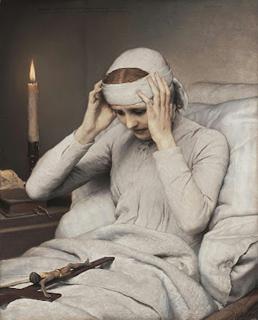
"A Dark
Cloud of Fog Instead of a Head"
I saw a strange church being built against every rule.... No angels
were supervising the building operations.
In that church, nothing came from high above... There was only division
and chaos. It is probably a church of
human creation, following the latest fashion, as well as the new heterodox
church of Rome, which seems of the same kind...
I saw all sorts of people, things, doctrines, and opinions. There was something proud, presumptuous, and
violent about it, and they seemed to be very successful. I did not see a single Angel nor a single
saint helping in the work. But far away in the background, I saw a
laughing figure which said: 'Do build it as solid as you can; we will pull it
to the ground'.... Among the strangest things that I saw, were long processions
of bishops. Their thoughts and utterances were made known to me through images
issuing from their mouths. Their faults towards religion were shown by external
deformities. A few had only a body, with a dark cloud of fog instead of a head.
Others had only a head, their bodies and hearts were like thick vapors. Some
were lame; others were paralytics; others were asleep or staggering.
Blessed Anna-Katarina Emmerick, Yves Dupont, Catholic Prophecy
Purgation Now
with Merit, or Purgatory Later Without
When I look to God, I see no gate to Paradise, and yet he who wishes to
enter there does so, because God is all mercy.
God stands before us with open arms to receive us into His glory. But well I see the divine essence to be of
such purity, far greater than can be imagined, that the soul in which there is
even the least note of imperfection would rather cast itself into a thousand
Hells than find itself thus stained in the presence of the Divine Majesty. Therefore the soul, understanding that
Purgatory had been ordained to take away those stains, casts itself therein,
and seems to itself to have found great mercy in that it can rid itself there
of the impediment that is the stain of sin.
No tongue can tell nor explain, no mind understand, the grievousness of
Purgatory. But although I see that there
is in Purgatory as much pain as in Hell, I yet see the soul that has the least
stain of imperfection accepting Purgatory as though it were a mercy, as I have
said, and holding its pains of no account as compared with the least stain that
hinders a soul in its love. I seem to
see that the pain that souls in Purgatory endure because of that in them which
displeases God (that is, what they have willfully done against His great
goodness) is greater than any other pain they feel in Purgatory. And this is because they see the truth and
the grievousness of the hindrance that prevents them from drawing near to God,
since they are in grace.
St. Catherine of Genoa, Purgation
and Purgatory
All
Are Called to be Co-Redeemers with Christ
God has entrusted to each one
of us a share in the great redemptive work of Jesus. As consecrated souls, we are especially
called to cooperate in Christ’s work.
First of all, we must cooperate with grace, so that the fruits of the
redemption can be fully applied to our souls.
This is the work of our own personal sanctification. It is not limited to this one aspect,
however. We are called to sanctify
ourselves in order to be able to bring others to sanctity. Each one of us has a mission to fulfill for
the good of others and for their sanctification. We must collaborate with Christ in extending
the fruits of the Redemption to as many souls as possible. This work is entrusted to us by the heavenly
Father, and we must apply ourselves to it with the interior disposition of
Christ: a total, generous, exclusive dedication, a dedication capable of making
even the greatest sacrifices. All
actions are of value only insofar as they help toward the accomplishment of
this work. Anything that does not
contribute to our own sanctification or to the sanctification of other is
useless, a waste of time, and should be courageously eliminated.
Fr. Gabriel of St. Mary
Magdalen, O.C.D., Divine Intimacy
And
yet, the fathers of Vatican II professed to worship the same god as the
Mohammedans!
He [Muhammad] seduced the people by promises of carnal pleasure to
which the concupiscence of the flesh goads us. His teaching also contained
precepts that were in conformity with his promises, and he gave free rein to
carnal pleasure. In all this, as is not unexpected, he was obeyed by carnal
men. As for proofs of the truth of his doctrine, he brought forward only such
as could be grasped by the natural ability of anyone with a very modest wisdom.
Indeed, the truths that he taught he mingled with many fables and with
doctrines of the greatest falsity. He did not bring forth any signs produced in
a supernatural way, which alone fittingly gives witness to divine inspiration;
for a visible action that can be only divine reveals an invisibly inspired
teacher of truth. On the contrary, Mohammed said that he was sent in the power
of his arms—which are signs not lacking even to robbers and tyrants. What is
more, no wise men, men trained in things divine and human, believed in him from
the beginning. Those who believed in him were brutal men and desert wanderers,
utterly ignorant of all divine teaching, through whose numbers Mohammed forced
others to become his followers by the violence of his arms. Nor do divine
pronouncements on the part of preceding prophets offer him any witness. On the
contrary, he perverts almost all the testimonies of the Old and New Testaments
by making them into fabrications of his own, as can be seen by anyone who
examines his law. It was, therefore, a shrewd decision on his part to forbid
his followers to read the Old and New Testaments, lest these books convict him
of falsity. It is thus clear that those who place any faith in his words
believe foolishly.
St. Thomas Aquinas, Summa Contra Gentiles
The
Principle Muslim objections to the Catholic Faith – Utterly carnal!
“We
preach Christ crucified, unto the Jews indeed a stumbling block, and unto the
Gentiles foolishness” 1 Cor 1:23.
These, then, are the points, which, as you affirm, are attacked and
ridiculed by the unbelievers. For the Muslims (Saraceni), as you say, ridicule
our claim that Christ is the Son of God, since God does not have a wife; and
they think us mad, assuming we profess there are three gods. They also mock our
belief that Christ, the Son of God, was crucified for the salvation of the
human race, because if God is omnipotent, He could have saved the human race
without the suffering of His Son; He could also have so constructed man that he
could not have sinned. They rebuke Christians because daily at the altar they
eat their God and because the body of Christ, were it even as big as a
mountain, should long since have been consumed.
St. Thomas, De Rationibus Fidei (The Reasons for Our Faith)
Behold, then the whole
of Christian perfection: love and sacrifice. Who cannot with
God's grace, fulfil this twofold condition? Is it, indeed, so difficult to love
Him Who is infinitely lovable and infinitely loving? The love that He asks of
us is nothing extraordinary; it is the devotedness of love - the gift of
oneself - consisting chiefly in conformity to the divine will. To want to love
is to love. To keep the commandments for God's sake is to love. To pray is to
love. To fulfil our duties of state in view of pleasing God, this is likewise
to love. Nay more, to recreate ourselves, to take our meals with the like intention
is to love. To serve our neighbor for God's sake is to love. Nothing then is
easier, God's grace helping, than the constant exercise of divine love and
through this, steady advance toward perfection.
Rev. Adolphe
Tanquewrey, S.S., D.D., The Spiritual Life
Vatican II and the Leap of
Faith for the Hermeneutics of Continuity
ON CATHOLIC UNITY
Vatican II pastoral
opinion:
And
we now ask: What does it mean to restore the unity of all Christians?... This
unity, we are convinced, indeed subsists in the Catholic Church, without
the possibility of ever being lost (Unitatis Redintegratio) the Church
in fact has not totally disappeared from the world. On the other hand, this
unity does not mean what could be called ecumenism of the return: that is,
to deny and to reject one’s own faith history. Absolutely
not! Pope Benedict XVI, to Protestants
at World Youth Day, August 19, 2005
Catholic Doctrine:
… the union of Christians can only be
promoted by promoting the return to the one true Church of Christ of
those who are separated from it… Pope
Pius XI, Mortalium Animos
ON RELIGIOUS LIBERTY
Vatican II pastoral
opinion:
The
Council further declares that the right to religious freedom has its foundation
in the very dignity of the human person... This right to religious freedom is
to be recognized in the constitutional law whereby society is governed. Thus it
is to become a civil right. Declaration on Religious Liberty, Dignitatis
Humanae
Catholic Doctrine:
And from this wholly false idea of social organization they do not fear to
foster that erroneous opinion, especially fatal to the Catholic Church
and the salvation of souls, called by our predecessor, Gregory XVI, insanity,
namely that the liberty of conscience and worship is the proper right of every
man, and should be proclaimed by law in every correctly established society...
Each and every doctrine individually mentioned in this letter, by Our Apostolic
authority We reject, proscribe and condemn; and We wish and command that
they be considered as absolutely rejected by all the sons of the Church.
Pope Pius IX, Quanta Cura
ON
SALVATION
Vatican II pastoral
opinion:
The separated churches and communities
as such, though we believe they suffer from the defects already mentioned, have
been by no means deprived of significance and importance in the mystery of
salvation. For the Spirit of Christ has not refrained from using them as
means of salvation which derive their efficacy from the very fullness of
grace and truth entrusted to the Catholic Church. Decree on Ecumenism, Unitatis
Redintegratio
Catholic Doctrine:
The most Holy Roman Church firmly believes, professes and preaches that none of
those existing outside the Catholic Church, not only pagans, but also Jews and
heretics and schismatics, can have a share in life eternal; but that they will
go into the eternal fire which was prepared for the Devil and his angels, unless
before death they are joined with her... Pope Eugene IV, Council
of Florence
ON ACCOMODATION OF
CATHOLIC TRUTH TO THE WORLD
Vatican II pastoral
opinion:
May the faithful,
therefore, live in very close union with the men of their time. Let them strive
to understand perfectly their way of thinking and feeling as expressed in their
culture. Let them blend modern science and its theories and the understanding
of the most recent discoveries with Christian morality and doctrine.... Thus
their religious practice and morality can keep pace with their scientific
knowledge and with an ever - advancing technology... Decree on the Church in the
Modern World, Gaudium
et Spes
Catholic Doctrine:
The Roman pontiff can and must reconcile himself
with human progress, with liberalism and with modern and human culture. – condemned.
Blessed Pope Pius IX, Syllabus of Errors
ON RELATIONS WITH FALSE
RELIGIONS
Vatican II pastoral
opinion:
Upon the Moslems, too, the Church looks with esteem...They adore
the one God...though they do not acknowledge Jesus as God they revere Him as a
prophet.... In addition they await the day of judgment when God will give each
man his due.... and give worship to God especially through prayer, almsgiving
and fasting. Decree
on the Relation of the Church to Non-Christian Religions, Nostra Aetate
Catholic Doctrine:
...that
false opinion which considers all religions more or less good and
praiseworthy... Not only are those who hold this opinion in error and deceived,
but also in distorting the idea of true religion they reject it, and little by
little, turn aside to naturalism and atheism...from which it clearly follows
that one who supports those who hold on these theories and attempt to realize
them, is altogether abandoning the divinely revealed religion. Pope Pius XI, Mortalium Animos
Why
is John Henry Cardinal Newman regarded by Modernists as their Spiritual Father?
– Because he was! So why do
“Conservative Catholics” admire Newman?
Because he explained how dogma can be discarded.
“Dr. Newman is the most
dangerous man in England. And you will see that he will make use of the laity
against your Grace. You must not be afraid of him. It will require much
prudence, but you must be firm, as the Holy father sill places his confidence
in you; but if you yield and do not fight the battle of the Holy See against
the detestable spirit growing up in England, he will begin to regret Cardinal
Wiseman, who knew how to keep the laity in order.”
Msgr. George Talbot, Papal
Chamberlain, Letter to Cardinal Henry Edward Manning, after Pope Pius IX
suppressed a plan for Dr. John Henry Newman going to Oxford to establish an
inter-faith oratory.
An English Catholicism, of
which Newman is the highest type, is the old Anglican, patristic, literary,
Oxford tone transplanted into the Church... In one word, it is a worldly
Catholicism, and it will have the worldly on its side, and will deceive many.
Cardinal Henry Edward Manning,
on Dr. John Henry Cardinal Newman
Another influential writer during the last century was Lord Acton (Sir
John Dalberg), who was famous for his critical historicism and also renowned
for his friendship with (Rev. Johann von) Dollinger (a Munich priest and
professor at the University, excommunicated for rejecting the dogma of papal
infallibility). Acton was almost excommunicated, as Dollinger was, but managed
to maintain the appearance of orthodoxy and remain in the Church. As liberal as
Lord Acton was, and although he sided with Newman in fighting the dogma of
Infallibility, he came to the same conclusion as (Cardianl Henry Edward)
Manning regarding Newman’s heterodox position. In a letter written by Acton a
few weeks before Manning’s death, after mentioning the ‘personal aversion to
Manning’ displayed by Newman he said, “Many will wonder how anybody who saw
much of him (Newman) could remain a Catholic — assuming that Newman really was
one.” Acton, although an ally of Newman in editing the liberal journal The
Rambler, was not baffled by Newman’s prosaic tact. Acton went much further than
Manning in his strictures on his old ally. He described Newman as “a sophist,
the manipulator and not the servant of truth.” When men of diametrically
opposed beliefs, as Acton and Manning, agree in their judgment of another man
whom they so well knew, the assumption that they are not both in error is not
unreasonable.
John Edward Courtenay Bodley, On Cardinal John Henry Newman
DOGMA IS THE PROXIMATE RULE OF FAITH; DOGMA is revealed
doctrine formally defined by the Church. The pope is the necessary but
insufficient means by which DOGMA is declared.
Hence, the distinction is made betewen
the Remote and the Proximate Rule of Faith.
The remote Rule of Faith is the Objective Deposit, [Scripture and
Tradition], It contains revealed truths which - for some reason or other - were
forgotten, obscure, or not sufficiently understood. Hence, they were broght into discussion, or
denied without injury to the Faith until they became clear or werer defined by
the Church. The Proximate Rule of Faith
is the teaching of the Church sufficiently proposed and manifestly promulgated
to the Faithful, [DOGMA]. If this
Proximate Rule of Faith proclaims anything as belonging to the Remote Rule
of Faith, it can no longer be challenged
without shipwreck of the Faith. For
unity of faith is whole and entire only while there is no dissent with the
Proximate Rule of Faith. On this point
Gregory of Valentia declares: "The Church has from darkness brought to
light wth her infallible authority some doctrines which, through human
negligence or malice or perversity of mind, remained concealed. And mayhap there are some still hidden in the
Church."
Msgr. George Agius, D.D., J.C.D.,
Tradition and the Church
Worth
Repeating: The SCHISM is HERE and Leo is just a dull echo of Francis/Bergoglio!
COMMENT: This
book in the article below provides an interpretation of Chapter 8 of Amoris Laetitia. It is addressed to
bishops with a “merciful heart” and offers an interpretation that is consistent
with the interpretation approved in the private letter sent by Pope Francis to
the bishops of Argentina as well as with the interpretation of Cardinal
Schornborn who Pope Francis publically identified as its ‘official
interpretor.’ These bishops say that the proper understanding and application
is that any Catholic living in public adultery based upon their own private
judgment in the internal forum can declare themselves worthy to receive Holy
Communion and absolution in the sacrament of Penance and therefore cannot be
denied these sacraments. It is given
semi-official approval by its publication in L’Osservatore Romano.
Pope
Leo XIV in a message to to the Dicastery for the Laity, Family and Life holding
a seminar entitled, “Evangelizing
with Families Today and Tomorrow,” endorsed Amoris Laetitia by directly quoting his predecessor from Amoris
Laetitia §76, writing the “Gospel of the family also nourishes
seeds that are still waiting to grow,” praising its “basis for caring for those
plants that are wilting and must not be neglected.”
Now the Novus Ordo, which may
be nothing more than a memorial meal as it was initially and officially defined
by Pope Paul VI, perhaps giving the Novus Ordo communion wafer to a person in
objective mortal sin is not a real problem. But what is certainly a grave sin
is that these persons can expect to be absolved by a confessor in the sacrament
of Penance without confessing or repentance of mortal sin. This does not
represent a change in the Church’s teaching.
It represents the active effort of a Francis (and now Leo) and his
minions to destroy Catholic doctrine and morality. As St. Thomas said, “All
heretics are schismatics,” the schism has long been present with every post-conciliar
pope who have repeatedly denied Catholic dogma. It is more evident each passing
day and every Catholic will have to pick sides. God cannot let an open attack
upon the sacrament of marriage go unpunished. Their hypocrisy is oozing from
every pore. Imagine if a Catholic with “humility, discretion and love for the
Church and her teaching, in a sincere search for God’s will and a desire to
make a more perfect response to it” arrives at traditional Catholicism, what
kind of response can be expect from the local bishop and Rome? If you want to know read our OPEN LETTERS!
After all, a “merciful heart” has its limits!
“If, as a result of the process
of discernment, undertaken with “humility, discretion and love for the Church
and her teaching, in a sincere search for God’s will and a desire to make a
more perfect response to it” (Amoris
Laetitia 300), a separated or divorced person who is living in a new
relationship manages, with an informed and enlightened conscience, to
acknowledge and believe that he or she are at peace with God, he or she cannot
be precluded from participating in the sacraments of Reconciliation and the
Eucharist (see AL, notes 336 and 351).”
Bishops Charles J Scicluna and
Mario Grech, Guide for the Interpretation
of Chapter 8 of Amoris Laetitia: An Invitatiion to the Bishops of Merciful
Hearts. This received semi-official
approbation by being featured in the publication, L’Osservatore Romano, 1-2017
"You know
Gaza is interesting. It's a phenomenal location on the sea, the best
weather—you know, everything's good. It's like some beautiful things could be
done with it. It's very interesting. Some fantastic things could be done with
Gaza."
President
Donald Trump, On the rebuilding of Gaza for Israel
COMMENT:
According to the
latest figures released by the Gaza Ministry of Health on December 23, 2025,
Israel had killed at least 70,937 Palestinians and wounded 171,192; of those
identified fatalities, 53% were women, children or elderly. But the estimate is
difficult to make. This estimate from the Ministry of Health is collected from
hospital records and in May of 2025 the United Nations reported that 94% of the
hospitals in Gaze had been destroyed. It is not possible  to know how many Palestinians are buried under the rubble, nor how many
will die from starvation and disease. There were 2.23 million Palestinians in
Gaza before the conflict and relief workers estimate the current population
requiring aid at 1.87 million. The difference is 360,000.
to know how many Palestinians are buried under the rubble, nor how many
will die from starvation and disease. There were 2.23 million Palestinians in
Gaza before the conflict and relief workers estimate the current population
requiring aid at 1.87 million. The difference is 360,000.
The picture on
the right is six bags containing the remains of children killed in the bombing
of a school. The picture on the left is northern area of Gaze with no structure
left standing. This killing and destruction was accomplished by American made
planes dropping 2,000 pound American made bombs. The specific bomb used by
Israelis on the school building was a Boeing GBU-39 designed to penetrate
warships and hardened targets. It splinters into small fast moving shrapnel
segments that can penetrate three feet of reinforced concrete. In an interview Jonathan Pollard, the Jewish
spy while working as a clerk for Naval Intelligence delivered to Israel what
Scott Ritter called the "Crown Jewels" of U.S. Intelligence Singles
and was sentenced to life in prison in 1987, said that Israel has promised
President Trump tax free concessions on anything he builds in Gaza. The picture
below is the visionary Trump plan, directed by his Jewish son-in-law Jared
Kushner, for turning Gaza everything in life Trump thinks is important. The
Blessed Virgin Mary said at Fatima, "Only the Lady of the Rosary can help
you" through devotion to her Immaculate Heart, the Rosary, and the First
Saturdays of Reparation. Whatever good President Trump may occasionally do, in
the end he cannot fix anything.

Pope Leo
appoints pro-LGBT archbishop as secretary for Dicastery for Clergy
Archbishop
Carlo Roberto Maria Redaelli's pro-LGBT views were recounted in a description
of his response to the same-sex 'marriage' of a Catholic scout leader.
LifeSiteNews | Jan 22, 2026 — Pope Leo XIV has appointed
a controversial and homosexualist archbishop to a prominent role in the
Vatican.
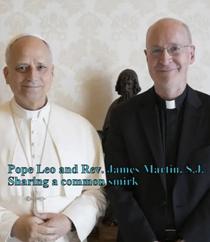 Archbishop Carlo Roberto Maria Redaelli of
Gorizia was named today as the new Secretary for the Dicastery for Clergy.
Archbishop Carlo Roberto Maria Redaelli of
Gorizia was named today as the new Secretary for the Dicastery for Clergy.
Raedelli and his pro-LGBT views were mentioned in a 2020 book by
Luciano Moia, a senior journalist for the Italian Bishops’ Conference’s daily
newspaper Avvenire. In his book, Moia argues that the Church should look at
“chastity” within a same-sex relationship the same way in which it looks at
chastity within marriage.
As an example of how the Church should begin to do this, the
author cited Raedelli’s response to the same-sex ‘marriage’ in 2017 of a
homosexual Catholic scout leader.
In Moia’s words,
Raedelli “threw everyone off. He refused the role of the judge, he didn’t
absolve, but neither did he condemn. He invited the community to reflect
together to understand if, even from such a divisive occurrence, one can
receive aspects of grace. An intervention in search of moderation and of that
invitation to welcome, discern and integrate that impregnates the magisterium
of Pope Francis.”
Contrary to the attitudes of Moia and Archbishop Redaelli, the
Catechism of the Catholic Church is very clear on homosexuality:
Basing itself on Sacred Scripture, which presents homosexual acts as
acts of grave depravity, tradition has always declared that ‘homosexual acts
are intrinsically disordered.’ They are contrary to the natural law. They close
the sexual act to the gift of life. They do not proceed from a genuine
affective and sexual complementarity. Under no circumstances can they be
approved.
Only after stating that homosexual acts cannot be approved does the
catechism move on to a discussion of chastity. In other words, chastity for
people with homosexual inclinations plainly means absolute continence.
Redaelli has served as auxiliary bishop of Milan from 2004 to 2012, and
as Archbishop of Gorizia, in northeastern Italy, since 2012. A canon lawyer by
training, he has been at the center of several controversies over the years.
For example, the archbishop has previously attracted attention for his
positions on the Traditional Latin Mass.
During the Italian
Bishops’ Conference General Assembly in Rome in November 2018, Redaelli had
questioned the legal basis of Pope Benedict XVI’s 2007 motu proprio Summorum
Pontificum.
The Pope stated
that the 1962 Roman Missal had never been abrogated and could be freely used.
However, according to the Italian blog Messainlatino.it, Redaelli stated that
the Missal promulgated by Pope John XXIII had in fact been abrogated by Pope Paul
VI, rendering Summorum Pontificum juridically ineffective. On this basis, the
motu proprio was described as a “juridical non-sense,” and the Traditional
Latin Mass as not legitimately liberalized.
However, Redaelli’s claim is juridically wrong because it rests on a
false premise. No explicit act ever abrogated the 1962 Roman Missal. Under
canon law (see canon 21), “in a case of doubt, the revocation of a pre-existing
law is not presumed.” Furthermore, Pope Benedict XVI did not grant a derogation
or indult but formally recognized a right that had never been suppressed.
As Secretary of the Dicastery for Clergy, Archbishop Redaelli will hold
a key administrative role within one of the most influential departments of the
Roman Curia. Under articles 113–120 of Praedicate Evangelium, the dicastery
oversees matters relating to diocesan clergy, including their pastoral
ministry, discipline, ongoing formation, and material support. [.....]
COMMENT:
Pope Leo's appointment meets two important criteria: He is accepting of
homosexuals, and therefore, will not be a problem for homosexuals in the clergy
that he will oversee; and, he is intent in doing away with the Indult. It is
Bishop Redaelli that understands the legal standing Summorum Pontificum while
the Indult conservative Catholics cannot figure it out. Summorum Pontificum was
abrogated by Pope Francis' Traditionis Custodes so the argument is really moot.
Be that as it may, there was never a Roman Missal published in 1962. There were
several changes in the Missal in 1962 just as there were changes before 1962
and there would be in the years that followed 1962. Each change in the Missal
abrogated the previous usage. The Missal that was in usage at the end of 1962,
the last change being addition of St. Joseph's name to the canon in December,
was changed in 1965, 1967, and 1969. Redaelli's claim that the 1962 Missal
usage was juridically suppressed by Paul VI is correct. It was
Benedict/Ratzinger who was dealing from the bottom of the deck when he said
that the 1962 usage had not been abrogated or legally suppressed. Shortly after
the publication of Summorum Pontificum Benedict/Ratzinger tried to clean up the
historical record by abrogating the two documents of Paul VI that did so. What
should be recognized is that Benedict/Ratzinger implied that the 1962 usage
could be suppressed but lied in claiming that that did not happen. What is
certain is that Benedict/Ratzinger said that those who used the 1962 Missale
were exercising the privilege of a "legal right" granted by the
legislator and not a moral and doctrinal right from God. He changed the 1962
usage from the Indult of JPII into a grant of legal privilege. It was
Francis/Bergoglio who returned it to an Indult in Traditionis Custodes where it
exists today. Those who have accepted the use of the 1962 Bugnini transitional
Missal by grant of Indult and/or legal privilege have no legal grounds to
complain when the grant is taken away.
Ss. Peter & Paul Roman Catholic Mission refused the offer to become
an Indult community for this very reason. We offer the pre-Bugnini
"received and approved" immemorial Roman rite not by grant of legal
privilege or Indult but by our rights as baptized Catholics derived from of our
duty to worship God as God Himself has determined that He wants to be
worshiped.
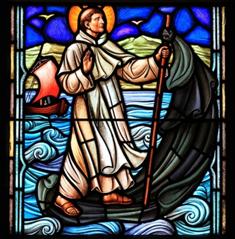
St. Raymond of Pennafort:
Dominican Friar, Priest, Master of the Order
A
renowned doctor of canon law and notable writer, Raymond of Pennafort (1175 –
1275) joined the Dominican Order in 1222, after a distinguished academic career
in Barcelona and Bologna. His two principal works are his Summa
Casuum on penitential discipline and his compilation of the
decretals of canon law, commissioned by Pope Gregory IX. This collection of
conciliar and papal decrees became a standard work for canon lawyers for nearly
seven hundred years. St. Raymond later became the third master of the Order.
According to Dominican tradition, he once rebuked the king of Aragon for his
immoral behavior. When St. Raymond attempted to leave the island of Majorca and
return to Spain, he could not because the kind had forbidden all sailors to
give him passage. St. Raymond placed his cappa, the black mantle of the
Dominican habit, on the water, stepped on it, and sailed to the mainland.
CANON LAW and the Judgment of a heretical pope
Comment:
The Decretals of
Gratian is a collection of canonical texts compiled in the 12th
century. Pope Gregory IX in 1230 directed St. Raymond of Pennafort,
the distinguished Dominican, to organize an addendum to the code to include
legal codes adopted since the time of Gratian but the work became a much more
extensive revision. Working from the Decretals of Gratian, St.
Raymond wrote a five volume edition of the Decretals that became the Corpus iuris canonici which
served as the legal code for the Latin Church’s canon law from that time until
the promulgation of the Code of Canon Law in 1917.
Decretum Gratiani,
which was included in the old Corpus Iuris Canonici,
affirmed that a Pope who deviates from right doctrine (i.e.: a notorious public
heretic) can be judged. The canon states that the "pope judges
all and is judged by no-one, unless he is found to have departed from the
faith":
‘Hujus culpas redarguere præsumit mortalium nullus, quia cunctos ipse judicaturus a nemine est judicandus,
nisi
deprehendatur a
fide devius (dist. XL, C. 6)’.
When
the revised Code of Canon Law (Codex Iuris Canonici 1917) came
into force, the Church eliminated from the new legislation the phrase "unless he is found to have
departed from the faith." This deletion was continued in the 1983
code. Although the phrase, "unless he is found to have departed from
the faith," was not included in the 1917 and the 1983 codes, the
canonical commentary still regards the phrase as legally binding:
‘Canon 1404 – The First See is
judged by no one.‘
COMMENTARY: "Canon 1404 is not a
statement about the personal impeccability or inerrancy of the Holy Father.
Should, indeed, the pope fall into heresy, it is understood that he would lose
his office. To fall from Peter’s faith is to fall from his chair."
New Commentary on the Code of
Canon Law, John P. Beal, James A. Coriden, and Thomas J. Green eds. (New
York: Paulist, 2000), p. 1,618.
The
code is the compilation of laws governing the Church as social institution.
Most of the laws in the code are of ecclesiastical positive human laws grounded
upon human authority, however, many of the legal codes are divine positive laws
grounded upon divine authority or upon natural law. If a human law is deleted
from the code, the law ceases to bind. If a law of divine authority is deleted
from the code, the law continue in force for the human authority of the Church
cannot overturn the law of God. This self-evident principle is stated in the
code itself. Consequently,
the commentary cited above is a recognition that the pope cannot be judged
"unless he is found to have departed from the faith" is of divine
origin. It is necessarily a divine law because the papacy is a divine
institution established directly by Jesus Christ and therefore governed in its
essence only by divine laws. In other words, if it were not a divine law,
the Church could not propose a human law to judge what was established by God.
Therefore,
it is of divine law that permits a heretical pope to be judged. Importantly,
although the law permits a heretical pope to be judged, it says nothing about
who and how a pope is to be judged regarding heresy and it does not address
penalties. It says nothing about removal from office. If the law intended the
removal from office the law itself would have to state the penalty and provide
a mechanism for its determination and enforcement.
So
now it falls to opinions regarding the judgment of a heretical pope. Most
theologians believe that it is "understood" that the removal from
office necessarily follows from a judgment of heresy often citing the
scriptural and traditional admonition to avoid heretics:
"A man that is a heretic,
after the first and second admonition, avoid: Knowing that he, that is such a
one, is subverted, and sinneth, being condemned by his own judgment"
(Titus 3:10-11).
They
argue that since the faithful cannot avoid a pope as head of the Church
therefore the heretical pope must lose his office. A serious problem with this
argument follows, that is, if the faithful cannot "avoid" a pope,
then there must necessarily be a pope who in fact cannot be
avoided. Therefore, those who would make the papacy vacant must also be
able to fill the office with a true pope.
But
can a heretical pope be avoided? It really becomes a problem for those who hold
the pope as their proximate rule of faith and not, as they should, dogma. For
if dogma is not the proximate rule of faith then the pope must be and he then
can never be a heretic for whatever the pope holds the dogma or doctrine to
mean is what it then means and only those who disagree with the pope are
heretics. For a Catholic, dogma is the proximate rule of faith and although a
heretical pope can do immeasurable damage to the Church he cannot touch
individual souls of the faithful.
If
we adhere to what the law says and nothing more we can say this: The definition
of heresy is the denial of dogma. The heretic denies dogma and the faithful
keep dogma. Those who can judge a heretical pope are the faithful. The law does
not distinguish or discriminate among the faithful as to the judgment. Dogma is
articulated for all the faithful. Its understanding does not require any
theological competence. It requires proper definition and correct grammar. Any
of the faithful, that is those who hold dogma as their proximate rule of faith,
can judge a manifestly heretical pope such as Pope Francis was. Any of the
faithful can know when a dogma is directly contradicted for the first
principles of the understanding, such as the principle of non-contradiction,
are innate in human nature. Thus all the faithful can judge, in fact must
judge, a heretical pope and so that they may not follow him in his heresy for
God has said that 'it
is not possible to deceive His elect' (Matt. 24:24). The law does
not specify the judge because the judgment rests with all the faithful, it is
universal. The law does not specify a penalty because none of the faithful have
the competency to impose a penalty and remove a heretical pope from office. It
is God who is the formal and final cause of the pope and the office of the
papacy. It is God who 'marries' the designated candidate to the papal office
and only God can remove him from it just as God removed the High Priest and
destroyed the Temple in Jerusalem and the Levitical priesthood which
can never be reconstituted.
Those
who hold dogma as their proximate rule of faith recognize Pope Francis as a
heretic because he denies dogmatic truth. He preaches a different gospel so we
"receive him not into the house nor say to him, God speed you" (2
John 10). Since he preaches a different gospel, "Let him be anathema"
because we are first "servants of Christ" (Gal 1: 8). For in dogma,
the Church has spoken and the heretic Pope Francis "will not hear the
church, (therefore) let him be to thee as the heathen and publican (Matt
18:17).
The
job of the faithful is to keep the faith.
Dogmas
“are to give light, not to receive light from human reason”!
I answer: The obligation
to believe what God says is a natural duty, it is a natural law, dictated by
the common sense of reason which the Creator has deposited in every human soul.
The Church only enforces this law, which existed before she herself existed,
because from all eternity it was a truth that the creature is bound to believe
the word of the Creator. If the Church allows no denial, no doubt, no
alteration or misconstruction of any of her dogmas, it is because the veracity
of the Son of God, who has revealed these truths, is attacked when any of His
doctrines are denied or doubted. These dogmas are so many fixed stars in the
firmament of holy Church. They cannot be reached by the perversity and
frivolity of man. He may close his eyes against them and deny their existence;
he may misrepresent them and look at them through glasses stained the color of
every prejudice; but he cannot do away with them altogether, nor change in any
way their natural brightness and brilliancy. Like the stars that deck the vault
of heaven, they are to give light, not to receive light from human reason. They
are the word of God, and what God says is truth, that cannot be made untruth.
The mind that receives truth is enlightened thereby; the mind that denies or
misrepresents it is darkened and corrupted.
Besides, every dogma
of faith is to the Catholic cultivated mind not only a new increase of
knowledge, but also an incontrovertible principle from which it is able to draw
conclusions and derive other truths. They present an endless field for
investigation so that the beloved Apostle St. John could write at the end of
his Gospel, without fear of exaggeration: “But there are also many other things
which Jesus did: which if they were written every one, the world itself, I
think, world not be able to contain the books that should be written.”
The Catholic Church,
by enforcing firm belief in her dogmas—which are not her inventions, but were
given by Jesus Christ—places them as a bar before the human mind to prevent it
from going astray and to attach it to the truth; but it does not prevent the
mind from exercising its functions when it has secured the treasure of divine
truth, and a “scribe thus instructed in the kingdom of heaven is truly like a
man that is a householder, who bringeth forth out of his treasure new things
and old.” …. They are new because newly enacted, declared, defined; they are
old because they contain no new revelation or any assumption of power never
granted by Christ, but simply old truths under new forms, the old power exercised
under new circumstances.
Rev. Joseph Prachensky, S.J., The
Church of the Parables and True Spouse of the Suffering Savior
When
Pope Leo XIV met with cardinals and bishops residing in Rome at Christmas, his
Master of Ceremonies, Monsignor Marco Agostini, outed them by identifying them
on an open microphone as “culattoni tutti insieme” (all the faggots
together).
Anyone
who questions Agostini’s statement is encouraged to read In the Closet of
the Vatican
by Frédéric Martel who estimated that around 80% of the
clergy working in the Vatican are homosexuals. The 555-page work is the
result of over 1,500 interviews with people in the Vatican and in 30 countries:
among them, 41 cardinals, 52 bishops and monsignors, 45 apostolic nuncios and
foreign ambassadors.
Some
of Martel’s conclusions include:
·
The
Vatican has one of the biggest gay communities in the world….it is one huge
closet.
·
The
Church has become sociologically homosexual. It is responsible for countless
instances of sexual abuse that are undermining it from within.
·
The
priesthood is (now) the ideal escape route for young homosexuals. Homosexuality
is one of the keys to their vocation.
·
There are
more and more homosexuals as one rises through the Catholic hierarchy. In the
College of Cardinals and at the Vatican, the preferential process is said to be
perfected; homosexuality becomes the rule, heterosexuality the exception.
Gene
Thomas Gomulka, is a sexual abuse victims’ advocate, investigative reporter,
author, and screenwriter. A former Navy Captain Chaplain Corps, seminary
instructor, and diocesan Respect Life Director. Gomulka was ordained a priest
for the Altoona-Johnstown diocese and later made a Prelate of Honor (Monsignor)
by JPII.
COMMENT: Apparently Msgr.
Agostini did not realize that the microphone was on when he said, "All the
faggots together." For his indiscretion he has been dismissed from his
position. While not knowing anything about Martel's book that is recommended by
Rev. Gomulka, it is just another addition to the a long list, and growing
longer, of documentation of the Homosexual Lobby's infiltration and control of
the Novus Ordo Church. Traditional Catholics have been exposing this crime for
a long time. One of the priests that help in the establishment of Saints Peter
& Paul Roman Catholic Mission was the late Rev. Enrique Rueda authored The
Homosexual Network published in 1982. Rev. Rueda inspired the work of Randy
Engel who continued his work with her book, Rite of Sodomy published in 2006.
The late Rev. John O'Connor, O.P., a traditional Dominican, exposed in detail
the homosexual takeover of the Dominican Order in the United States and the
failure of Rome to do anything about it. The Polish priest, Rev. Dariusz Oko, a theology professor at the Pontifical
University of John Paul II in Krakow, was fined in Germany in 2022 along with
his published, for "hate speech" in an article that referred to
homosexual priests as "a colony of parasites", "a cancerous
growth" and "a homosexual plague" in the Church. He also called
the "gay-affirming movement" a "homo-heresy." The book Goodbye,
Good Men by Michael S. Rose is another work that documents the homosexual
infiltration of the Church. Should we be surprised? Remember Bella Dodd, under sworn testimony before
Congress in the 1950s, claimed that she had helped place 1,500 committed
communists into Catholic seminaries. None of these homosexuals will ever give
up their sinecures in the Novus Ordo church network. Jesus Christ began and
ended His public life with the 'cleansing of the Temple' driving the profane
from the house of God. Call to mind what God did to Rome in 1527 when the
mercenary Protestant army of Charles V sacked Rome. The destruction and death
lasted about nine months. This cleansing of Rome made possible the rebuilding
and reformation accomplished by the Council of Trent. The punishment that is at
the door today will be a pitiless destruction of the entire Novus Ordo
structure and make possible the great restoration that will follow.
"All ceremonies are professions of faith, in which the interior worship
of God consists. Now man can make profession of his inward faith, by deeds as
well as by words: and in either profession, if
he makes a false declaration, he sins mortally."
St. Thomas Aquinas, (ST, I-II, Q. 103, Art. 4)
 Queers Always
Hang Together
Queers Always
Hang Together
“Sodomy Is a Gift from God…. Those who oppose sodomy should be debarred
from church seminaries.”
Rev.
Timothy Radcliffe, O.P., an Oxford scholar and international celebrity
appointed by Pope Francis to the Pontifical Council of Justice and Peace in
2015. On 6 October 2024, Pope Francis announced that Radcliffe would be created
a cardinal on December 8 but was the date was later changed to 7 December. Pope
Francis, granting him a dispensation from the current requirement that all
cardinals must be bishops, made him a cardinal deacon and assigned him to the Chiesa dei Santi Nomi di Gesu e Maria.
He participated as a cardinal elector in the 2025 conclave that elected Pope
Leo as the sole elector that was not a bishop.
Pro-LGBT Cdl. Radcliffe
urges ‘openness to novelty’ in address to extraordinary consistory
Reports from
inside the Vatican suggest growing unease among the cardinals after Pope Leo’s
two-day gathering opened with tightly controlled group sessions led by liberal
voices.
LifeSiteNews | Gaetano Masciullo | Thu Jan 8, 2026
VATICAN CITY— Pro-LGBT Cardinal Timothy Radcliffe delivered the opening
meditation at the consistory in Rome by urging  cardinals to remain “in the boat of Peter”
amid global crises and Church divisions while suggesting “memory and openness
to novelty must coexist in the life of the Church.”
cardinals to remain “in the boat of Peter”
amid global crises and Church divisions while suggesting “memory and openness
to novelty must coexist in the life of the Church.”
On the afternoon of January 7, Pope Leo XIV opened a two-day
extraordinary consistory at the Vatican, convening cardinals from around the
world to reflect on four major themes – the mission of the Church in today’s
world, synodality, the relationship between the Holy See and the particular
Churches, and the liturgy – though only the former two were selected for
detailed discussion, a decision that, according to off-the-record accounts
reported by the Italian blog Messainlatino, prompted discouragement and concern
among several participants.
“I am here to listen,” Pope Leo
XIV told the cardinals in his opening address, stressing that the meeting was
intended not to produce documents but “to continue a conversation that will
help me in serving the mission of the entire Church.”
According to the blog Messainlatino, multiple unnamed cardinals
described the first session as poorly prepared and structurally restrictive,
noting in particular that there were no free interventions scheduled for the
opening day. Discussions were conducted in small, pre-assigned working groups
based on language and curial affiliation, a format some participants reportedly
said did not resemble the traditional consistory model of the past.
The same source reported that, for reasons of time, the theme of the
liturgy was effectively excluded from substantive group discussion, despite
being listed among the four initial topics. Several cardinals allegedly
lamented what they perceived as a lack of interest in the Church understood as
“mystery,” and said that the overall approach appeared to be in continuity with
the synodal processes of recent years.
The opening meditation was delivered by Cardinal Timothy Radcliffe,
O.P., a leftist prelate who has praised “gay sexuality” in blasphemous remarks,
celebrated “LGBT Masses,” supported admitting homosexuals to the priesthood,
and encouraged Catholics to watch homosexual movies and read homosexual novels.
In his reflection on the Gospel of Mark (6:45–52), Radcliffe urged the
cardinals to “remain in the boat of Peter” amid contemporary storms facing both
the world and the Church, including war, inequality, sexual abuse scandals, and
ideological divisions.
Radcliffe warned against remaining “on the shore” out of fear or
disagreement, arguing that unity and mutual charity among the cardinals were
essential to supporting the Pope. He stated that “memory and openness to
novelty must coexist in the life of the Church,” citing Evangelii
Gaudium and Saint Augustine to argue that Tradition and renewal are
inseparable.
Messainlatino also reports that upcoming sessions of the consistory are
expected to open with reflections by pro-LGBT Cardinal José Tolentino de Mendonça and Cardinal Luis Antonio
Tagle, both widely regarded as prominent liberal voices within the College of
Cardinals.
COMMENT: Cardinal Radcliffe is a notorious homosexual. Pope Leo in
selecting him as the spiritual director of the consistory is making an open declaration
that the spirit of the consistory is NOT the Holy Spirit. The Mission of the
Church was established by its founder, Jesus Christ. It was established with a
specific commission to "make disciples of all nations." Synodality is
a denial of the dogma of the universal jurisdiction of the pope. The Church's
relationship with non-Catholic churches is established by God: "There is
no salvation outside the Catholic Church." It is the relationship is
between those who can be saved and those who are not. Finally, the liturgy is
the work of God Who dogmatically established at the Council of Trent:
"Those that say that the received and approved rites customarily used in
the solemn administration of the sacraments may be changed into other new
rites... by any pastor of the churches whomsoever: anathema sit.
Pope Leo begins
a new catechism series dedicated to Vatican II
Pope Leo on
Wednesday praised the ‘liturgical reform’ launched by Vatican II that laid the
groundwork for the revolutionary Novus Ordo Missae, the new Mass.
LifeSiteNews | Emily Mangiaracina | Jan 8, 2026
 VATICAN CITY— Pope Leo XIV announced
Wednesday that he is beginning a catechesis series to “closely” study the
Second Vatican Council, which many priests and scholars have affirmed to be in
need of correction.
VATICAN CITY— Pope Leo XIV announced
Wednesday that he is beginning a catechesis series to “closely” study the
Second Vatican Council, which many priests and scholars have affirmed to be in
need of correction.
“We are beginning
a new catechesis series dedicated to the Second Vatican Council and to a fresh
reading of its Documents,” Leo wrote in an X post on January 7. “The Council’s
Magisterium remains even today the North Star guiding the Church’s journey.”
“Closely studying the Council documents will help us to be attentive
interpreters of the signs of the times, and to proclaim the Gospel to all,” Leo
said Wednesday during his general audience.
In Leo’s strong
support for Vatican II, he aligns himself with Pope Francis, who described the
Council as “a visit of God to His Church,” and as “irreversible.”
The pope has not
given further details thus far on the forthcoming “catechesis” of Vatican II.
However, during his general audience on Wednesday, he highlighted aspects of
the Council that he highly esteems.
For example, Leo
praised the “liturgical reform” launched by Vatican II, which laid the
groundwork for the revolutionary Novus Ordo Missae, the new Mass. The Council
“set in motion an important liturgical reform by placing at the center the
mystery of salvation and the active and conscious participation of the entire
People of God,” Leo said in his general audience.
Liturgist and author Dr. Peter Kwasniewski has pointed out that the
idea articulated in the Second Vatican Council’s Sacrosanctum Concilium that “In the restoration and promotion of
the sacred liturgy, this full and active participation by all the people is the
aim to be considered before all else” is backward.
“It cannot escape our notice that this text turns things on their
head,” Kwasniewski remarked in 2019. “Where Pius X had said that what should be
‘provided for before everything else’ is the ‘sanctity and dignity of the
temple,’ Vatican II says that ‘the aim to be considered before all else’ is
‘full and active participation by all the people.’ In doing so, it inverts the
hierarchy of goods. Now the worship of God and its right condition becomes
secondary to the people’s involvement.”
Pope Leo also on
Wednesday lauded Vatican II for being responsible for a Church committed to
“seeking the truth through the way of ecumenism, interreligious dialogue and
dialogue with people of good will,” as if the Church needs to seek truth
outside of Herself. The idea that the fullness of the truth is not found within
the Catholic Church is heretical.
Leo’s description of the Second Vatican Council during his general
audience and in his social media post as the “guiding star” of the Church’s
path suggests he sees this council as surpassing in importance every other
council of the Church, which is especially significant given that Vatican II
appeared to contradict previous magisterial councils in certain respects.
Prelates such as
Bishop Athanasius Schneider and Archbishop Carlo Maria Viganò have pointed to
errors in the Second Vatican Council regarding religious freedom and other
religions, and in doing so have been supported by many priests and scholars.
For example,
Bishop Schneider has said Lumen Gentium
is “wrong” and errs by suggesting that Christians and Muslims participate
together in the same act of adoration when it states that “Muslims, who,
professing to hold the faith of Abraham, along with us adore the one and
merciful God.”
It errs because Muslims worship on a natural level, at the same level
of anyone who adores God with the “natural light of reason,” whereas Christians
adore God on a supernatural level as His adopted children “in the truth of
Christ and in the Holy Spirit.”
“This is a substantial difference,” Schneider observed. He explained
that the use of the phrase “with us” represents a relativization of the act of
adoration of God and also of Christians’ “sonship.”
In addition, Muslims reject the Trinity, which they consider to be an
idolatrous idea. Christ made clear that “whoever rejects me rejects the one who
sent me” (Luke 10:16) and “no one comes to the Father except through me” (John
14:6).
Schneider criticized texts suggesting that Buddhists and Hindus can
attain illumination on their own, without “the grace of Christ,” as a heresy. Nostra Aetate claims that “in Hinduism,
men contemplate the divine mystery,” and that Buddhism “teaches a way by which
men, in a devout and confident spirit, may be able either to acquire the state
of perfect liberation, or attain, by their own efforts or through higher help,
supreme illumination.”
The German prelate has also criticized Dignitatis Humanae for putting forth “a theory never before taught
by the constant Magisterium of the Church, i.e., that man has the right founded
in his own nature, ‘not to be prevented from acting in religious matters according
to his own conscience, whether privately or publicly, whether alone or in
association with others, within due limits.’”
Archbishop Viganò agreed with Bishop Schneider in his criticism of the
Second Vatican Council, noting that Vatican II’s formulation of religious
freedom “contradict[s] the testimony of Sacred Scripture and the voice of
Tradition, as well as the Catholic Magisterium which is the faithful guardian
of both.”
It is also noteworthy that Vatican II’s Decree on Ecumenism, Unitatis Redintegratio, condones
“prayers in common” with our “separated brethren” in “certain special
circumstances, such as the prescribed prayers “for unity,” and during
ecumenical gatherings.”
However, the Councils of the Church have repeatedly made clear that
Catholics cannot pray with heretics or schismatics, let alone those of other
religious practices:
· “One must neither pray nor sing psalms with heretics, and whoever shall
communicate with those who are cut off from the communion of the Church,
whether clergy or layman: let him be excommunicated.” — Council of Carthage
· “No one shall pray in common with heretics and schismatics.” — Council
of Laodicea
· If any ecclesiastic or layman shall go into the synagogue of the Jews or
to the meeting houses of the heretics to join in prayer with them, let them be
deposed and deprived of communion. If any bishop or priest or deacon shall join
in prayer with heretics, let him be suspended from communion. — II Council of
Constantinople
COMMENT: Pope Leo is just another heretic embracing the
heresies of Vatican II, a pastoral council that has by every statistical
analysis has proven to be an utter pastoral failure. A pastoral approach to
pastoral problem is comparable to a business plan to the operation of the
business. Now is a business plan leads to financial ruin of a business the
board of directors will immediately fire the CEO, his staff and advisors, and
seek another with a different business plan. What can be said about the Novus Ordo
popes is that the "pastoral plan" they have adopted from Vatican II
is not a failure but rather a resounding success because the purpose of the
plan is to destroy the Church of Jesus Christ. What they are doing is what they
have always intended to do. The Church was established in Truth by Truth Itself
and does not "seek" truth from those who deny it.
In
2005 the Dover, PA electorate removed the School Board members that permitted
Intelligent Design to be considered in as a possible explanation for the
natural order found in the material universe. Scientists, while affirming that
the natural order in the universe must necessarily be the result of mechanical
chance, “listened with a vast radio telescopic network for signals (from outer
space) that resembled coded intelligence and were not merely random” for
evidence of intelligent life in the universe.
If these scientists affirm that the DNA code of biological life, which is
clearly goal directed, is “merely random” and not a sign of “intelligence” how
can they be open to recognize any sign of intelligible communication!? Is this
WSJ article evidence that there is no intelligence design in the Dover, PA
electorate or in modern science?
Science Increasingly Makes
the Case for God
The odds of life existing on another planet grow
ever longer. Intelligent design, anyone?
Eric Metaxas:
Dec. 25, 2014
In 1966 Time magazine ran a cover story asking: Is God Dead? Many have accepted the cultural narrative that he’s obsolete—that as science progresses, there is less need for a “God” to explain the universe. Yet it turns out that the rumors of God’s death were premature. More amazing is that the relatively recent case for his existence comes from a surprising place—science itself.
Here’s the story: The same year Time featured the now-famous headline, the astronomer Carl Sagan announced that there were two important criteria for a planet to support life: The right kind of star, and a planet the right distance from that star. Given the roughly octillion—1 followed by 27 zeros—planets in the universe, there should have been about septillion—1 followed by 24 zeros—planets capable of supporting life.
With such spectacular odds, the Search for Extraterrestrial Intelligence, a large, expensive collection of private and publicly funded projects launched in the 1960s, was sure to turn up something soon. Scientists listened with a vast radio telescopic network for signals that resembled coded intelligence and were not merely random. But as years passed, the silence from the rest of the universe was deafening. Congress defunded SETI in 1993, but the search continues with private funds. As of 2014, researches have discovered precisely bubkis—0 followed by nothing.
What happened? As our knowledge of the universe increased, it became clear that there were far more factors necessary for life than Sagan supposed. His two parameters grew to 10 and then 20 and then 50, and so the number of potentially life-supporting planets decreased accordingly. The number dropped to a few thousand planets and kept on plummeting.
Even SETI proponents acknowledged the problem. Peter Schenkel wrote in a 2006 piece for Skeptical Inquirer magazine: “In light of new findings and insights, it seems appropriate to put excessive euphoria to rest . . . . We should quietly admit that the early estimates . . . may no longer be tenable.”
As factors continued to be discovered, the number of possible planets hit zero, and kept going. In other words, the odds turned against any planet in the universe supporting life, including this one. Probability said that even we shouldn’t be here.
Today there are more than 200 known parameters necessary for a planet to support life—every single one of which must be perfectly met, or the whole thing falls apart. Without a massive planet like Jupiter nearby, whose gravity will draw away asteroids, a thousand times as many would hit Earth’s surface. The odds against life in the universe are simply astonishing.
Yet here we are, not only existing, but talking about existing. What can account for it? Can every one of those many parameters have been perfect by accident? At what point is it fair to admit that science suggests that we cannot be the result of random forces? Doesn’t assuming that an intelligence created these perfect conditions require far less faith than believing that a life-sustaining Earth just happened to beat the inconceivable odds to come into being?
There’s more. The fine-tuning necessary for life to exist on a planet is nothing compared with the fine-tuning required for the universe to exist at all. For example, astrophysicists now know that the values of the four fundamental forces—gravity, the electromagnetic force, and the “strong” and “weak” nuclear forces—were determined less than one millionth of a second after the big bang. Alter any one value and the universe could not exist. For instance, if the ratio between the nuclear strong force and the electromagnetic force had been off by the tiniest fraction of the tiniest fraction—by even one part in 100,000,000,000,000,000—then no stars could have ever formed at all. Feel free to gulp.
Multiply that single parameter by all the other necessary conditions, and the odds against the universe existing are so heart-stoppingly astronomical that the notion that it all “just happened” defies common sense. It would be like tossing a coin and having it come up heads 10 quintillion times in a row. Really?
Fred Hoyle, the astronomer who coined the term “big bang,” said that his atheism was “greatly shaken” at these developments. He later wrote that “a common-sense interpretation of the facts suggests that a super-intellect has monkeyed with the physics, as well as with chemistry and biology…. The numbers one calculates from the facts seem to me so overwhelming as to put this conclusion almost beyond question.”
Theoretical physicist Paul Davies has said that “the appearance of design is overwhelming” and Oxford professor Dr. John Lennox has said “the more we get to know about our universe, the more the hypothesis that there is a Creator . . . gains in credibility as the best explanation of why we are here.”
The greatest miracle of all time, without any close seconds, is the universe. It is the miracle of all miracles, one that ineluctably points with the combined brightness of every star to something—or Someone—beyond itself.
Mr. Metaxas is the author, most recently, of “Miracles: What They Are, Why They Happen, and How They Can Change Your Life” (Dutton Adult, 2014).
JP II the 'Grate' - if somehow he made
it to Purgatory - ask him to turn out
the lights and lock the place up when he is the last to leave.
John Paul II was a
pope under whose reign we had the most horrific scandal in the Church's
2000-year history. Thousands of children
were molested by priests and bishops he ordained. By the end of his pontificate, lawsuits were
bankrupting Catholic Churches all over the world; and between one third and one
half of the clergy (sources available upon request) were admittedly homosexual,
with a significant percentage being pederasts whom the pope didn't even admit
existed when he was told of their crimes, much less did anything to stop them,
even when stark evidence was brought before him, as in the case of Legionnaires
leader Marciel Maciel. At the same time
he hid other clerics from prosecution, as in the case of Cardinal Bernard Law
of Boston.
This was the pope who
allowed the Vatican Bank's corruption that started under Paul VI to continue
with little or no reform; and who protected its chief perpetrator, Bishop Paul
Marcinkus, from prosecution. He did
nothing to investigate the suspected murder of John Paul I, the very pope who
made it known in the first days of his reign that he was going to clean up the
financial misdealings of his curia. This
was the pope who took 250 million dollars of the Vatican's money and gave it to
Solidarity in Poland, thereby making the Church a political institution instead
of a spiritual one. By the same token he
condemned Liberation theology because if its tendency to get involved in
politics.
This was the pope who
went to the hut of an African witch doctor in 1985 and afterward wrote,
"the prayer meeting in the sanctuary at Lake Togo was particularly
striking. There I prayed for the first
time with animists." In December
1984 he sent a
Vatican representative to the laying of the foundation of the largest
mosque in Europe. In September 1989 he
wrote to Muslim leaders and said: "In the name of the same God we
adore," without any qualifications whatsoever. In May 1999 he kissed the Koran in a public
ceremony; and in 2000 asked John the Baptist "to protect Islam." In February 1986 he received the red dust of
the Hindu religion on his forehead in honor of the goddess Shiva. In March 1986 in New Delhi he stated that
"collaboration between all religions is necessary for the good of
mankind... as Hindus, Buddhists, Jainists, and Christians, we unite to proclaim
the truth about man."
This was the pope who
invited all the world's non-Christian and pagan religions to pray for world
peace at Assisi in 1986 and Assisi in 2002 (with five additional Assisi-like
gatherings in the 1990s in various countries) and never once in those 16 years
did he preach the Gospel to them about conversion to Christ for salvation. Instead he sent them all back to their
countries encouraging them to continue to pray to their false gods, the very
opposite that St. Paul did in Acts 17. He
paid no attention to any of his high-placed clerical advisors who told him these
acts were abominations.
This was the pope who,
against two millennia of Catholic tradition, told husbands to be mutually
submissive to women; dispensed with head coverings for women; and allowed women
and girls to be communion ministers, altar girls, and directors of chanceries,
thereby increasing the feminization of the Church amidst an already feminized
clergy who were by this time at least a third homosexual, while another
significant portion were receiving paternity suits.
This was the pope who profusely
apologized for the ecclesiastical policies of previous popes; who had his
Vatican envoy sign the 1998 Lutheran/Catholic Joint declaration which, in
direct contradiction to the Council of Trent, said "man is justified by
faith alone." This was the pope who
told the Lutherans they had a "profound religiousness and spiritual
heritage" and that Martin Luther was driven by a "burning passion of
the question of eternal salvation," and who told the Lutheran bishops that
Rome's excommunication of Luther had expired, and that "There is a need
for a new evaluation of the questions raised by Luther and his
teaching." This was the pope who
implied or taught universal salvation and that hell may not be applicable to
any human being. This was the pope who
at the very beginning of his pontificate in the 1979 encyclical Redemptor Hominis used the word
"church" 150 times but never once mentioned the word
"Catholic." This was the pope
who continually sided with liberals like Karl Rahner, Urs von Balthasar and Raymond
Brown but who would hardly give an ear to those, such as Archbishop Lefebvre,
who wanted to preserve the tradition and who decried the anti-Catholic
innovations being foisted on the Catholic populace. (Fortunately, Pope Benedict XVI saw John Paul
II's mistake and reversed the decision against Lefebvre). This was the pope who was criticized by his
own admirers for failing to discipline wayward clerics, both in their doctrinal
aberrations and moral laxity (Charles Curran, Edward Schillebeeckx, Hans Kung,
et al). Ironically, the only cleric that
was excommunicated was Lefebvre, yet he was one of the most doctrinally sound
and morally upright clerics the Church had ever known.
This was the pope who
in 1981, contrary to tradition, implied or taught that the Jewish Old Covenant
is not revoked and that Jews have a special relationship with God, as does
Paragraph 121 of his papally-signed 1994 Catechism. He continued to propagate confusing and
doctrinally fallacious teaching about the Jews and Judaism through his
cardinals who taught that the Jews did not need to convert to Christianity to
be saved since they have their own covenant with God (Kasper, Keeler,
Willebrands, George, Ratzinger, et al).
This was the first pope in history to visit Israel and who then placed
himself under Judaism by praying at the Jerusalem's Wailing Wall. This was the pope who, for the first time in
the history of the papacy, visited and prayed in Jewish synagogues - the
religion that denies more than any other that Jesus Christ is God.
Last but not least,
this was the pope who changed the Church's criterion for sainthood, which now
allows him and all his fellow 20th century popes to be easily canonized in the
face of the fact that there have been only three popes canonized since 1294
(Pius X, d. 1914; Pius V, d. 1572; Celestine V, d. 1294). As such, the very popes who lived and reigned
during the Church's worst corruptions and scandals are now being exonerated and
place in heaven.
Robert Sungenis, Ph.D., Letter to Editor, Culture Wars Magazine
In pastoral
letter, Charlotte's Bishop Martin ends altar rails for holy Communion
National Catholic Reporter | Patricia L. Guilfoyle | Charlotte, N.C. —
December 23, 2025
 Bishop Michael Martin has established guidelines for the reception of
holy Communion in the Diocese of Charlotte to strengthen unity in
worship, uphold the church's liturgical norms and encourage active
participation by the faithful.
Bishop Michael Martin has established guidelines for the reception of
holy Communion in the Diocese of Charlotte to strengthen unity in
worship, uphold the church's liturgical norms and encourage active
participation by the faithful.
Martin announced
the new norms in a pastoral letter that affirms the common posture of standing
to receive holy Communion, encourages priests to offer Communion
under both bread and wine more often, and calls for the broader use of trained
laypeople to serve as Eucharistic ministers.
"The liturgy of the Church is the work of God and the work on
behalf of God in the life of the Church," Martin wrote in the Dec.
17 letter. "These norms
for our diocese move us together toward the Church's vision for the fuller and
more active participation of the faithful."
In his pastoral letter, the bishop emphasized that the celebration
of the Eucharist is a communal act of worship, not only an individual act of
piety.
"Throughout
the ages and within the context of our rich liturgical traditions from the East
to the West, our unity as believers in Holy Communion is expressed through
our postures and gestures that reflect our mystical communion and unity as
fellow believers," he said.
The new guidance does not replace the diocese's general
liturgical norms established in 2005, but builds upon them and aligns
closely with the Catholic Church's universal norms (what is called
the "General Instruction of the Roman Missal") and directives set by
the U.S. Conference of Catholic Bishops.
The pastoral letter follows months of consultation with the
diocese's Office for Divine Worship and the Presbyteral Council of priests,
which represents all priests of the diocese in administrative and policy
discussions.
In his
pastoral letter, Martin affirmed the "normative posture" for
receiving holy Communion in the United States is standing, after bowing
the head as a sign of reverence.
The directive
instructs any parishes that currently use altar rails for
distributing Communion to discontinue the practice and remove any portable
kneelers or prie-dieus by Jan. 16, noting that such practices are "a
visible contradiction" to the prescribed posture of standing.
"Instead,"
his pastoral letter states, the church "emphasizes that receiving
Holy Communion is to be done as the members of the faithful go in
procession, witnessing that the Church journeys forward and receives
Holy Communion as a pilgrim people on their way."
In many churches,
altar rails are architectural elements that differentiate the sanctuary from
the nave and once were used for Communion distribution.
Over the past decade or so, a small number of churches in the diocese
reintroduced the use of rails or kneelers to distribute Holy Communion,
but most diocesan churches already follow the practice of
receiving Communion while standing, consistent with U.S. norms.
In his pastoral letter, the bishop reiterated that individuals may
not be denied holy Communion if they choose to kneel, yet he encouraged
the faithful to "prayerfully consider the blessing of communal witness
that is realized when we share a common posture."
Clergy and catechists, he added, "are to instruct communicants
according to the normative posture in the United States" and "are not
to teach that some other manner is better, preferred, more efficacious,
etc."
In guidance to pastors that accompanied the bishop's
pastoral letter, the diocese's Office for Divine Worship noted that if a
communicant wishes to kneel but is physically unable, the pastor should address
the situation privately.
"He is to
catechize and remind the person that standing to receive is no less reverent or
worthy a way to receive Our Lord," advised Fr. Noah Carter, diocesan
liturgy director. "In both ways, the communicant who is properly
disposed to receive holy Communion gains the same graces and gifts
contained in the Eucharist, regardless of standing or kneeling."
In
his letter, Martin also encouraged pastors, where and when possible, to
distribute holy Communion under the forms of both bread and wine more
often.
While affirming church teaching that Christ is fully present — body,
blood, soul and divinity — under either bread or wine, he encouraged priests to
consider the "fuller sign" of distributing holy Communion under
both kinds to foster "a deeper participation in the Eucharistic
mystery," consistent with prevailing church practice.
The bishop specifically noted that "a significant number of
parishes" did not resume distribution of the Precious Blood in the wake of
the COVID-19 pandemic. "To foster unity, it is helpful that we all
practice a similar way of distributing Holy Communion," he said.
"Parishioners who travel from parish to parish because of their
own needs may otherwise rightly question why the Precious Blood is always
available in one church and never available in another."
The pastoral letter specifically recommends distributing the
Precious Blood for at least one Mass every Sunday and for major solemnities,
including: Christmas, the Easter Vigil, Divine Mercy Sunday, Pentecost, Trinity
Sunday, Corpus Christi, Christ the King Sunday, and Holy Thursday. It also encourages
distributing holy Communion under both kinds for first holy Communion
Masses, wedding Masses, parish patronal feast days and church anniversaries.
It reaffirms that the consecrated host may be received either on the tongue or
in the hand, at the discretion of the communicant.
It explicitly prohibits the practice of intinction — dipping the host
into the Precious Blood before placing it on the communicant's tongue — at
public liturgies.
In his pastoral letter, the bishop also encouraged parishes to enlist more
laypeople to help clergy with distributing holy Communion.
Priests and deacons are the "ordinary ministers of
holy Communion," while laypeople may serve as "extraordinary
ministers of holy Communion" when needed, such as when there are too
many communicants for the clergy to distribute Communion efficiently.
In many parishes, extraordinary ministers also take Communion to
the sick and homebound.
The diocese's existing liturgical norms already call for
extraordinary ministers in such situations and provide for people to serve in
three-year terms. The new guidelines formalize practices that are already
commonplace in the diocese and across the U.S.
They set eligibility and formation requirements, and direct parishes to
have enough eucharistic ministers "for roughly 75 communicants" at
each Mass. Parishes are also directed to invite people to serve as
extraordinary ministers and offer training at least once a year.
To be appointed as such, a layperson must: be a
practicing Catholic who has received the sacraments of initiation; be at
least 16 years old; "demonstrate a deep reverence for and devotion to the
holy Eucharist"; be "distinguished in their Christian life, faith and
morals"; and take part in the diocese's safe environment training.
COMMENT: The immemorial rule of receiving Holy Communion in the Catholic
Church is kneeling and on the tongue from the hands of a Catholic priest or
deacon. In the Latin Rite communion is distributed only under the appearance of
bread. The current practice of the Novus Ordo Church is by Indult granted by
the Vatican at the petition from the Novus Ordo National Conference of Catholic
Bishops in the United States. An Indult is a permission to NOT obey the law.
Bishop Martin's Letter begins with a lie. It ends with imposing the norms of
the Lutheran church on the Novus Ordites and his determination to prevent
anyone from building a Catholic sanctuary. The Lutherans do not believe in the
True Presence in their services and neither does Bishop Martin. The Novus Ordo
Mass was initially defined as a memorial meal, and if that is all it is, then
the Lutheran norms are perfectly reasonable and there is no problem with Bishop
Martin's arguments. But Bishop Martin is liar and therefore we cannot expect
him to acknowledge this truth. A PEW poll in 2019 found that only 26% for all
Catholics under 40 years of age (and only 63% of all Novus Ordites who go to
Mass at least once each week) believe in the Catholic dogma of the True
Presence. These Catholics under 40 years of age were raised on the current
Indult and have lost the Catholic faith. What an established practice does in its signification is
what it was intended to do. The intention of Bishop Martin is to destroy
the belief in any remaining Catholics of the True Presence. The argument that
standing better symbolizes that we are a "pilgrim people" has been
used for more than fifty years. It was a stupid argument in the beginning and
remains a more stupid argument today because the result of the practice are
evident. The Novus Ordo church has yet to publically acknowledge that their
church is on a pilgrimage to hell!
"ALL
HERETICS ARE SCHISMATICS." St. Thomas Aquinas quoting St. Augustine
“It is not to
be excluded that I will enter history as the one who split the Catholic Church.”
Pope Francis,
concluding remarks attributed to him in the Der Spiegel article on the Crisis
in the Catholic Church.
COMMENT: As if that was not Pope Francis' intention
and what in fact he had long been doing throughout his pontificate? The question
remains as to what name in history will Francis be known? But let's leave that
for later. The truth is that Conservative Catholics have never gotten anything
in its right hierarchical order. They stupidly thought the “split” in the
Church began when traditional Catholics were disobedient to legitimate exercise
of authority by resisting the overthrow of our Ecclesiastical Traditions by
which alone the Faith can be known and communicated to others. Conservative
Catholics are only now turning to face the front of this conflict but they are
unarmed for the fight. Pope Francis, who professed the same doctrine as his
conciliar predecessors, only drovethe wedge far deeper into the Bark of Peter
to “split” the Church. The Conservative Catholics are at last alarmed because
the Ship is taking on massive amounts of water. Unfortunately, the poor
Conservative Catholics who are raising their voices against the corruption of
Francis and his successor Leo will surely fail. Let's call them the Dubiaists.
The Dubiaists have doubts but no real convictions. They will fail because they
turned their backs against the literal meaning of DOGMA long ago and cannot
recognize heresy. They now have nothing from which to mount their defense for
DOGMA is the one and only weapon against an abusive authority. Authority is
subject only to Truth. and DOGMA is the most perfect expression of Truth
available to all men.
Greetings from Pope Leo to Father Franz
Schmidberger, SSPX
 Pope
Leo extends his heartfelt congratulations to venerable Father Franz
Schmidberger, SSPX on the occasion of his fiftieth anniversary of his priestly
ordination and extends his apostolic blessing.
Pope
Leo extends his heartfelt congratulations to venerable Father Franz
Schmidberger, SSPX on the occasion of his fiftieth anniversary of his priestly
ordination and extends his apostolic blessing.
Friedrichshafen, Germany, December
14, 2025
COMMENT: We have publically
affirmed that the SSPX was formally regularized with modernist Rome no later
than 2015 and most likely in 2012 although this is not commonly shared with its
member priests or those faithful who attend their chaples for Mass. Fr.
Schmidberger was the general superior of the SSPX after the retirement of
Archbishop Lefebvre, and after his death when Bishop Fellay became the general
superior, Fr. Schmidberger was his direct assistant. It was under the guidance
of Fr. Schmidberger that the secret negotiations with modernist Rome began in
the 1990s that would eventually lead to their regularization. This
"heartfelt" greetings and congratulations from Pope Leo is in
acknowledgment of Fr. Schmidberger's untiring commitment to betray Catholic
tradition.
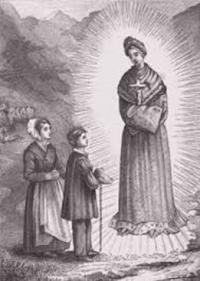 "There will be two worm-ridden popes".
Blessed Virgin Mary, Our
Lady of La Salette to Melanie
The
idea that there would be two worm-ridden popes is an unofficial, unpublished
prophecy of Melanie, one of two children at the apparition of La Salette in
France. It pops up in one of her letters to Fr. Roubaud back on September 30,
1884, and it was brought to light by author Michel Corteville in his book, Découverte
du secret de La Salette. Some say that the phrase actually
translates to: “two shaky, servile, doubtful popes.” The original French reads:
Mais avant ce temps (des tribulations) il
y aura deux fois une paix de peu de durée, deux Papes vermoulus, plats,
douteux.*
TRANSLATION: “But
before this time (of tribulations) there will be twice a peace of short
duration, two worm-eaten, flat, and doubtful Popes.”
“Living Tradition,” synonym for Immanentism of
the Modernist
The term, “living
tradition,” a novelty of modernist construction given official standing at
Vatican II, conflates the subjective understanding with the objective truth, is
part of the theological justification to replace our received traditions with
novelties grounded in fantasy.
“The
root of this schismatic act can be discerned in an incomplete and contradictory
notion of Tradition. Incomplete, because it does not take sufficiently into
account the living character of Tradition, which, as the Second Vatican
Council clearly taught, “comes from the apostles and progresses in the Church
with the help of the Holy Spirit. There is a growth in insight into the
realities and words that are being passed on. This comes about in various ways.
It comes through the contemplation and study of believers who ponder these
things in their hearts. It comes from the intimate sense of spiritual realities
which they experience. And it comes from the preaching of those who have
received, along with their right of succession in the episcopate, the sure
charism of truth”.
John Paul II, explaining the problems with
Archbishop Lefebvre’s consecration of four bishops from his failure to
understand the novel Vatican II definition of tradition
Hermeneutics
of Continuity/Discontinuity – Even
JPII did not deny this dogma!
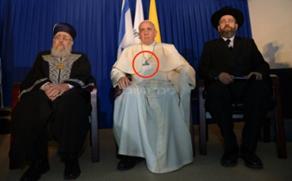 Pope Francis Teaches:
We hold the Jewish people in special regard because their covenant with
God has never been revoked, for “the gifts and the call of God are irrevocable”
(Rom.11:29). The Church, which shares with Jews an important part of the Sacred
Scriptures, looks upon the people of the covenant and their faith as one of the
sacred roots of her own Christian identity (cf. Rom. 11:16-18). As Christians,
we cannot consider Judaism as a foreign religion; nor do we include the Jews
among those called to turn from idols and to serve the true God (cf. 1 Thes.
1:9). With them, we believe in the one God who acts in history, and with them we
accept his revealed word. Pope Francis, Evangelii Gaudium
The Church officially recognizes that the People of Israel continue to
be the Chosen People. Nowhere does it say: “You lost the game, now it is our
turn.” It is a recognition of the People of Israel. Pope Francis, On Heaven and Earth
The
Catholic Church Teaches:
Hebrews 7:18: “On the one hand, a former commandment is annulled because of its weakness and uselessness…”;
Hebrews 10:9: “Then he says, ‘Behold, I come to do your will.’ He takes away the first [covenant] to establish the second [covenant]…”;
2 Corinthians 3:14: “For to this day when they [the Jews] read the Old Covenant, that same veil remains unlifted, because only through Christ is it taken away”;
Hebrews 8:7: “For if there had been nothing wrong with that first covenant, no place would have been sought for another”;
Colossians 2:14: “Having canceled the written code, with its decrees, that was against us and stood opposed to us; He took it away nailing it to the cross”;
Pope Pius XII, Mystici Corporis, para. 29: “…the New Testament took the place of the Old Law which had been abolished…but on the gibbet of His death Jesus made void the Law with its decrees fastened the handwriting of the Old Testament to the Cross”;
The Catechism of the Council of Trent: “…the people, aware of the abrogation of the Mosaic Law…”;
Council of Florence: [This council] firmly believes, professes, and teaches that the matter pertaining to the law of the Old Testament, of the Mosiac law, which are divided into ceremonies, sacred rites, sacrifices, and sacraments, because they were established to signify something in the future, although they were suited to the divine worship at that time, after our Lord’s coming had been signified by them, ceased, and the sacraments of the New Testament began; and that whoever, even after the passion, placed hope in these matters of the law and submitted himself to them as necessary for salvation, as if faith in Christ could not save without them, sinned mortally. Yet it does not deny that after the passion of Christ up to the promulgation of the Gospel they could have been observed until they were believed to be in no way necessary for salvation; but after the promulgation of the Gospel it asserts that they cannot be observed without the loss of eternal salvation. All, therefore, who after that time observe circumcision and the Sabbath and the other requirements of the law, it declares alien to the Christian faith and not in the least fit to participate in eternal salvation, unless someday they recover from these errors. Pope Eugene IV, Council of Florence, Cantate Domino
Council of Trent: “but not even the Jews by the very letter of the law of Moses were able to be liberated or to rise therefrom”;
Cardinal Ratzinger: “Thus the Sinai [Mosaic] Covenant is indeed superseded” (Many Religions – One Covenant, p. 70).
St. John Chrysostom: “Yet surely Paul’s object everywhere is to annul this Law….And with much reason; for it was through a fear and a horror of this that the Jews obstinately opposed grace” (Homily on Romans, 6:12); “And so while no one annuls a man’s covenant, the covenant of God after four hundred and thirty years is annulled; for if not that covenant but another instead of it bestows what is promised, then is it set aside, which is most unreasonable” (Homily on Galatians, Ch 3);
St. Augustine: “Instead of the grace of the law which has passed away, we have received the grace of the gospel which is abiding; and instead of the shadows and types of the old dispensation, the truth has come by Jesus Christ. Jeremiah also prophesied thus in God’s name: ‘Behold, the days come, says the Lord, that I will make a new covenant with the house of Israel, and with the house of Judah…’ Observe what the prophet says, not to Gentiles, who had not been partakers in any former covenant, but to the Jewish nation. He who has given them the law by Moses, promises in place of it the New Covenant of the gospel, that they might no longer live in the oldness of the letter, but in the newness of the spirit” (Letters, 74, 4);
Justin Martyr: “Now, law placed against law has abrogated that which is before it, and a covenant which comes after in like manner has put an end to the previous one; and an eternal and final law – namely, Christ – has been given to us, and the covenant is trustworthy…Have you not read…by Jeremiah, concerning this same new covenant, He thus speaks: ‘Behold, the days come,’ says the Lord, ‘that I will make a new covenant with the house of Israel and with the house of Judah…’” (Dialogue with Trypho, Ch 11).
John Paul II: “Christ fulfills the divine promise and supersedes the old law.” (Redemptoris Mater)
Taken from
Robert Sungenis, The Old Covenent:
Revoked or Not Revoked?
Pope Leo:
Don’t let tension between tradition, novelty become ‘harmful polarizations’
EWTN | Victoria Cardiel | October 27, 2025
Pope Leo XIV said at a Mass on Sunday that no one in the Church “should
impose his or her own ideas” and asked that tensions between tradition and
novelty not become “ideological contrapositions and harmful polarizations.”
“The supreme rule in the Church is love. No one is called to dominate;
all are called to serve,” Leo said in St. Peter’s Basilica on Oct. 26.
“No one should impose his or her own ideas; we must all listen to
one another,” he continued. “No one is excluded; we are all called to
participate. No one possesses the whole truth; we must all humbly seek it and
seek it together.” [.....]
COMMENT: The problem is this: the love of novelty is an
ideology, Tradition along with sacred Scripture is divine revelation. The
Church always and everywhere has condemned novelty until Vatican II and the
Novus Ordo Church of Novelty embraced it. The conflict between novelty and
tradition is the conflict between God's revelation and demonic lies; the
conflict between the Church and the World. Those who are faithful to tradition
do not "impose their own ideas" but defend God's revealed truth
against the novelty of the world. The Novus Ordo Novelty Church is
"seeking truth"; the Church of Jesus Christ possesses it. Pope Leo
like his predecessor likes to characterize tradition as rigid and dead and the
novelty of modernism as mature and hopeful. This was once an intensely debated
matter but, at this time, after all the wreckage of the last 50 years all
tradition has to do is to point at the fruit of Vatican II novelty. Both Leo
and his predecessor Francis worked in South America. The total population of
South and Central America is about 600 million. Since Vatican II about 300
million have apostatized from the Catholic Church. These last two popes have
personally presided over the greatest apostasy over the shortest period of time
in the history of the Catholic Church. Anything Leo has to say, as long as he
is not sitting in the Chair of Peter, must be examined in light of this record.
Fruit
of Vatican II - Apostasy
In Honduras, the country of the once most powerful man in the Roman
Curia under Francis/Bergoglio, Cardinal Rodríguez Maradiaga, a personally
corrupt and immoral man who had been a bishop in the capital since 1978, first as auxiliary then
as Archbishop for 30 years, the hierarchy led by him managed the amazing feat of transforming that country
in the first Catholic-minority nation in Central America, a vertiginous fall
from 94% to 46% in the same period - and the same happened in
Uruguay, across the Rio de la Plata from (Bergoglio's home) Buenos Aires.
Rorate Caeli
Data Collapse of Catholic Faith in Latin America from 2014 presided
over by Pope Leo/Provost and his predecessor Francis/Begoglio
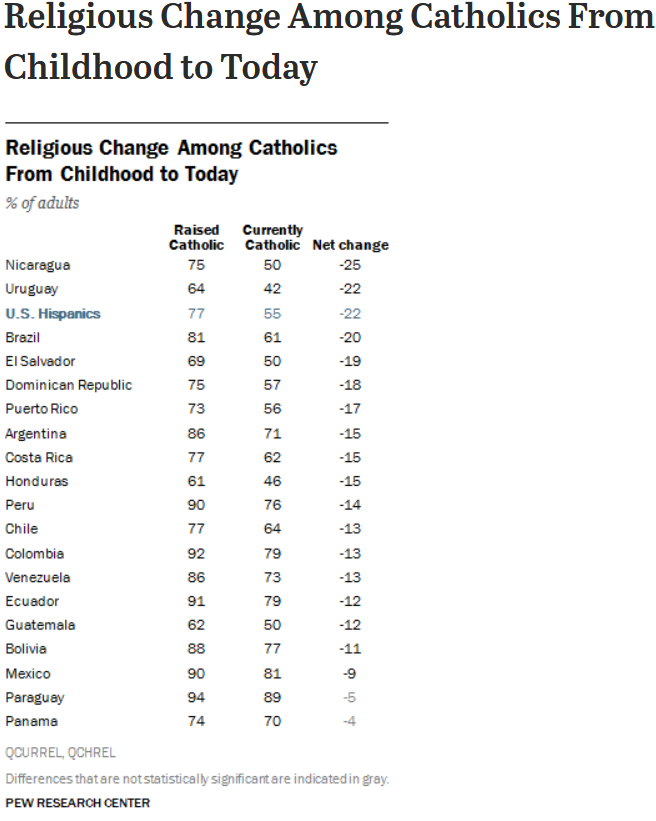
The
“received and approved rites of the Catholic Church, accustomed to be used
in the solemn administration of the sacraments”:
…..Because, as we will see, Catholics must celebrate only the “received and approved rites” of the Church as a matter of Divine Law.
God revealed this truth in Scripture through St. Paul. Before St. Paul
teaches the Corinthians liturgical and theological details concerning the Holy
Mass (consecration formula, Real Presence), he prefaces his teaching by
affirming: “For I have received
of the Lord that which I also delivered
unto you…” (I Cor 11:23). St. Paul says again: “For I delivered
unto you first of all, which I also received” (1Cor 15:3). In these and other
verses, St. Paul emphasizes that we must believe and practice only what we have
“received” from Christ and the apostles which has been “delivered” unto us, and
which includes the liturgical rites of the Church. This is a divinely revealed
truth and a matter of Faith.
The Church has taught this divine truth throughout her history. For
example, in the Papal Oath of Coronation, which originates at least as far back
as Pope St. Agatho in 678 A.D. (and which was set aside by Paul VI), every Pope
swore to change nothing of the “received tradition.” Pope
Pius IV’s Tridentine Profession of Faith, which is binding on the souls of all
Catholics, likewise expresses this principle by requiring adherence to the “received and approved rites of the
Catholic Church used in the solemn administration of the sacraments.” The “received and approved rites of the Church”
originate from the Spirit of Christ and the traditions of the apostles which
have been handed down to us through the ages.
Because the “received and approved rites” are part of the Church’s infallible
expression of the unchanging Deposit of Faith, as inspired and nurtured by the
Holy Ghost, they cannot be set aside or changed into new rites. This is why the
Ecumenical Council of Trent (1545-1563) infallibly declared:
“If anyone says that the received and approved rites
of the Catholic Church, accustomed to be used in the administration of the
sacraments, may be despised or omitted by the ministers without sin and at
their pleasure, or may be
changed by any pastor of the churches to other new ones, let him be anathema.”
Because the Council declares anathema (that is, condemned, or severed
from the Body of Christ) anyone who would set aside or change into new rites
the already “received and approved
rites” of the Church, proves that adherence to the “received and approved rites” is a matter of Divine Law. The
absolute necessity to preserve the substance of the Church’s ancient liturgical
rites is a requirement of the Faith because the rites preserve and express that
Faith. To hold that the Church’s rites can change implies a belief that the
Church’s doctrines can change, because the rites preserve and express the
doctrines. Hence, those who do not preserve the Church’s rites (by omitting or
changing them) are objectively anathema
because they sin against the Faith itself.
In light of the foregoing
condemnation, the Holy Council of Trent directed that the Roman Missal be
restored so that the faithful would know once and for all what is the “received and approved rite” of Mass.
To that end, Pope St. Pius V issued his papal bull Quo Primum Tempore to legally codify “the decrees of the Holy Council of Trent”
and render a definitive application of the Divine Law dogmatized by the Council.
This judgment mandated a single usage of the Roman rite for the Latin Church,
with some minor exceptions for usages greater than 200 years old, “in order that what has been handed down by
the most holy Roman Church, the Mother and Teacher of the rest of the churches
may be accepted and observed by all everywhere.” Hence, the sainted Pope
declared the oft-called “Tridentine
Mass” to be the “received and
approved rite” of the Church, and which precluded the creation of any “new
rite” of Mass in the future. Further, because Quo Primum is an infallible application of
Divine Law (that is, we must use only the “received
and approved rites”), St. Pius V rightly declared the decree to be
irreformable and valid forever.
This brings us to the inevitable and
troubling question: Is the
Novus Ordo a “new rite” of Mass that comes under the anathema of the Council of
Trent, as definitively interpreted by St. Pius V in Quo Primum? The name of the
rite itself (Novus Ordo
which means “new order” or “new ordinary” of the Mass) certainly suggests the
same. More importantly, so do the words of Pope Paul VI. In his November 19,
1969 General Audience address, Paul VI refers to the Novus Ordo as a “new rite” of
Mass several times, for example: “We wish to draw your attention to an event
about to occur in the Latin Catholic Church: the introduction of the liturgy of
the new rite of the Mass.”
He also says, “In the new rite you will find the relationship between the
Liturgy of the Word and the Liturgy of the Eucharist...”
We also consider the statements of
the members of Paul VI’s liturgical commission that created the New Mass, such
as the secretary and head of the commission, Fr. Annibale Bugnini, who said:
“It is not simply a question of restoring a valuable masterpiece, in some cases
it will be necessary to provide new
structures for entire rites…it will truly be a new creation.” Bugnini’s
assistant, Fr. Carlos Braga, also stated that the New Mass has “an entirely new foundation of
Eucharistic theology” and whose “ecumenical requirements” are “in harmony with
the Church’s new positions.”
Fr. Joseph Gelineau, one of the most influential members of the commission,
also said: “To tell you the truth, it is a different liturgy of the Mass. This
needs to be said without ambiguity: the
Roman rite as we knew it no
longer exists.” Therefore, both Paul VI and his appointed
authors of the Novus Ordo admitted that the New Mass is not the rite “received”
from tradition, but rather a rite created by innovation – an entirely unprecedented
act in the history of the Church.
But we should not rely on these
statements alone. While they may reveal the intent of the innovators, it is
still necessary to look at the substance of the Novus Ordo rite itself. As we have seen, the
Council of Trent and St. Pius V intended to preserve the substantial identity
of the Roman rite forever. If the New Mass does not preserve this identity,
then it cannot be considered the “received
and approved rite” of the Catholic Church no matter what anyone says. Even
the Second Vatican Council, which did not (and could not) mandate the creation
of a new rite of Mass, recognized this truth by directing that the rites “be revised carefully in the light of sound
tradition” with “due care being
taken to preserve their
substance.”
The Council of Trent’s condemnation
of omitting or changing the “received
and approved rites” into “new rites”
is best understood by referring to one of the oldest maxims of the Church’s
sacred theology: “legem credendi statuit lex orandi.”
This is a Latin phrase which means “the rule of prayer determines the rule of
faith” (often referred to as “lex
orandi, lex credendi”). In other words, the way we pray determines
what we believe. If a liturgical tradition which expresses a doctrine of the
Faith is altered or removed altogether, the underlying doctrine will
necessarily be compromised. This is why the “received and approved rites” must be faithfully preserved and
never transformed into “other new ones”
as declared by Trent.
…… However, the Novus
Ordo Missae deviates from the Roman Missal of St. Pius V to such an
extent that it no longer retains the substantial identity of the Roman rite.
Even before the introduction of such abuses as audible canons, vernacular and versus populum (toward the
people) celebrations, lay ministers, Communion under both species, Communion in
the hand to standing communicants and the like, Cardinals Ottaviani and Bacci
advised Paul VI that “the Novus Ordo represents, both
as a whole and in its details, a striking departure from the Catholic theology
of the Mass as it was formulated in Session XXII of the Council of Trent.”
Consequently, Cardinal Ottaviani (who, as head of the Holy Office, was
responsible for safeguarding the doctrine of the Faith), in his famous
intervention, concluded that the Novus Ordo was indeed a different rite of
Mass.
For example, Ottaviani says: “To abandon a liturgical tradition which
for four centuries stood as a sign and pledge of unity in worship, and to replace
it with another liturgy which, due to the countless liberties it
implicitly authorizes, cannot but be a sign of division – a liturgy which
teems with insinuations or manifest errors against the integrity of the
Catholic Faith – is, we feel bound in conscience to proclaim, an
incalculable error.” He also says,
“It is obvious that the New
Order of Mass has no intention of presenting the Faith taught by the
Council of Trent. But it is to this Faith that the Catholic
conscience is bound forever.” Accordingly, Ottaviani appealed to Paul VI “not to deprive us of the possibility of
continuing to have recourse to the integral
and fruitful Missal of St. Pius V, so highly praised by Your
Holiness, and so deeply venerated by the whole Catholic world.” Therefore,
both the critics and the
creators of the New Mass, including Paul VI himself, agree that the
Novus Ordo differs
in substance from
the Tridentine Missal and, hence, constitutes a “new rite” of Mass.
John
Salza, J.D., The Novus Ordo Mass and
Divine Law, excerpt from Catholic Family News
He
failed on two occasions, 1942 & 1952, to consecrate Russia to the
Immaculate Heart of Mary as our Lady requested!
He contributed his share in liturgical destruction by establishing the liturgical
commission under Bugnini in 1948 and having Bea, his personal confessor,
undertake a new Latin translation of the Psalms.
“I am concerned about the messages of the Virgin to the little Lucia of
Fatima. This persistence of the Good Lady in face of the danger that threatens
the Church is a divine warning against the suicide that the alteration of the
Faith, in its liturgy, its theology, and its soul, would represent. I hear
around me innovators who wish to dismantle the Sacred Chapel, destroy the universal
flame of the Church, reject her ornaments, and make her remorseful for her
historical past.”
Pope Pius XII, 1933
And
now, addressing the “false prophets that exploit fear and hopelessness to sell
magical formulas of hate and cruelty,” Pope Francis again insults the Catholic
Faith as known and practiced by all our forefathers!
COMMENT: Pope Francis often referenced St. Vincent of Lérins as if his
understanding of Tradition is in accord with that of the great Church
Father. It most certainly was not which
is evident to anyone familiar with his writings. This corruption can only be
attributed to malice. Francis the
Lutheran and St. Vincent the Catholic did not profess the same Faith and only
one of them is the Faith without which it is impossible to please God. Francis characterized faithfulness to the
revelation of God as “rigidity” which was itself attributed to deeper
psychological and moral failings of traditional Catholics. “Love is not rigid,”
claimed Francis while he counseled the overthrow of God’s commandments, but St.
John the Apostle of Love and devotee of the Sacred Heart reports a very
different Gospel of Jesus Christ:
· If you love me, keep my commandments. John 14:15
· If you keep my commandments, you shall abide in my love; as I also have
kept my Father’ s commandments, and do abide in his love. John 15:10
· He that hath my commandments, and keepeth them; he it is that loveth
me. And he that loveth me, shall be loved of my Father: and I will love him,
and will manifest myself to him. John 14:21
· Jesus answered, and said to him: If any one love me, he will keep my
word, and my Father will love him, and we will come to him, and will make our
abode with him. John 14:23
· In this we know that we love the children of God: when we love God, and
keep his commandments. 1 John 5:2
· And by this we know that we have known him, if we keep his
commandments. 1 John 2:3
Love is never lax or slothful in its pious attention to duty. The laxism and sloth of Pope Francis was
because without Faith, he had no true love of God.
Leo
the Homosexual following in the way of Francis the Homosexual.
Pictured
below is Leo and Francis both greeting homosexual "married" couples
for public photo-ops. The other pictures are Francis and Leo both slumming around
with the pervert James Martin.
The
Vatican is in the hands of the Homosexual Lobby. We must pray to God to purge
His Church of this gross perversion.
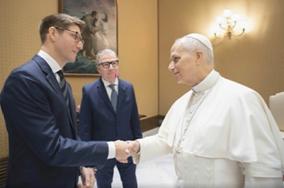
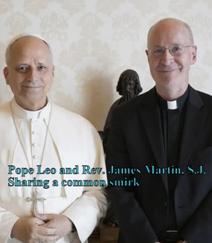
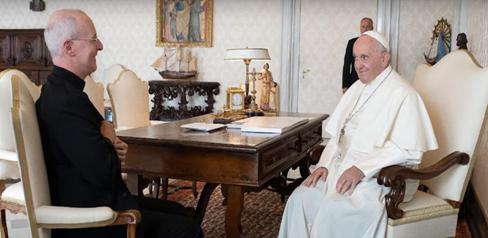
Preaching
to the DEAF!
 You gather here today, present-day
apostles, as the Church and, therefore, the world stand perched on the edge of
a cliff. And yet you who are entrusted with the keeping of souls choose to
speak not a word of the spiritual danger which abounds. Today we stand on the cusp of all
that has been prophesied about the Church and the abominations which would come
forth in these times, a time when all of hell attacks the Church of Jesus
Christ, and a time when the fallen angels of hell no longer seek entry into her
sacred halls but instead stand inside, peeking out of her windows and unlocking
doors to welcome in more diabolical destruction.
You gather here today, present-day
apostles, as the Church and, therefore, the world stand perched on the edge of
a cliff. And yet you who are entrusted with the keeping of souls choose to
speak not a word of the spiritual danger which abounds. Today we stand on the cusp of all
that has been prophesied about the Church and the abominations which would come
forth in these times, a time when all of hell attacks the Church of Jesus
Christ, and a time when the fallen angels of hell no longer seek entry into her
sacred halls but instead stand inside, peeking out of her windows and unlocking
doors to welcome in more diabolical destruction.
Do you not know that Our Lord will send forth His
avenging angels to heap coals of fire upon the heads of those who were called
to be His apostles and who have not guarded what He has given unto them?
And yet almost all of you, my brothers, stood by
silently watching as the Synod on Synodality took place, an
abomination constructed not to guard the Deposit of Faith, but to dismantle it,
and yet few were the cries heard from you – men who should be willing to die
for Christ and His Church.
The Synod’s final document has been released,
yet with the sleight of hand which is so characteristic of the
Francis-controlled Vatican. By drawing attention to the issues which
worried many, they have slipped in what was always their real goal without
anyone even noticing. What they were after in the first place was the
dismantling of Christ’s Church by replacing the structure of the Church as
Our Lord instituted it with a diabolically-inspired new structure of
“synodality” which in actuality is a new church that is in no way Catholic.
Bishop
Joseph Strickland, former bishop of Tyler, TX who was removed from his office
by Pope Francis the Diabolical for preaching Catholic truth, addressing the
U.S. bishops gathered at their annual meeting
Latae sententiae crimes in the external forum require a determination of guilt!
“A
sentence declaratory of the offence is always necessary in the forum externum,
since in this tribunal no one is presumed to be excommunicated unless convicted
of a crime that entail such a penalty.”
Pope
Benedict XIV, De syndod, X, I, 5
COMMENT: Recently a group of young men and women
missionaries for the Church of Jesus Christ of Latter-day Saints (Mormons) were
doing their required missionary work in central city York. A friendly
theological discussion took place on the steps of our Mission chapel. The
friendly exchanged ended and the climate cooled when the question about the
exact number of Joseph Smith's and Brigham Young's wives was brought up.
Mormons believe that Jesus Christ founded one Church. They believe that that
Church became corrupted and God abandoned it. God then, centuries later,
reconstituted His Church when the angel Moroni lead the illiterate Joseph Smith
to a hidden book and provided him with mystical spectacles permitting him to
read it. When you ask a Mormon how is it that Jesus Christ promised to be with
His Church until the end of time and taught that marriage is between one man
and one woman until death, why is it that they believe Joseph Smith or Brigham
Young and not believe Jesus Christ? They answer by walking away. Jesus Christ
uses the metaphor of marriage to describe His relationship with His Church and
with each of the faithful individually. Every man-made heretical and schismatic
sect eventually repudiates marriage because they cannot abide the metaphor.
Luther permitted bigamy. The Orthodox permit divorce and remarriage three
times. Joseph Smith had "up to forty wives" and Brigham Young had
"fifty-six wives, twenty-one had never been married before;
seventeen were widows; six were divorced; six had living husbands; and the
marital status of six others is unknown. Nine of his wives had previously been
plural wives of Joseph Smith, and Young was sealed to them as a proxy for
Smith" (WIKI). The first clue to the Mormons that they were being lead into a spiritual desert was
polygamy but some like the desert. Mormons claim that Brigham Young saw the
light and abandoned the practice for the Latter Day Saints but this occurred
only after the U.S. government told they to give it up or get out. Although
Mormons are no longer polygamists, they permit divorce and "temple"
remarriage which is just serial polygamy. These "missionaries" now
know that Jesus Christ did not abandon His Church and will not do so no matter
how corrupt churchmen become. The Catholic Church alone offers the possibility
of salvation.
It’s Official: Mormon Founder Had Up to 40 Wives...
 Mormon leaders have acknowledged for the first time that the church’s
founder and prophet, Joseph Smith, portrayed in church materials as a loyal
partner to his loving spouse Emma, took as many as 40 wives, some already
married and one only 14 years old.... The biggest bombshell for some in the essays is that Smith married women
who were already married, some to men who were Smith’s friends and followers.
Mormon leaders have acknowledged for the first time that the church’s
founder and prophet, Joseph Smith, portrayed in church materials as a loyal
partner to his loving spouse Emma, took as many as 40 wives, some already
married and one only 14 years old.... The biggest bombshell for some in the essays is that Smith married women
who were already married, some to men who were Smith’s friends and followers.
Religious
Liberty from Vatican II has its root in the Americanist Heresy
On every side the dread phantom of war holds sway:
there is scarce room for another thought in the minds of men. The combatants
are the greatest and wealthiest nations of the earth; what wonder, then, if,
well provided with the most awful weapons modern military science has devised,
they strive to destroy one another with refinements of horror. There is no
limit to the measure of ruin and of slaughter; day by day the earth is drenched
with newly-shed blood, and is covered with the bodies of the wounded and of the
slain. Who would imagine as we see them thus filled with hatred of one another,
that they are all of one common stock, all of the same nature, all members of
the same human society? ....We implore those in whose hands are placed the
fortunes of nations to hearken to Our voice. Surely there are other ways and
means whereby violated rights can be rectified. Let them be tried honestly and
with good will, and let arms meanwhile be laid aside.
Benedict XV, Ad beatissimi apostolorum, November 1, 1914
“We consider the establishment of our country’s
independence, the shaping of its liberties and laws, as a work of special
Providence, its framers ‘building better than they knew,’ the Almighty’s hand
guiding them. We believe that our country’s heroes were the instruments of the
God of nations in establishing this home of freedom; to both the Almighty and
to His instruments in the work we look with grateful reverence. And to maintain
the inheritance of freedom which they have left us, should it ever–which God
forbid—be imperiled, our Catholic citizens will be found to stand forward as
one man, ready to pledge anew ‘their lives, their fortunes, and their sacred
honor.’”
Archbishop (soon to be Cardinal) James
Gibbons, addressing the American bishops at the Third Plenary Council of
Baltimore, 1884 attended by 14 archbishops and 61 bishops.
Moved to the very depths of our hearts by the
stirring appeal of the President of the United States, and by the action of our
national Congress, we accept whole-heartedly and unreservedly the decree of
that legislative authority proclaiming this country to be in a state of war.
Inspired neither by hate nor fear, but by the holy sentiments of truest
patriotic fervor and zeal, we stand ready, we and all the flock committed to
our keeping, to cooperate in every way possible with our President and our
national government, to the end that the great and holy cause of liberty may
triumph and that our beloved country may emerge from this hour of test stronger
and nobler than ever. Our people, as ever, will rise as one man to serve the
nation.
Pledge of U.S. Catholic Archbishops, April
18, 1917; sent to President Woodrow Wilson by Cardinal James Gibbons,
Archbishop of Baltimore, the leading Catholic prelate in the United States.
“The primary duty of a citizen is loyalty to
country. It is exhibited by an absolute and unreserved obedience to his
country’s call.”
Cardinal James Gibbons, Archbishop of
Baltimore (1877-1921), April 1917 in support of the U.S. declaration of war
against Germany and Austria-Hungary. The Balfour Declaration agreement
committed the British to deliver Palestine into Jewish hands in return for the
Jews bringing the United States into WWI in support of the British. Cardinal
James Gibbons was the chief propagator of the heresy of Americanism which
became settled Novus Ordo doctrine after Vatican II (religious liberty)
primarily by the work of Fr. John Courtney Murray who greatly admired Cardinal
Gibbons. Gibbons did his best to align American Catholics with Jewish interests
to bring the United States into the Great War. In doing so Gibbons worked
directly to undermine the peace plans of Pope Benedict XV. Pope Benedict
devised a generous peace plan and contacted Cardinal Gibbons to do what he
could to influence the United States government to back his offer of a
negotiated peace. Gibbons did nothing of the sort. While giving lip service to
the Pope's peace plan six months too late, he in fact never contacted President
Wilson or any official of the government to even mention Pope Benedict's peace
plan. Gibbons was too busy building the National Catholic War Council (NCWC)
and supporting the call of universal military service. The purpose of the NCWC
as Gibbons said in a letter to all American bishops was to form “the mental and
moral preparation of our people for the war.”
To
Congar's credit, he at least told the truth about what he helped destroy!
“It cannot be denied that the
Declaration on Religious Liberty does say materially something else than the
Syllabus of 1864; it even says just about the opposite of Propositions 15 and 77 to 79 of this
document..... I collaborated on the final paragraphs which left me less
satisfied. It involved demonstrating
that the theme of religious liberty was already contained in Scripture. Now, it
isn't there.”
Cardinal Yves Marie Joseph Congar, O.P., forbidden to teach by
the Church and whose books were suppressed in the early 1950s, made a peritus
at Vatican II by Novus Ordo St. John XXIII, and is considered by many to have
been the most influential of all the periti. He was raised to the cardinalate
by Novus Ordo St. John Paul II. He rejected the dogmatic teaching of Trent
which his teacher and mentor, Fr. Marie-Dominique Chenu, O.P., derisively called “Baroque
theology”.
Excerpts
from the Diary of Msgr. Joseph Fenton:
·
“He
[Cardinal Ottaviani] remarked that we were on the eve of the Council, and that
no one knew who the Council’s theologians were to be.” (Sept. 28, 1962)
·
“It is a
crime that we did not take the Anti-Modernist Oath. Poor O[ttaviani] must have
failed to have our own profession passed by the central commission. It
contained his condemnation of [Fr. John Courtney] Murray [the Americanist
heretic who structured the Council teaching on Religious Liberty].” (Oct. 9,
1962)
·
“I had
always thought that this council was dangerous. It was started for no
sufficient reason. There was too much talk about what it was supposed to
accomplish. Now I am afraid that real trouble is on the way.” (Oct. 13,
1962)
·
“I
started to read the material on the Liturgy, and I was shocked at the bad
theology. They actually have been stupid enough [to say] that the Church
is ‘simul humanam et divininam, visibilem et invisibilem’ [at the same
time human and divine, visible and invisible]. And they speak of the Church
working ‘quousque unum ovile fiat et unus pastor’ [until there be one fold
and one shepherd], as if that condition were not already achieved.” (Oct. 19,
1962)
·
“I do not
think that any little work on our part is going to bring good to the Church. We
should, I believe, face the facts. Since the death of [Pope] St. Pius X the
Church has been directed by weak and liberal popes, who have flooded the
hierarchy with unworthy and stupid men. This present conciliar set-up makes
this all the more apparent. [Fr.] Ed Hanahoe, the only intelligent and
faithful member of [Cardinal] Bea’s secretariat has been left off the list of
the periti. Such idiots as [Mgr. John
S.] Quinn and the sneak [Fr. Frederick] McManus have been put on. [Fr. George]
Tavard is there as an American, God help us. From surface appearance it
would seem that the Lord Christ is abandoning His Church. The thoughts of many
are being revealed. As one priest used to say, to excuse his own
liberalism, which, in the bottom of his heart he knew was wrong, ‘for the
last few decades the tendency in Rome has been to favor the
liberals.’ That is the policy now. We can only do what we can to
overt an ever more complete disloyalty to Christ.” (Oct. 19, 1962)
·
“[Fr.] Ed
Hanahoe gave me two books on Modernism. In one of them I found evidence that
the teaching in the first chapter of the new schema on the Church [that became
the Vatican II dogmatic constitution Lumen
Gentium] and the language are those of [the excommunicated Modernist Fr.
George Tyrrell [who died outside the Catholic Church and was denied
ecclesiastical burial]. May God preserve His Church from that chapter. If it
passes, it will be a great evil. I must pray and act.” (Sept. 24, 1963)
Paul
VI declared Novus Ordo Saint. So just what is a “Novus Ordo Saint”?
A Novus Ordo Saint is a man-made saint. Contrasted with Catholic saints
who are God-made saints. In virtue of their union with God they are sanctified,
and therefore, Catholic Saints exhibit heroic virtue in their lives. God
confirms their sanctity by working miracles through their intercession and
thus, a cult of veneration (dulia) develops and spreads throughout the Church.
The Church recognizes God's evidence that they are saints and declares this
fact to the universal Church. Contrary to this, Novus Ordo Saints are man-made saints
and their elevation to the title of sainthood is for the purpose of promoting
the human ideology exemplified in their lives. There is no real cult of
veneration (dulia) among the faithful to Novus Ordo Saints. Since God does not
work true miracles through the intercession of man-made saints, only man-made
miracles are required for the beatification of man-made Novus Ordo Saints.
Finally, the Novus Ordo beatification process does have a promotor
fidei, the so-called “devil’s advocate,” although his role has been
change as the promotor ideologiae. The greatest difference
between Catholic Saints and Novus Ordo Saints is that the former are in heaven
and the latter, very well may not be.
COMMENT
ON THE MODERN MIND DEVOID OF GOD’S GRACE
“But
instead of a mind, universal literacy has given [the common man] a rubber
stamp, a rubber stamp inked with advertising slogans, with editorials, with
published scientific data, with the trivialities of tabloids and the
profundities of history, but quite innocent of original thought. Each man's
rubber stamp is the twin of millions of others, so that when these millions are
exposed to the same stimuli, all receive identical imprints. [...] The amazing
readiness with which large masses accept this process is probably accounted for
by the fact that no attempt is made to convince them that black is white.
Instead, their preconceived hazy ideas that a certain gray is almost black or
almost white are brought into sharper focus. Their prejudices, notions, and
convictions are used as a starting point, with the result that they are drawn
by a thread into passionate adherence to a given mental picture.”
Edward
Bernays, from his book, The Minority
Rules, 1927. Bernays was a Jewish double nephew of Sigmund Freud and a pioneer
in public relations and propaganda. He was called "the father of public
relations" in his obituary. Bernays was named one of the 100 most
influential Americans of the 20th century by Life Magazine. He was the subject
of a full-length biography called The Father of Spin (1999) and later an
award-winning 2002 documentary for the BBC called The Century of the Self. (Wiki)
"Pray for
the conversion of Russia." Blessed Virgin Mary at Fatima
Your must understand. The leading Bolsheviks who took over Russia were
not Russians. They hated Russians. They hated Christians. Driven by ethnic
hatred they tortured and slaughtered millions of Russians without a shred of
human remorse. The October Revolution was not what you call in America the
"Russian Revolution." It was an invasion and conquest over the
Russian people. More of my countrymen suffered horrific crimes at their
bloodstained hands than any people or nation ever suffered in the entirety of
human history. It cannot be understated. Bolshevism was the greatest human
slaughter of all time. The fact that most of the world is ignorant of this
reality is proof that the global media itself is in the hands of the
perpetrators. We cannot state that all Jews are Bolsheviks. But: without Jews
there would have been no Bolshevism. For a Jew nothing is more insulting than
the truth. The blood maddened Jewish terrorists murdered sixty-six million in
Russia from 1918 to 1957.
Aleksandr Solzhenitsyn (1918-2008), Noble Prize winning novelist,
historian and victim of Jewish Bolshevism
American
Catholic Apostasy: PEW POLE 2025
29% of U.S. Catholics say they attend Mass weekly.
59% of Catholics say abortion should be legal.
76% U.S. Catholics say society should be accepting of
homosexuality.
61% U.S. Catholics support legal homosexual
"marriage."
80% of Catholics view Pope Francis favorably.
84% of U.S. Catholics say they have a favorable view of Leo although 67% say they know little about Leo, and 25% know nothing at all.
Pope Leo XIV commemorates
Nostra Aetate anniversary with interfaith celebrations
Catholic
NewsAgency | Vatican City |Kridina Millare
| Oct 29, 2025
Pope
Leo XIV joined faith leaders on Tuesday to commemorate the 60th anniversary of
Nostra Aetate, the Church’s declaration on building relationships with
non-Christian religions.
Approximately
300 representatives of world religions and cultures joined the Holy Father for
an evening ecumenical prayer service for peace organized by the Community of
Sant’Egidio and held at the Colosseum in Rome.
“Peace
is a constant journey of reconciliation,” the Holy Father said at the Oct. 28
event.
Thanking
religious leaders for coming together in Rome, he said their interfaith meeting
expressed their shared “conviction that prayer is a powerful force for
reconciliation.”
“This is our witness: offering
the immense treasures of ancient spiritualities to contemporary humanity,” he
said.
“We
need a true and sound era of reconciliation that puts an end to the abuse of power,
displays of force, and indifference to the rule of law,” he added. “Enough of
war, with all the pain it causes through death, destruction, and
exile!”
In his remarks, the pope urged
people not to be indifferent to the “cry of the poor and the cry of the earth”
in their pursuits for peace in countries scarred by ongoing conflict and
injustice.
“In
the power of prayer, with hands raised to heaven and open to others, we must
ensure that this period of history, marked by war and the arrogance of power,
soon comes to an end, giving rise to a new era,” he said.
“We cannot allow this period to continue. It
shapes the minds of people who grow accustomed to war as a normal part of human
history,” he continued.
Pope
Leo and other religious leaders lit candles to symbolize their shared prayer
and renewed commitment to engage in interfaith dialogue.
Several
people waved small blue banners with the word “peace” in different languages
while Pope Leo and the other religious leaders lit candles to symbolize their shared
prayer and renewed commitment to engage in interfaith dialogue.
 After the prayer gathering at Rome’s iconic landmark, the Holy Father
returned to the Vatican to join colorful celebrations jointly organized by the
Dicastery for Interreligious Dialogue and the Dicastery for Promoting Christian
Unity.
After the prayer gathering at Rome’s iconic landmark, the Holy Father
returned to the Vatican to join colorful celebrations jointly organized by the
Dicastery for Interreligious Dialogue and the Dicastery for Promoting Christian
Unity.
To mark the 60th anniversary of Nostra
Aetate, several
multicultural music and dance performances were held inside the Vatican’s Paul
VI Audience Hall as well as a presentation highlighting papal initiatives to
promote the Church’s dialogue with other religions since the pontificate of
Pope Paul VI.
Pope
Leo’s appearance and special address toward the end of the two-hour gathering
highlighted the Church’s reverence for all people and its desire to collaborate
with others for the common good.
“We belong to one human family,
one in origin, and one also in our final goal,” he said. “Religions everywhere
try to respond to the restlessness of the human heart.”
“Each in its own way offers
teachings, ways of life, and sacred rites that help guide their followers to
peace and meaning,” he said.
Emphasizing the common mission
shared among people of different religions to “reawaken” the sense of the
sacred in the world today, the Holy Father encouraged people to “keep love
alive.”
“We
have come together in this place bearing the great responsibility as religious
leaders to bring hope to a humanity that is often tempted by despair,” Leo
said.
“Let
us remember that prayer has the power to transform our hearts, our words, our
actions, and our world,” he said.
COMMENT: Now for the third time in his short pontificate Leo/Provost
quotes Leonard Boff's Cry of the Earth,
Cry of the Poor. Boff is a former Franciscan priest who was censored by the
liberal Cardinal Ratzinger when he headed the Congregation for the Doctrine of
the Faith under the liberal JPII for his extreme Marxist liberation theology.
Boff is famous for his development of an integrated theology of Marxism, Gaia
cult earth worship and "social justice." He was admired by
Francis/Bergoglio and he is admired thrice as much by Leo/Provost. The picture
with its Satanic imagery was reportedly published by the Vatican. Leo/Provost,
like Francis/Bergoglio, wants to restore native American culture and religious
traditions. It should be remembered that Christopher Columbus encountered
cannibalism on his second voyage of exploration and ritual murder was
widespread not only among the Aztecs and Incas but in smaller tribes across
both North and South America as reported by Jesuit missionaries. In the
interfaith celebrations at the Vatican a young native American boy half dressed
paraded an image of a snake into the assembly before Leo/Provost. Is this the
native American tradition that the Vatican wants to recover?
Doctrinal Note on Marian
titles: Mother of the faithful, not Co-redemptrix
The document of the
Dicastery for the Doctrine of the Faith, approved by Pope Leo XIV, offers
clarifications on titles applied to the Blessed Virgin Mary, and calls for
special attention to the use of the expression, “Mediatrix of all graces.”
Vatican News
The Dicastery for the Doctrine of the Faith
on Tuesday, 4 November 2025, published Mater populi fidelis (“The Mother of the
Faithful People”), a Doctrinal Note “On Some Marian Titles Regarding Mary’s
Cooperation in the Work of Salvation.” Signed by the Prefect, Cardinal Víctor
Manuel Fernández, and the Secretary for the Dicastery’s Doctrinal Section,
Monsignor Armando Matteo, the Note was approved by the Pope on 7 October.
Mater
populi fidelis (MPF) is the fruit of a long and complex collegial effort. It is
a doctrinal document on Marian devotion, centred on the figure of Mary, who is
associated with the work of Christ as Mother of believers. The Note provides a
significant biblical foundation for devotion to Mary, as well as marshalling
various contributions from the Fathers, the Doctors of the Church, elements of
Eastern tradition, and the thought of recent Popes.
In
this positive framework, the doctrinal text analyses a number of Marian titles,
encouraging the adoption of some of those appellations and warning against the
use of others. Titles such as “Mother of Believers,” “Spiritual Mother,”
“Mother of the Faithful” are noticed with approval in the Note. Conversely, the title of
“Co-redemptrix” is deemed inappropriate and problematic. The title of
“Mediatrix” is considered unacceptable when it takes on a meaning that excludes
Jesus Christ; however, it can used appropriately so long as it expresses an
inclusive and participatory mediation that glorifies the power of Christ. The
titles “Mother of Grace” and “Mediatrix of All Graces” are considered
acceptable when used in a very precise sense, but the document also warns of
particularly broad explanations of the meaning of the terms.
Essentially,
the Note reaffirms Catholic doctrine, which has always emphasised that
everything in Mary is directed towards the centrality of Christ and His
salvific work. For this reason, even if some Marian titles admit of an orthodox
interpretation through correct exegesis, Mater populi fidelis says it is
preferable to avoid them.
In
his presentation of the Doctrinal Note, Cardinal Fernández expresses
appreciation for popular devotion but warns against groups and publications
that propose a certain dogmatic development and raise doubts among the
faithful, including through social media. The main problem in interpreting
these titles applied to Our Lady, he says concerns the way of understanding
Mary's association with Christ's work of redemption (paragraph 3).
Co-redemptrix
Regarding
the title “Co-redemptrix,” the Note recalls that “some Popes have used the title
“without elaborating much on its meaning.” Generally, it continues, “they have
presented the title in two specific ways: in reference to Mary’s divine
motherhood (insofar as she, as Mother, made possible the Redemption that Christ
accomplished) or in reference to her union with Christ at the redemptive Cross.
The Second Vatican Council refrained from using the title for dogmatic,
pastoral, and ecumenical reasons. Saint John Paul II referred to Mary as
‘Co-redemptrix’ on at least seven occasions, particularly relating this title
to the salvific value of our sufferings when they are offered together with the
sufferings of Christ, to whom Mary is united especially at the Cross” (18).
The
document cites an internal discussion within the then-Congregation for the
Doctrine of the Faith, which in February 1996 had discussed the request to
proclaim a new dogma on Mary as “Co-redemptrix or Mediatrix of all graces.”
Then-Cardinal Joseph Ratzinger was opposed to such a definition, arguing, “the
precise meaning of these titles is not clear, and the doctrine contained in
them is not mature. […] It is not clear how the doctrine expressed in these
titles is present in Scripture and the apostolic tradition.”
Later,
in 2002, the future Benedict XVI expressed himself publicly in the same way:
“The formula ‘Co-redemptrix’ departs to too great an extent from the language
of Scripture and of the Fathers and therefore gives rise to misunderstandings…
Everything comes from Him [Christ], as the Letter to the Ephesians and the Letter
to the Colossians, in particular, tell us; Mary, too, is everything that she is
through Him. The word ‘Co-redemptrix’ would obscure this origin.”
The
note clarifies that Cardinal Ratzinger did not deny the good intentions behind
the proposal, nor the valuable aspects reflected in it, but nonetheless
maintained that they were “being expressed in the wrong way” (19).
Pope
Francis also expressed his clear opposition to the use of the title
Co-Redemptrix on at least three occasions.
Tuesday’s
Doctrinal Note concludes: “It is always inappropriate to use the title
‘Co-redemptrix’ to define Mary’s cooperation. This title risks obscuring
Christ’s unique salvific mediation and can therefore create confusion and an
imbalance in the harmony of the truths of the Christian faith. […] When an
expression requires many, repeated explanations to prevent it from straying
from a correct meaning, it does not serve the faith of the People of God and
becomes unhelpful” (22).
Mediatrix
The
Note emphasises that “the biblical statement about Christ’s exclusive mediation
is conclusive. Christ is the only Mediator” (24).
At
the same time, MPF recognises “the fact that the word ‘mediation’ is commonly
used in many areas of everyday life, where it is understood simply as
cooperation, assistance, or intercession. As a result, it is inevitable that
the term would be applied to Mary in a subordinate sense. Used in this way, it
does not intend to add any efficacy or power to the unique mediation of Jesus
Christ, true God and true man” (25).
Further,
“it is clear that Mary has a real mediatory role in enabling the Incarnation of
the Son of God in our humanity” (26).
Mother of believers and
Mediatrix of all graces
Mary’s
maternal role “in no way obscures or diminishes” the unique mediation of
Christ, “but rather shows its power […] Understood in this way, Mary’s
motherhood does not seek to weaken the unique adoration due to Christ alone
but, rather, seeks to enkindle it.”
Therefore, the Note states, “one
must avoid titles and expressions that present Mary as a kind of ‘lightning
rod’ before the Lord’s justice, as if she were a necessary alternative before
the insufficiency of God’s mercy” (37b).
Thus,
the title “Mother of Believers” “enables us to speak of Mary’s role in our
relation to our life of grace”. However, MPF goes on to urge caution concerning
the use of expressions that may convey “less acceptable notions” (45).
“Cardinal Ratzinger already
affirmed” for example, “that the title ‘Mary, Mediatrix of All Graces’ was not
clearly grounded in Revelation.” So, the Note continues, “in line with this
conviction, we can recognize the difficulties this title poses, both in terms
of theological reflection and spirituality” (45). In fact, “no human person —
not even the Apostles or the Blessed Virgin — can act as a universal dispenser
of grace. Only God can bestow grace, and he does so through the humanity of
Christ” (53).
“Some titles, such as ‘Mediatrix
of All Graces,’ have limits that do not favour a correct understanding of
Mary’s unique place,” MPF explains, adding, “In fact, she, the first redeemed,
could not have been the mediatrix of the grace that she herself received”
(67).
Nonetheless,
the Doctrinal Note acknowledges that “the term ‘graces,’ when seen in reference
to Mary’s maternal help at various moments in our lives, can have an acceptable
meaning. The plural form expresses all the aids — even material — that the Lord
may grant us when He heeds His Mother’s intercession” (68).
COMMENT: Amazing
to hear these apostates chirping about the lack of "precise meaning"
of theological terms while obscurity in definition is, and has been since
Vatican II, the calling card of the Novus Ordo theologian and prelates. They
like to muddle what is clear. Let's start with the title, "Mother of
Believers" and "Mother of the Faithful." These are, in fact,
worthy titles of the Mother of God and frequently occur in St. Mary of Agreda's
City of God, yet the Novus Ordo clerics would never be found offering a precise
definition and meaning for the term "faithful" and then identify
exactly who the "faithful" are.
The
term "faithful" has a precise Catholic definition. It refers to those
who have been baptized into the Catholic Church and profess the one, holy,
catholic and apostolic faith. By virtue of this incorporation by baptism they
have become "children of God." They faithfully believe all the truths
that God has revealed on the authority of God the Revealer. Only those who have
become thus members of the Mystical Body of Christ share by participation in
His divine nature and become brothers and sister of Jesus Christ and therefore,
sons of His Mother. This definition excludes all heretics, schismatics, Jews,
pagans, and any other form of idolaters. Novus Ordo clerics heretically teach
that everyone is a child of God by virtue of the Incarnation. Everyone by
nature is a creature of God created in His image and likeness with the
spiritual soul with the powers of reason and free will, but every creature is
born in original sin and cut off from the friendship of God. He is only a
"child of God" in potentia.
Without the sacrament of Baptism and the Catholic faith they can never become
"children of God." This obscurity of definition as to who is a child
of God and thus a child of the Blessed Virgin Mary ultimately obscures what is
necessary as a necessity of means to obtain salvation.
The
title Mediatrix of all grace is long established and of sound and precise
theological understanding. Those that pretend otherwise are ignorant, proud,
and deceitful. They have no excuse. 'The law of prayer determines the law of
belief' is, as affirmed by St. Pius X in Pascendi,
a canon of faith from the time of Celestine I, that is, a dogma of the Catholic
Church. The immemorial Roman rite has a Mass in honor of the Blessed Virgin Mary,
Mediatrix of all grace celebrated on May 31 established by Pope Benedict XV.
Regarding this feast, Dom Gaspar Lefebvre, O.S.B. of the Abby of St. Andrew
teaches:
"The
will of God is that we should have everything through Mary," says St.
Bernard. The Father has sent us His Son, but His will was to make His coming
depend upon the Fiat of the Virgin, which He commanded to the angel Gabriel to
solicit on the day of the Annunciation.
The
Father and the Son send us the Holy Ghost, but it is through Mary that He comes
down to men. On the day of Pentecost, according to an ancient Tradition, the
heavenly fire which descended on the Cenacle first rested on Mary, and then on
the apostles. This is a figure of what happens every day in the Church where
the Holy Ghost is sent invisibly into our souls. "All the gifts of the
Holy Ghost are distributed by Mary to those whom she chooses, whenever she
wishes and as much as she wishes," says St. Bernardine of Siena.
The
graces which the Holy Ghost pours down on us are due to the merits of Christ on
Calvary; but in order that God may bestow them on the world, it is necessary
that Mary should intervene. Having cooperated by her divine maternity and by
her sufferings at the foot of the Cross in the Incarnation and Redemption, she
has deserved to co-operate when they are continually applied to creatures by
the most High. "By the communion of sorrows and of will between Christ and
Mary," says St. Pius X, "she has deserved to become the dispenser of
all the blessings which Jesus acquired for us by His blood" (Encyclical
2-2-1904). Such is His will, but it is essential that she should constantly
intercede for each one of us. This she does, relying on the blood of Christ by
whom she was herself saved, and who alone saves us. This actual intervention of
Mary plays a preponderating part in the salvation of the world. It is important
that we should realize this, and it is the object of the feast of Mary
Mediatrix of all Graces. A clear idea of the fact may be obtained by simple
reading the texts of the Mass and Vespers.
"Through
the Virgin," says St. Bernardine of Siena, "life-giving graces flow
from Christ, who is the head, into His mystical body." "Through
her," adds St. Antoninus, "come from heaven all the graces granted to
the world." "What all the saints united to thee may obtain for us by
their intercession," writes St. Anselm, "thy pleading alone may
obtain without the help of their prayers." The maternal solicitude of Mary
for the whole human race is therefore continual, and it is because of this that
unceasingly, through the Mass, the sacraments, the hierarchy and other channels
of grace, the merits of Calvary are applied to our souls. "We may
affirm," declared Pope Leo XIII, "that by the will of God, nothing is
given to us without Mary's mediation, in such a way that just as no one can approach the almighty
Father but through His Son, so no one, so to speak, can approach Christ but
through His Mother" (Encyclical, 9-22-1891).
Let
us therefore not consider as of small importance the efforts made to establish
this point of doctrine of Mary's mediation, since this doctrine enables us to
understand the divine plan, and clearly manifests the mediation of the Son of
God of which it is a corollary.
St. Mary of Agreda at
the Coronation of the Blessed Virgin Mary, Queen of Heaven, writes that Jesus
Christ addressed the entire heavenly assembly of angels and saints saying:
"My Father and
eternal God, this is the Woman, that gave Me my human form in her virginal
womb, that nourished Me at her breast and sustained labors for Me, that shared
in my hardships and co-operated with Me in the works of Redemption. This is
She, who was always most faithful and fulfilled our will according to our
entire pleasure; She, pure and immaculate as my Mother, through her own works,
has reached the summit of sanctity according to the measure of the gifts We
have communicated to Her; and when She had merited her reward and could have
enjoyed it forever, She deprived Herself of it for Our glory and returned to
attend to the establishment, the government, and instruction of the Church
militant; and We, in order that She might live in it for the succor of the
faithful, deferred her eternal rest, which She has merited over and over again.
In the highest bounty and equity of our Providence it is just, that my Mother
should be remunerated for her works of love beyond all other creatures; and
toward Her the common law of the other mortals should not apply. If I have
merited for all infinite merits and boundless graces, it is proper that my
Mother should partake of them above all the others who are so inferior; for She in her conduct
corresponds to our liberality and puts no hindrance or obstacle to our infinite
power of communicating our treasures and participating them as the Queen and
Mistress of all that is created."
Sanctifying grace is
the created participation in the divine nature. The Blessed Virgin is the
"Queen and Mistress of all that is created." In this Mass the Church
prays:
" O Lord Jesus Christ,
our Mediator with the Father, who hast appointed the most blessed Virgin, Thy
mother, to be our mother also and our mediatrix before Thee: Grant that
whosoever draweth nigh to Thee to beseech any benefit, may receive all things
through her and rejoice.
Rev. Gregory
Alastruey's theological work titled, The
Blessed Virgin Mary, says that, "There are five principle titles and offices due Mary, the Mother
of God, by reason of her cooperation in redemption: Mediatrix, Co-redemptrix,
Mother of Christians, Patroness or Advocate, and Queen and Mistress of the
universe. I would recommend those who deny this proper honor to the
Mother of God obtain a copy of the book and have their stupidity erased. I do
not say, ignorance erased because willful ignorance is stupidity. Fr. Alastruey affirms that
"Mary is truly mediatrix of the human race and this doctrine pertains to
the deposit of faith." He then draws from Scripture, the Fathers,
and theologians in support of this truth. He proves from the Church Fathers
that the word "mediatrix" was explicitly used by St. Ephrem, St.
Epiphanius, St. John Chrysostom, St. Basil of Seleucia, St. Andrew of Crete, St
Germanus of Constantinople, St. John Damascene, St Theodore, St. Antoninus and
Denis the Carthusian. He draws richly from the divine liturgy from both Eastern
and Roman traditions. The errors of the Protestant heretics are addressed and
exposed which are curiously the same as expressed by the Novus Ordo popes.
Lastly, it is worth
asking Why do the Novus Ordo popes hate these proper titles of the Mother of
God? The answer is simple. The Blessed Virgin asked the three children at
Fatima on June 13, 1917, "Are
you willing to offer yourselves to God to bear all the sufferings He wills to
send you, as an act of reparation for the sins by which He is offended, and of
supplication for the conversion of sinners?" To which question all
answered, "Yes, we are willing." The Mother of God said on July 13
after the children had seen a vision of Hell, "Sacrifice yourselves for
sinners, and say many times, especially whenever you make some sacrifice: O
Jesus, it is for love of You, for the conversion of sinners, and in reparation
for the sins committed against the Immaculate Heart of Mary." On August 19
(the apparition did not occur on the August 13 because the children were in
prison) the Mother of God continued saying, "Pray, pray very much, and
make sacrifices for sinners; for many souls go to hell, because there are none
to sacrifice themselves and to pray for them." The Blessed Virgin is
asking the children to be co-redemptors and co-mediators of grace with her in
union with our Lord and Savior Jesus Christ for the conversion and salvation of
sinners. If the title of Co-Redemtrix and Mediatrix of all Grace can be taken
away from the Mother of God then no one is responsible to do penance for their
own sins or the sins of others. This falls back to the Protestant heresy on the
dogma of justification and the very nature of our incorporation into the divine
nature in the Mystical Body of Christ. Leo/Provost, like his predecessor
Francis/Bergoglio, believes that proselytism is "solemn nonsense."
They attack the titles to excuse their own faithless sloth. They are working to
obscure the very means of salvation. As Jesus Christ said: "But woe to you
scribes and Pharisees, hypocrites; because you shut the kingdom of heaven
against men, for you yourselves do not enter in; and those that are going in,
you suffer not to enter" (Matt 23:13).
Pope Leo is just
another heretic who denies the Blessed Virgin Mary her just titles of Mediatrix
of all Grace and Co-Redemtrix. Only a few days ago, he celebrated with
heretics, schismatics, Jews, Moslems, and a variety of idolaters a shared
communion praying to their common god a united petition for peace in the world.
He continues to ignore the peace plan offered by the Blessed Virgin Mary,
Mediatrix of all Grace, at Fatima. Pope Leo will soon learn that those who
insult the Mother have made an enemy of the Son.

 It was the opening of the three-day
“Raising Hope for Climate Justice” conference organised by the Laudato si’
Movement in collaboration with ecclesial and institutional partners.
It was the opening of the three-day
“Raising Hope for Climate Justice” conference organised by the Laudato si’
Movement in collaboration with ecclesial and institutional partners.  If
the ice block is 20,000 years old then the Genesis creation account and the
global flood of Noe is reduced to mythology and not divine revelation. The fact
is, ancient mythology ended with the Christian revelation of Jesus Christ but
the modern scientific world is doing its best to resurrect the cult of
mythology. The world likes to talk about the scientific fables of Big Bang,
primordial soups with lightening bubbling forth proteins that congeal into
cellular life with the teleological purpose of producing the DNA of Darwinian
man. These fables are believed and shamelessly pandered by our neo-modernists
popes. The absurdity is that the neo-modernists popes have embraced the myths
of scientology when science itself has discredited their claims. Scientists
have been predicting global flooding of coastal areas for the last fifty years
with no evidence of rising sea levels. Global warming is not science. It is
liberal ideology applied to climatology that always calls for a one-world
governance to enforce its dictatorial and anti-Catholic mandates. The alleged
global warming is always without exception a man made assault on Mother Earth
that requires the ritual murder of 6.5 billion people for a world
"sustainable" population of 500 million for expiation. Never is it
considered in their calculus that the
If
the ice block is 20,000 years old then the Genesis creation account and the
global flood of Noe is reduced to mythology and not divine revelation. The fact
is, ancient mythology ended with the Christian revelation of Jesus Christ but
the modern scientific world is doing its best to resurrect the cult of
mythology. The world likes to talk about the scientific fables of Big Bang,
primordial soups with lightening bubbling forth proteins that congeal into
cellular life with the teleological purpose of producing the DNA of Darwinian
man. These fables are believed and shamelessly pandered by our neo-modernists
popes. The absurdity is that the neo-modernists popes have embraced the myths
of scientology when science itself has discredited their claims. Scientists
have been predicting global flooding of coastal areas for the last fifty years
with no evidence of rising sea levels. Global warming is not science. It is
liberal ideology applied to climatology that always calls for a one-world
governance to enforce its dictatorial and anti-Catholic mandates. The alleged
global warming is always without exception a man made assault on Mother Earth
that requires the ritual murder of 6.5 billion people for a world
"sustainable" population of 500 million for expiation. Never is it
considered in their calculus that the
 Here's a particularly forlorn historical
date: More than 100 years ago, between the 19th and 20th of December 1917, in
the midst of the Bolshevik revolution and civil war, Lenin signed a decree
calling for the establishment of The All-Russian Extraordinary Commission for
Combating Counter-Revolution and Sabotage, also known as Cheka.
Here's a particularly forlorn historical
date: More than 100 years ago, between the 19th and 20th of December 1917, in
the midst of the Bolshevik revolution and civil war, Lenin signed a decree
calling for the establishment of The All-Russian Extraordinary Commission for
Combating Counter-Revolution and Sabotage, also known as Cheka. 
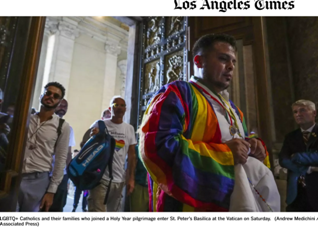 “My
reaction was a silent cry of horror, indignation, and sorrow,” the auxiliary of
Astana, Kazakhstan, said regarding the Vatican’s approval of an LGBT-themed
“pilgrimage” on its Jubilee website, in an interview with Diane Montagna, a
journalist in Rome.
“My
reaction was a silent cry of horror, indignation, and sorrow,” the auxiliary of
Astana, Kazakhstan, said regarding the Vatican’s approval of an LGBT-themed
“pilgrimage” on its Jubilee website, in an interview with Diane Montagna, a
journalist in Rome.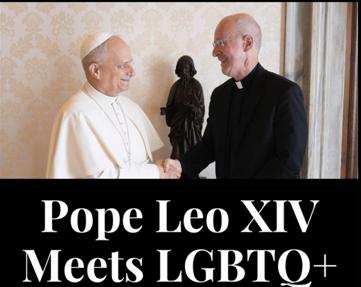 He pointed out that in doing so, Pope Leo
XIV broke with the precedent of all popes before Francis, who “neither received
officially nor posed for photographs with those who, by word or deed, openly
rejected the doctrinal and moral teaching of the Church.”
He pointed out that in doing so, Pope Leo
XIV broke with the precedent of all popes before Francis, who “neither received
officially nor posed for photographs with those who, by word or deed, openly
rejected the doctrinal and moral teaching of the Church.”
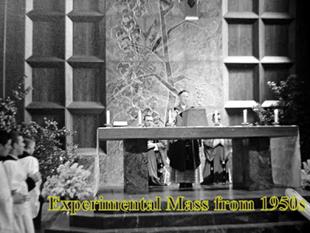
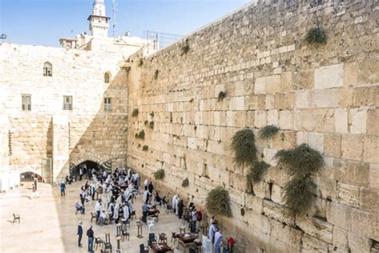 The 'Western Wall' (Wailing Wall) in
Jerusalem is held by Jews as a remnant of Herod's Temple destroyed by the
Romans in 72 A.D. Yet, Jesus prophesized not only that the Temple would be
destroyed but also that there would not remain a "stone upon a
stone." So how is it that there remains a large wall on the western side
at the south end of the 'Temple Mount'? Some Catholics claim the prophecy of
Jesus was referring only to the edifice itself and not the entire foundation
for the Temple. Jesus words must be taken in literally unless there it is
clearly manifest that the metaphorical sense is intended exclusively.
Therefore, the 'Wailing Wall' where the Jews worship is not a remnant of the
ancient Temple, and the 'Temple Mount', on which is currently situated the
Al-Aqsa mosque and the "Dome of the Rock", is not the location of the
Temple destroyed in 72 A.D. The 36 acre 'Temple Mount' is actually the location
of the Roman fortress Antonia built by Herod.
The 'Western Wall' (Wailing Wall) in
Jerusalem is held by Jews as a remnant of Herod's Temple destroyed by the
Romans in 72 A.D. Yet, Jesus prophesized not only that the Temple would be
destroyed but also that there would not remain a "stone upon a
stone." So how is it that there remains a large wall on the western side
at the south end of the 'Temple Mount'? Some Catholics claim the prophecy of
Jesus was referring only to the edifice itself and not the entire foundation
for the Temple. Jesus words must be taken in literally unless there it is
clearly manifest that the metaphorical sense is intended exclusively.
Therefore, the 'Wailing Wall' where the Jews worship is not a remnant of the
ancient Temple, and the 'Temple Mount', on which is currently situated the
Al-Aqsa mosque and the "Dome of the Rock", is not the location of the
Temple destroyed in 72 A.D. The 36 acre 'Temple Mount' is actually the location
of the Roman fortress Antonia built by Herod. Carlo Alberto Capella was
Vatican diplomat who was convicted by a Vatican tribunal of possessing and
sharing child pornography. Capella admitted guilt to the charges. He is the
only one who has served a prison sentence in the Vatican jail for this crime or
for any sexually related crime against minors.
Carlo Alberto Capella was
Vatican diplomat who was convicted by a Vatican tribunal of possessing and
sharing child pornography. Capella admitted guilt to the charges. He is the
only one who has served a prison sentence in the Vatican jail for this crime or
for any sexually related crime against minors.